Latin or English for Students with Dyslexia — What the Research Says
When students with dyslexia have to choose a second foreign language, parents often hear the same advice: “You’d better take English—Latin is too hard.” This advice sounds plausible. But in many cases, it’s wrong.
Katrin Sellin (BVL 2013) and Anne Friedrich (2017, Pegasus Online Journal) have specifically investigated which languages are better suited for students with dyslexia—and have come to a surprising conclusion. Background: The Lapicida Learning Methodology Overview summarizes all the scientific foundations.
Latin or English for students with dyslexia—which language is better suited?
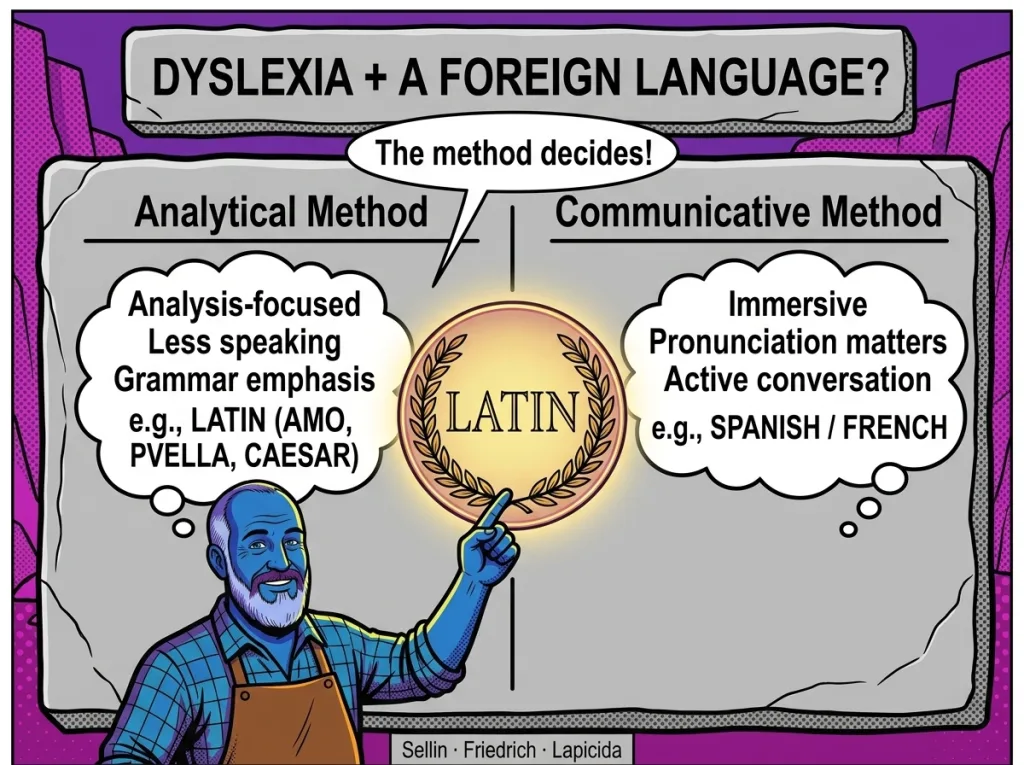
Latin or English for dyslexia: According to Sellin (BVL 2013), Latin is often the better choice for students with dyslexia who think analytically. The reasons: Latin is phonetic (no spelling traps like in English), there is no pressure to communicate orally, and the pace of instruction is slower. English is considered particularly difficult for students with dyslexia because of its extremely irregular spelling. However, the decision depends on the individual’s profile—not every case of dyslexia is the same.
Why English Is Especially Difficult for Students with Dyslexia
Among learning therapists, English is considered one of the most difficult languages for people with dyslexia—and that’s not because of the grammar, but because of the spelling. The Federal Association for Dyslexia and Dyscalculia (BVL) offers more background information on dyslexia in language instruction.
| Challenges in English | Why it affects students with dyslexia | In Latin |
|---|---|---|
| Irregular Spelling | English has almost no phonetic spelling: “knight,” “through,” “enough.” Every word is a special case. | Latin is phonetically accurate 1:1: every letter corresponds to a sound |
| High Pressure to Communicate | Approx. 80% of students with dyslexia have difficulty processing speech sounds. Spontaneous speech overwhelms them. | Latin does not require speech production—analysis instead of conversation |
| Faster pace of instruction | English classes with role-playing, listening comprehension, and speech production are more fast-paced. | Latin classes are slower and more analytical |
| Writing in a foreign language | Essays in English = spelling errors are directly graded. | Latin: Translation into German — no free-form writing in the foreign language |
Key point: English is not difficult for students with dyslexia because of the grammar—but because of the gap between pronunciation and spelling. This gap does not exist in Latin.
Why Latin Offers Advantages for Analytical Students with Dyslexia
Latin has specific characteristics that offer clear advantages for some students with dyslexia. Katrin Sellin (BVL 2013) describes this profile: analytically minded students who prefer thinking to speaking and who cope better with clear rules than with exceptions.
Phonetic spelling. “Luna” is spelled as it sounds. So is “amamus.” No English “knife” with a silent “k,” no “beautiful” with an unexpected vowel. For students with dyslexia, whose core difficulty lies in the letter-sound correspondence, Latin virtually eliminates this hurdle.
No writing assignments in the foreign language. In Latin class, students do not write essays in Latin. The main task is translation into German. Spelling errors in German are generally not penalized during translation (or only if they distort the meaning). This takes a tremendous amount of pressure off the students.
Structured, deductive teaching of rules. Latin presents the rule first, then the example. Modern English is often learned inductively from texts—students with dyslexia often cannot independently derive abstract rules from texts (Sellin 2013). The clear structure of Latin grammar provides them with the analytical foundation they need.
No pressure to communicate orally. Latin is not spoken. This removes the pressure of spontaneous speech production, which is particularly stressful for students with dyslexia who have processing difficulties. At the same time, the pace of the lesson remains more relaxed, allowing time for decoding.
Learn Latin now. Our learning app:

When Latin Might Be the Wrong Choice—and How to Decide
Latin isn’t the best choice for all students with dyslexia. The decision depends on the individual’s dyslexia profile:
| Profile | Recommendation | Reason |
|---|---|---|
| Analytical, loves structure, no need to speak aloud | Latin | Clear grammar rules, phonetic accuracy, no pressure to speak |
| Strong feel for language, enjoys communicating, little patience for rules | Spanish or French | More regular pronunciation than in English, which aids communication |
| Main problem: concentration and attention (ADHD comorbidity) | Discuss with a learning therapist | Weigh the advantage of Latin’s faster pace against its higher demands for abstract thinking |
| Already experiencing significant difficulties with English | Consider Latin as a second foreign language | English remains a required subject—adding Latin won’t hurt if the teaching method is right |
The decision should never be based solely on a “dyslexia” diagnosis. A learning therapist or school psychology service can assess the individual’s profile. Those who choose Latin can find all dyslexia-friendly learning methods at lapicida-latinus.de/de/latein-lernen/. The specific app recommendation: LRS Latin App — Color Coding & OpenDyslexic.
More blog posts on this topic:






Frequently Asked Questions: Latin or English for Those with Dyslexia
Is Latin really easier than English for people with dyslexia?
For students with dyslexia who think analytically, the answer is often yes—due to the phonetic spelling and the lack of pressure to communicate. This isn’t a universal rule: the individual dyslexia profile is the deciding factor. English has a particularly bad reputation among dyslexia experts, especially because of its irregular spelling.
Do I have to make my child choose between Latin and English?
In most German states, English is a required subject. The question is therefore often: Latin as a second foreign language in addition to English, or another language? Latin as a second foreign language does not harm students with dyslexia—provided the teaching method and accommodations are appropriate.
What does Katrin Sellin (BVL) specifically say about Latin for students with dyslexia?
In her BVL brochure (2013), Sellin recommends Latin for students with dyslexia who work analytically: phonetic accuracy, no pressure to speak, structured grammar, and a slower pace of instruction. At the same time, she warns: If the teaching approach is based on isolated tables and alphabetical lists, Latin won’t be helpful. The method is key.
Does an app help with learning Latin when you have dyslexia?
Yes, if it has features specifically designed for dyslexia. Lapicida Latinus was developed by someone with dyslexia for learning Latin: color coding, OpenDyslexic, a 5-card limit, and sentence-based practice. All features are available in the free version.
Are accommodations also provided for Latin tests?
Yes. Accommodations apply to all subjects, not just German or English. Typical accommodations in Latin class include: extra time (up to 50%), shorter translation passages, and alternative test formats. Regulations vary by state—information is available from the Federal Association for Dyslexia and Dyscalculia.
Decided on Latin? Get started with dyslexia support features.
Learn Latin now. Our learning app: