Learning Latin as a Beginner — How to Get Off to the Right Start
If you're a beginner who wants to learn Latin, you'll get three different answers: "Buy Wheelock," "Use Duolingo," "Read Lingua Latina." All three can work—but none of them tell you in what order you should do them. This article gives you a concrete plan.
- Which Resources Do Experienced Latin Learners Recommend? (An Honest Overview)
- The step-by-step learning path: from zero to your first reading
- How much time you’ll need each day
- The 4 most common beginner mistakes—and how to avoid them
How do I learn Latin as a beginner?
- A-declension (1st declension): Learn the endings of the most common nouns
- o-declension (2nd declension): masculine + neuter, gender distinctions
- Verbs in the present tense (1st conjugation: amare): Form all 6 forms
- Sentence Analysis: Subject, Predicate, Accusative Object — Read the Sentence in Its Entirety
- First Reading: Approach an authentic Latin text with vocabulary aids
This order is crucial. Latin is a case-based language—without declension endings, no sentence can be read. Those who start with texts or vocabulary learn only superficially and fail at the first unfamiliar sentence.
What resources do experienced Latin learners recommend?
In Latin learning communities (Reddit r/latin, language forums), the same resources are mentioned time and again. Here’s an honest overview:
| Resource | Type | For whom | Strengths / Weaknesses |
|---|---|---|---|
| Lingua Latina per se Illustrata (Ørberg) | Book (Reading Method) | Self-learners who enjoy reading | ✅ Immersive, no translation; ⚠️ Grammar is implicit, slow progression |
| Wheelock's Latin | Course (English) | Structured learners | ✅ systematic, comprehensive; ⚠️ in English, high density |
| Duolingo Latin | App (gamification) | Getting Started / Motivation | ✅ free, low barrier to entry; ⚠️ no structured grammar, breaks down at the sentence level |
| Perseus Digital Library | Text Archive (free) | Intermediate level and up | ✅ All original texts freely available; ⚠️ No learning path |
| Lapicida Latinus | App (sentence structure practice + sentence quizzes + reading) | High school, self-study, Latinum | ✅ Structured learning path, original texts, sentence components color-coded; ⚠️ No printed dictionary |
Recommendation for beginners: Lingua Latina or a structured course as a foundation—plus an app for daily verb conjugation practice. Duolingo can be used as a supplement for vocabulary, but it is not sufficient as the sole resource for Latin.
The Step-by-Step Learning Path for Latin Beginners
Latin has a strict internal logic—if you know the correct order, you’ll learn faster and without confusion.
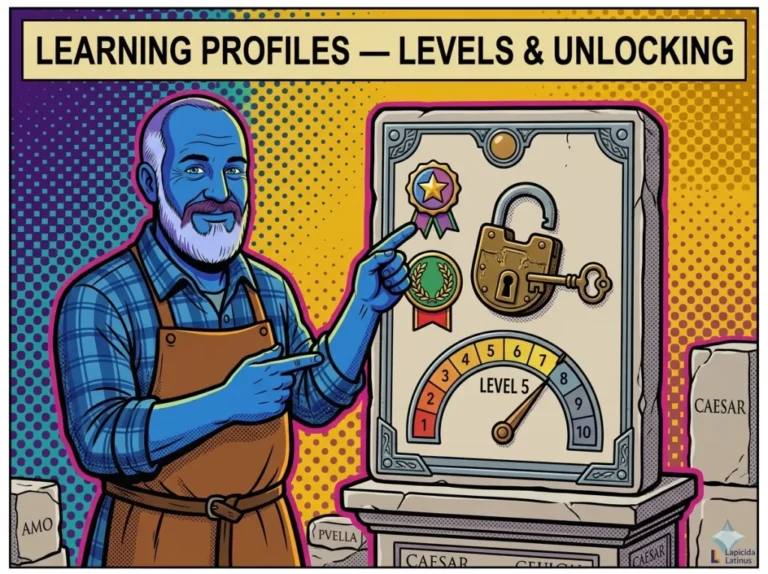
| Level | Content | Goal | Duration (approx.) |
|---|---|---|---|
| 1 | a-declension (1st declension, feminine): puella, -ae | Form all 6 cases correctly | Weeks 1–2 |
| 2 | o-declension (2nd declension, masc./neut.): dominus, -i | Mastering gender and endings | Weeks 2–3 |
| 3 | Adjectives in the a/o-declension: bonus, -a, -um | Adjective agrees with noun | Weeks 3–4 |
| 4 | Standard verbs in the present tense (1st conjugation: amare) | Produce 6 forms actively | Weeks 4–6 |
| 5 | Sentence Quiz: Subject + Predicate, Present Tense Only | Analyze your first simple sentence | Weeks 5–7 |
| 6 | Sentence Quiz: + Accusative Object | Read a complete main clause | Weeks 6–8 |
| 7 | First reading passage for the level, vocabulary for the reading passage | Understanding authentic Latin text | Months 2–3 |
In Lapicida, the grammar trainer follows this exact path: It begins with the a-declension (Freemium), and the sentence quiz starts with simple present tense sentences. Vocabulary is color-coded by sentence function (subject: purple, predicate: yellow, object: red)—this way, you learn vocabulary in a grammatical context, not in isolation.
Learn Latin now. Our learning app:

The 4 Most Common Beginner Mistakes When Learning Latin
- Starting with texts before mastering verb forms: the Duolingo approach. You memorize individual sentences but don’t understand why *puellam* is in the accusative. The first unfamiliar sentence causes everything to fall apart.
- Vocabulary only, no grammar: 500 vocabulary words are of little use if you can’t tell whether a noun is the subject or the object. Grammar forms and vocabulary must be learned in parallel.
- Too much at once: All 5 declensions in the first week. Result: nothing sticks. Better: master one declension completely before moving on to the next.
- No active production: Passive recognition isn’t learning. Actively form structures, actively analyze sentences. The sentence quiz forces you to do exactly that.
How much time per day?
Consistency beats intensity. 20 minutes a day for 6 months is better than 2 hours on the weekend. The spacing effect (Ebbinghaus 1885, Cepeda et al. 2006) proves it: spaced learning reinforces forms much more effectively than marathon sessions crammed into a single block.
All modules, methods, and grammar resources are organized and presented in an overview on the Latin Learning Portal.
An even more detailed starter plan with initial practice steps is available under “Getting Started with Latin.”
If you don’t want to spend any money, you’ll find realistic assessments of free options under “Learn Latin Online for Free.”
Adults starting from scratch should also read “Learning Latin as an Adult”—it covers common stumbling blocks and how to overcome them.
More blog posts on this topic:






Frequently Asked Questions — Learning Latin as a Beginner
Is Duolingo enough to learn Latin?
Duolingo can help you get started and build vocabulary—but it doesn’t provide a systematic approach to grammar. Latin sentences rely on case endings, not word order. If you learn only with Duolingo, you’ll recognize familiar sentences but won’t understand unfamiliar texts.
Is *Lingua Latina per se Illustrata* good for beginners?
Yes—for learners who want an immersive learning experience. The book builds grammar implicitly through increasingly complex texts. Weakness: Those who need explicit rules may find it harder to get started. Recommendation: Use LLPSI as a foundation for reading, alongside a verb form trainer for active memorization.
How long will it take before I can read a Latin text?
With 30 minutes a day and structured learning (conjugations first, then sentence analysis), you’ll be able to tackle your first simple texts after 3–4 months. Reading Caesar’s texts with a dictionary is realistic after 6–9 months.
Do I need a textbook, or is an app enough?
A good app is sufficient to get started, provided it systematically trains you in verb forms and sentence analysis. In addition, a concise grammar reference (e.g., Rubenbauer/Hofmann or Steele’s Latin) is recommended as a reference guide. Duolingo alone is not enough.
Is Latin really that hard?
Latin has a strict grammar with six cases and complex verb forms—which is more challenging than English or Spanish. But Latin has no pronunciation barrier and very regular grammar. Once you understand the logic, you’ll make rapid progress.
Where should I start—vocabulary or grammar?
Both at the same time, but grammar takes priority. Learn 10 vocabulary words a day while working through the a-declension. Vocabulary words without a grammatical context won’t stick—only when you can embed words into sentence structures does the knowledge really sink in.
Get started now—structured from Level 1
Learn Latin now. Our learning app: