Glory Be in Latin (Gloria Patri) — Text, Translation & Meaning

The Glory Be in Latin — the Gloria Patri — is the “lesser doxology,” the short hymn of praise to the Holy Trinity that concludes every psalm in the Liturgy of the Hours and each decade of the Rosary. It is one of the first Latin prayers most Catholics learn by heart.
On this page you will find the full Latin text, a line-by-line English translation, the meaning, the origin and a pronunciation note:
- the full Latin text of the Gloria Patri
- the English translation, line by line
- meaning, origin (Breviarium Romanum) and ecclesiastical pronunciation
If you want not only to pray the Gloria Patri but also to read and understand the Latin, you will find it as a reading in the Lapicida app — opened up word by word.
How does the Glory Be go in Latin?
The Glory Be in Latin is: “Gloria Patri, et Filio, et Spiritui Sancto. Sicut erat in principio, et nunc, et semper, et in saecula saeculorum. Amen.” — “Glory be to the Father, and to the Son, and to the Holy Spirit. As it was in the beginning, is now, and ever shall be, world without end. Amen.”
Gloria Patri — Latin text with a line-by-line translation
Here is the full Gloria Patri in its received liturgical form (Latin on the left, English on the right):
| Latin | English |
|---|---|
| Gloria Patri, et Filio, et Spiritui Sancto. | Glory be to the Father, and to the Son, and to the Holy Spirit. |
| Sicut erat in principio, et nunc, et semper, et in saecula saeculorum. Amen. | As it was in the beginning, is now, and ever shall be, world without end. Amen. |
Grammar note for learners: Patri, Filio and Spiritui Sancto are all in the dative (“to the Father, to the Son…”), governed by gloria [sit] — the verb “be” is understood. In saecula saeculorum (literally “unto the ages of ages”) is the Latin idiom for “for ever and ever.”
Meaning: praise to the Holy Trinity
The Gloria Patri is called the “lesser doxology” (a doxology is a short formula of praise), as distinct from the “greater doxology,” the Gloria in excelsis of the Mass. Its first half glorifies the three Persons of the Trinity equally; its second half affirms that this glory is eternal — “as it was in the beginning, is now, and ever shall be.” In the Liturgy of the Hours it is added to the end of nearly every psalm and canticle.
Learn Latin now. Our learning app:

How you read it in the app — word by word
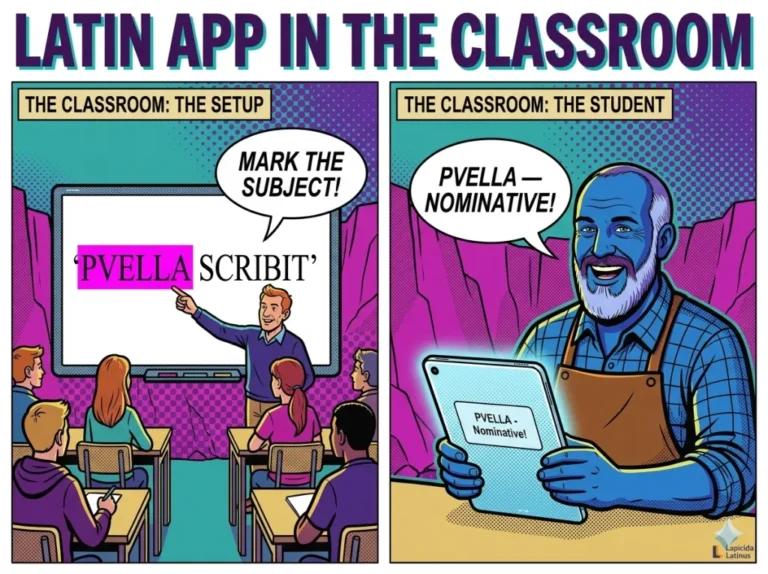
In the Lapicida app the Gloria Patri is set up as a reading: the full Latin text opened up word by word — with vocabulary help, form analysis and translation. A perfect first step into liturgical Latin. Open the reading in the app.
Origin and pronunciation
The first half of the Gloria Patri is ancient, echoing the baptismal formula of Matthew 28:19 (“in the name of the Father, and of the Son, and of the Holy Spirit”); the second half (Sicut erat in principio…) was added in the early Church to affirm the eternity of the Son against Arianism. It stands as a doxology in the Breviarium Romanum.
Pronunciation (Church Latin): c before e/i sounds like “ch” — saecula = “SÉ-choo-la”; Spiritui = “spee-REE-too-ee.” In Classical Latin c is always “k” and ae is “ai.”
The Gloria Patri follows each decade of the Rosary in Latin, after the Pater Noster and ten Ave Marias.
Frequently asked — the Glory Be in Latin
What is the Glory Be in Latin?
The Glory Be in Latin is the Gloria Patri: ‘Gloria Patri, et Filio, et Spiritui Sancto. Sicut erat in principio, et nunc, et semper, et in saecula saeculorum. Amen.’ It is a short hymn of praise to the Holy Trinity.
What does Gloria Patri mean?
Gloria Patri means ‘Glory be to the Father’. It is the opening of the lesser doxology, a short formula praising the Father, the Son and the Holy Spirit.
When is the Gloria Patri prayed?
It concludes almost every psalm and canticle in the Liturgy of the Hours, and it is said after each decade of the Rosary, following the Our Father and ten Hail Marys.
What does ‘in saecula saeculorum’ mean?
Literally ‘unto the ages of ages’, it is the Latin idiom for ‘for ever and ever’ (rendered in the traditional English as ‘world without end’).
Learn Latin now. Our learning app: