
How Lapicida Works — The Latin Learning Method
Lapicida is not a flashcard app or a gamification experiment. Lapicida is a learning system based on three proven learning methods—combined with authentic Latin material from classical times. Here, we explain why it works.

The Three Pillars of the Lapicida Latin Learning Method
1. Active Recall
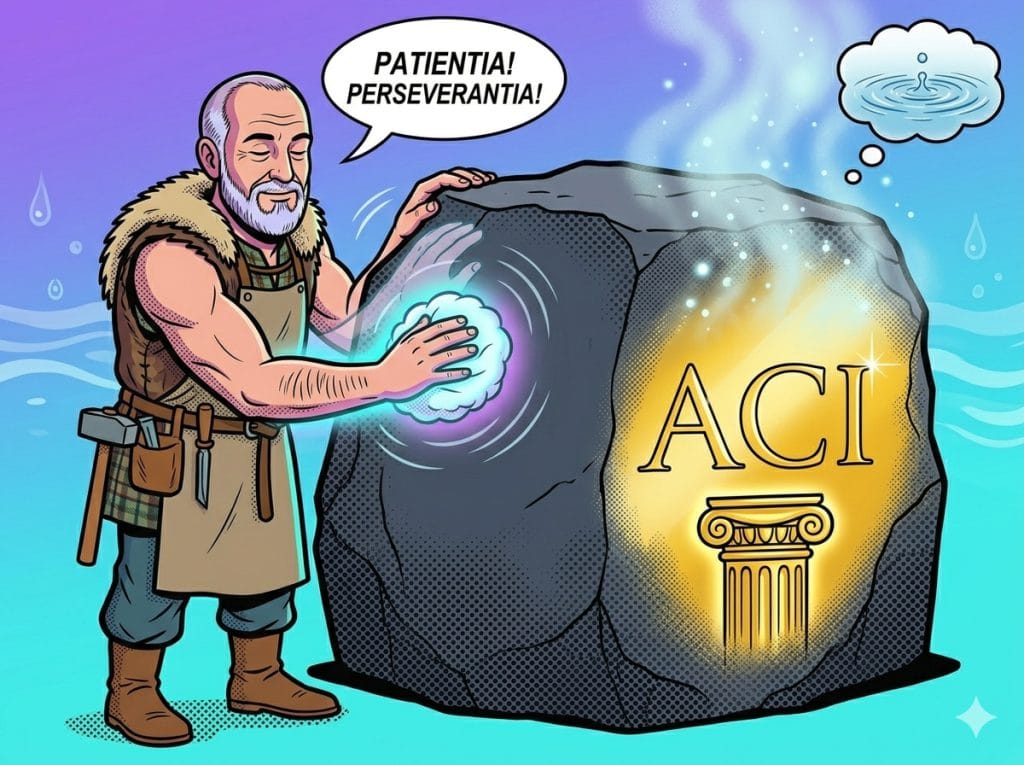
What it is: Instead of reading grammar rules, you have to actively recall them. Lapicida asks you a question—you provide the answer.
Why it works: Cognitive science studies consistently show that actively retrieving knowledge anchors it 2–3 times more firmly in long-term memory than passive reading or underlining. This effect is called the testing effect—it’s particularly effective for grammar and formal rules. → Testing effect (Wikipedia), experimentally demonstrated by Roediger & Karpicke (2006, Psychological Science). Robert Bjork (UCLA) calls this mechanism “Desirable Difficulty”—the productive effort involved in recalling information strengthens the memory trace more permanently than effortless rereading.
In the Form Trainer V2: In Boxes 1–2, targeted multiple-choice questions and chunks serve as an introduction—in Boxes 3–5, active input and free-text entry.
In the Vocabulary Trainer: Different modes present varying levels of challenge—from typing to assembling syllables to multiple-choice questions with intelligent distractors.
2. Spaced Repetition
What it is: Lapicida shows you difficult content more often and easy content less often. The interval increases with every correct answer.
Why it works: The brain forgets according to an exponential curve (Ebbinghaus’s forgetting curve). Spaced repetition combats this—daily burst sessions of 5–10 minutes are significantly more effective than a single hour of cramming. → Ebbinghaus’s forgetting curve and “A Meta-Analysis” by Cepeda et al. (2006) of 254 studies confirm: Short, spaced sessions consistently outperform binge learning when the total time spent is the same.
In Lapicida: 7-box system based on the Leitner principle. New cards → Box 1. Every correct answer → next box. Incorrect → back to Box 1. Box 7 = permanently learned. Error tolerance: Typos do not count as errors.
3. Contextual Learning (Meaningful Context)
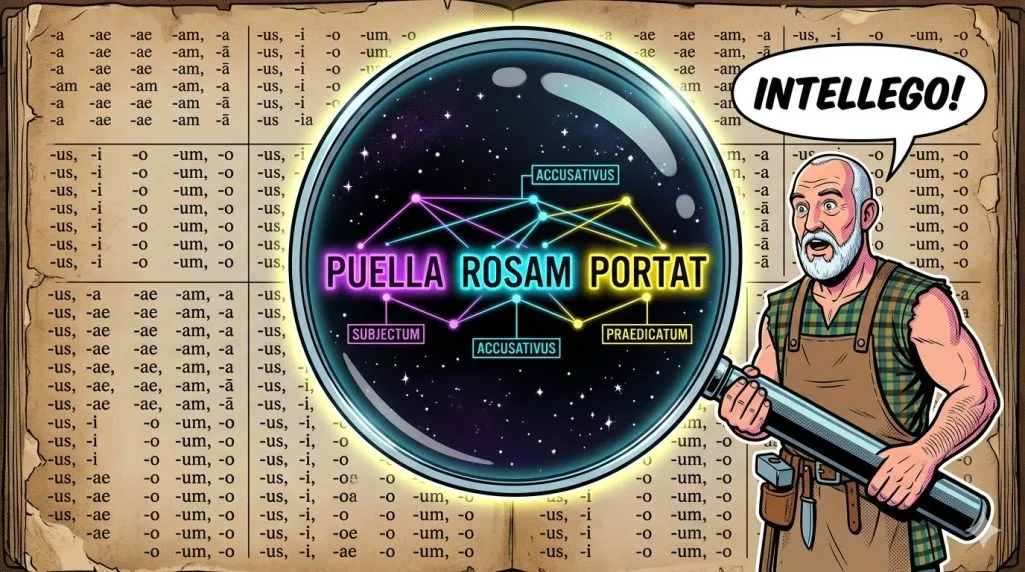
What it is: Forms and constructions are never learned in isolation with the Latin learning method—always within a real sentence.
Why it works: The brain retains information better when it is embedded in a meaningful context. The same content in a real sentence by Cicero sticks—an isolated table does not.
John Sweller’s “Cognitive Load Theory” (1988) explains why: Knowledge of grammatical rules involves a high degree of interactivity between elements—isolated tables overload working memory, while context reduces the load.
In Lapicida: Every verb form and every declension ending is linked to an example sentence from classical literature. Hand-curated sentences—no generated content.
The Vocabulary Trainer: Learning in 13 Modes
The Vocabulary Trainer is the most versatile module. Depending on the box level, the modes switch automatically—this keeps learning cognitively active and prevents habituation.
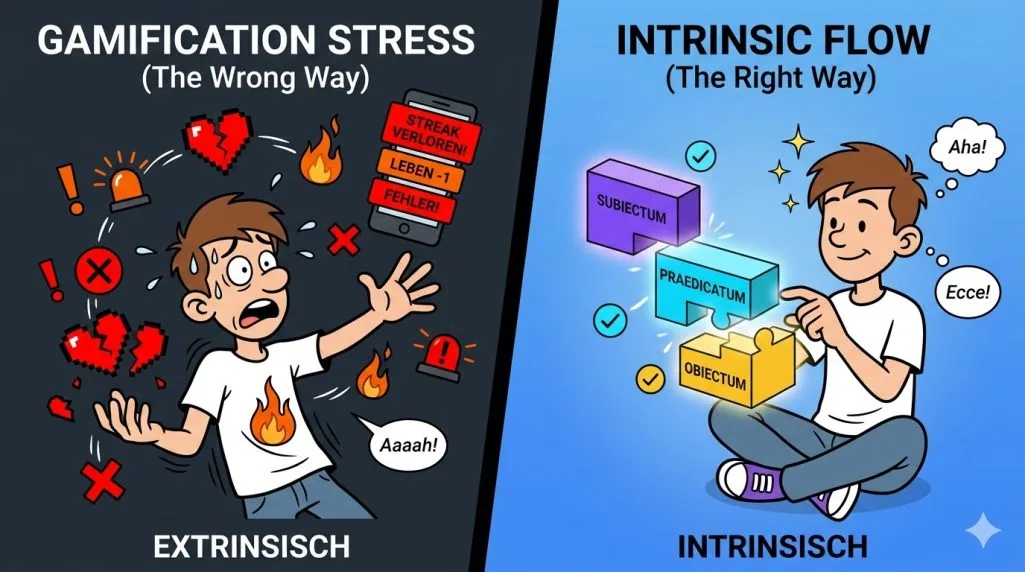
Lapicida deliberately focuses on intrinsic motivation: no streak pressure, no red Xs, no “level lost.” The sense of competence and control—not external pressure—sustains learning in the long term.
In “The Inner Game,” Timothy Gallwey describes how external pressure (red X’s, losing a streak) activates the critical “Self 1” and blocks natural learning. Lapicida deliberately suppresses this mechanism.
An Overview of the Modes
Beginner (Box 0–1): Flip — classic flashcard, self-assessment. Tetris — drag falling letter blocks into the correct column.
Building (Boxes 1–3): Chunks — putting syllables or letters together in the correct order. Multiple Choice — 4 options with intelligent distractors (as the box level increases, the options become more easily confused: same word type, similar length, same first letter).
Advanced (Boxes 2–3): Trace — trace a letter path on a 5×5 grid. Snake — steer a snake through the grid and collect letters in the correct order.
Expert (Box 3 + Mastery): Shooter — Shoot falling letter balloons. Circus — Roman chariot race; collect letters in the correct lanes. Missed shots cost points.
Why Response Speed Matters
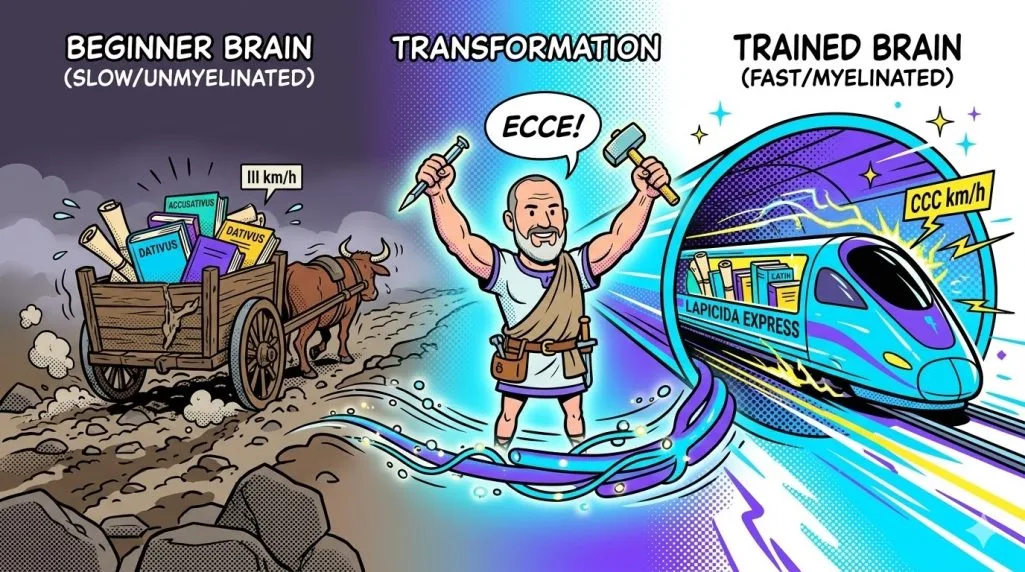
Lapicida measures how long it takes you to answer—and uses this as a learning indicator. If you answer a card quickly and confidently, you’ve truly internalized it.
The scientific basis: myelination. Through repeated practice, the brain wraps myelin around the nerve pathways. More myelin = faster signal transmission = faster, more confident responses. The signal races at 300 km/h instead of 3 km/h. (Daniel Coyle, *The Talent Code*)
Personal Baseline. Our Latin learning method compares you only to yourself: the average of your last 30 answers. Significantly faster → 1.5× points. Significantly slower → 0.75× points.
Multiple-Choice with Learning-Effective Distractors
Multiple-choice questions are only effective for learning if the incorrect answers require genuine mental effort. Lapicida scales the difficulty of distractors based on the box level:
Box 1: Distractors from the same word type. Box 2–3: Distractors based on potential for confusion—same word type, similar length, same first letter, similar ending.
Scientific basis: Desirable Difficulties (Robert Bjork). Learning tasks that seem more difficult than necessary anchor knowledge more permanently—a highlight of our Latin learning method
Lapicida’s Modules — What They Can Do
Form Quiz (Grammar)
Nouns: 5 declension classes, all cases (starting in 8th grade). Verbs: 4 conjugations, 6 tenses, active + passive, indicative + subjunctive (starting in 8th grade). Adjectives: 1st, 2nd, and 3rd declensions, comparative, past participle (starting in 9th grade). Pronouns: personal, demonstrative, relative (starting in 9th grade). Participles: past participle, past perfect participle, future perfect participle (starting in 10th grade). Progressive: Multiple choice (Box 1–2), chunks, input ranging up to free-text entry (Box 5).
Sentence Quiz (Syntax)
15 topics covering the high school curriculum for grades 5–12—from simple subject-predicate structures to ACI, NCI, ablative absolute, and passive voice. The Sentence Quiz uses the 7-box system (spaced repetition)—no changing modes.
Vocabulary Trainer
13 modes, 7 boxes, spaced repetition based on the Leitner principle. Lessons structured according to school textbooks. Exam mode for targeted test preparation. Speed-based scoring relative to your personal baseline.
Reading Mode
Authentic Latin texts—Cicero, Caesar, Pliny, Ovid. Work through sentence by sentence, with a sentence quiz after each sentence. Perfect for Latinum preparation and reading classes.
The Learning Path: How the Method Is Structured
Two levels: Modules and Trainer
Modules: Learn forms—short, fast, precise
The modules (nouns, adjectives, verbs, pronouns, demonstratives, participles) practice endings in short units. With our Latin learning method, incorrect answers are displayed immediately—the card moves back one box and reappears more quickly (5-box system with soft reset). At the end of each card: a relevant example sentence with part-of-speech labels and a translation—the context in which the form is used—plus a declension table for reference. For verbs, starting with higher-level cards, copular verbs such as *esse* and *ire* are actively incorporated.
Vocabulary Trainer: Reinforce words through 13 modes
7-box system based on the Leitner principle. The modes change automatically based on your learning progress—from “Flip” and “Tetris” for beginners to “Shooter” and “Circus” for advanced learners. Each correct answer moves the card to the next box. Incorrect—back to Box 1. Box 7 = permanently learned.
Sentence Quiz: Step by step through 15 topics
The Sentence Quiz follows a didactically structured learning path—15 topics ranging from subject+predicate to the passive voice, each logically building on the previous one. In our Latin learning method, each topic starts with easy cards and gradually increases in difficulty. Once you achieve 80% mastery, you unlock the next topic. Cards from previous sections are actively mixed in. All tenses and all voices are given equal weight—active, passive, and deponent. If you make a mistake, you won’t see red X’s, but rather targeted explanations: what the form or sentence element reveals, and what you should pay attention to next time.
Reading: Everything Combined in Authentic Texts
Cicero, Caesar, Ovid, Pliny—sentence by sentence, with a sentence quiz after each one. No contrived school texts. Reading mode is the final step: understanding instead of practice.
Why I Chose These Methods
by Andreas, developer of Lapicida
When I was studying Latin with dyslexia, traditional cramming wasn’t an option. What helped me was actively applying what I learned in real sentences. Not memorizing declensions—but analyzing real sentences until the patterns became second nature.
The Latin learning method in the Lapicida app is an attempt to systematize this approach—for anyone who finds traditional Latin learning difficult.
Scientific support: Anonymized learning and response time data are collected in a specially developed research infrastructure—as the basis for a bachelor’s thesis on digital learning support in Latin instruction.
Ready for the next step?
See Getting Started or our FAQ for more information


Color-coding — Meaning Before Reading
Latin endings look similar. Very similar. a, ae, ae, am, ā — five forms of the a-declension, four of which are nearly identical. Hungarian psychologist Pál Ranschburg showed in 1905 why this is problematic: Similar items inhibit each other in memory—the so-called Ranschburg inhibition. Without an additional cue, the brain cannot tell them apart.
Lapicida solves this with color coding: Each part of a sentence has a fixed color throughout the app—the subject is always blue, the predicate is always red, and the accusative object is always indigo. Ramus et al. (2003) show that color is processed in a distinct area of the brain, parallel to text recognition—the visual cue takes effect before the word is decoded.
The same principle applies to word segmentation: In the form trainer, Lapicida displays the form broken down on the results screen—root (purple) · tense marker (amber) · case ending (green). No abstract explanations—instead, it’s immediately visually clear where the form begins and ends.
| Parts of a sentence | Color | Why |
|---|---|---|
| Subject | Subject | Nominative — who is acting |
| Predicate | Predicate | Verb — what happens |
| Accusative object | Accusative object | Directly affected |
| Dative object | Dative object | Indirectly affected |
| Genitive | Genitive | Belonging |
This isn’t just a tool—it’s better teaching. People who learn with color coding understand sentence structure faster and make fewer ending errors. For everyone.
Multisensory learning—hearing, seeing, interacting
The brain learns best when multiple sensory channels are active at the same time. Neurologist John Gabrieli (MIT, 2009) calls this the multisensory learning advantage: When you hear and see information at the same time, you retain it much more effectively than through reading alone.
Since May 2026, Lapicida has automatically played the correct Latin pronunciation after every answered question—over 28,000 vocabulary words, forms and practice sentences are available as audio files. A speaker button is always visible, regardless of the autoplay setting. The browser caches the files locally—once loaded, they work without needing to be reloaded.
The principle behind this: When you not only see but also hear the words, you have two memory anchors instead of one. This makes recognition much easier when translating.
Offline tip: Say the vocabulary words aloud while writing them down. The same mechanism—hearing + seeing + writing—creates the same multisensory effect on paper.
Avoid piecemeal skills—the sentence is the clock
Imagine a watchmaker who knows every single gear in a watch perfectly—but doesn’t know how to put them together. This is exactly what learning therapist Katrin Sellin describes as “fragmented skills”: Students can recite declension tables by heart—but they fail in real sentences because they’ve never learned to put the parts together.
Traditional Latin learning systematically produces fragmented skills: cramming tables, learning vocabulary in isolation, then translating sentences. Lapicida turns this on its head. Every form, every word immediately appears in a real sentence. The sentence quiz forces the brain to always work within the bigger picture.
The “predicate-first” strategy reinforces this: The verb in a Latin sentence immediately reveals person, number, and tense—and thus provides the anchor for everything else. The German Dyslexia Association (BVL) explicitly recommends this strategy—not only for students with special learning needs, but as the most effective translation technique in general.
In the Sentence Quiz, Lapicida trains users to follow exactly this approach: identify the predicate, then the subject, then the objects. The drag-and-drop structure makes putting the sentence together a natural learning process.
Better Learning—for Everyone
Color coding, sentence-based work, a 5-card limit, multisensory audio: These principles were developed in learning therapy research—for learners for whom traditional cramming from tables doesn’t work. But Snowling & Hulme (2012) show that learning differences exist on a continuum, not in discrete categories. Almost everyone reaches points where memorizing tables becomes overwhelming.
That’s why Lapicida makes no distinction: the same method, the same app, the same features—for everyone. If you want additional tools (OpenDyslexic font, increased letter spacing), you can enable them in the settings. If you don’t need them, you won’t even notice they’re there.
A learning method that makes what’s supposed to be hard even harder—and makes what’s unnecessarily hard easier. Active recall instead of passive reading. Sentence context instead of tables. Color instead of guessing. Audio instead of silence.
More on the Lapicida method for dyslexia: Learning Latin with dyslexia—what really helps. And how spaced repetition works: Spaced repetition for learning Latin.
Frequently Asked Questions About How It Works
Do I have to follow a specific order?
No. Recommended for beginners: nouns → verbs → sentence quiz — since they build on one another.
How long should I study each day?
10–20 minutes a day are more effective than a single 2-hour session per week. Short, regular review sessions help knowledge stick better.
What’s the difference between the Conjugation Quiz and the Sentence Quiz?
The Form Trainer V2 embeds each form in a real Latin sentence—forms are never tested in isolation. The Sentence Quiz trains syntactic understanding in real sentences—ideal for text analysis and translation.
Why do the modes change in the Vocabulary Trainer?
Changing quiz formats keeps cognitive engagement high. Learning science calls this “interleaving”—mixed practice is more efficient than block-based repetition.
Can I use just individual sections?
Yes. Each module can be used separately—ideal for targeted preparation for your next test.
What learning method does Lapicida use?
Lapicida combines three scientifically proven methods: spaced repetition (spaced review based on the forgetting curve), active retrieval (actively recalling knowledge instead of passively reading), and contextual learning (grammar and vocabulary in real sentences). This learning method is specifically tailored to the requirements of Latin classes.
Scientific Sources
- Ebbinghaus, H. (1885). On Memory. — The forgetting curve and the basis of spaced repetition.
- Bjork, R. A. (1994). Memory and Metamemory Considerations in the Training of Human Beings. — Desirable Difficulties, Testing Effect.
- Sweller, J. (1988). Cognitive Load during Problem Solving. — Cognitive Load Theory, 5-card limit.
- Cepeda, N. J. et al. (2006). Distributed Practice in Verbal Recall Tasks. — Meta-analysis of 254 studies on spaced repetition.
- Ramus, F. et al. (2003). Theories of Developmental Dyslexia. — Parallel color processing prior to text recognition.
- Ranschburg, P. (1905). On the Importance of Similarity in Learning. — Ranschburg Inhibition.
- Gabrieli, J. D. E. (2009). Dyslexia: A New Synergy Between Education and Cognitive Neuroscience. — Multisensory learning advantage.
- Sellin, K. (2013). Second Language Acquisition: Latin (BVL Handout). — 5-card limit, predicate-first, fragmentary skills.
- Snowling, M. J. & Hulme, C. (2012). Annual Research Review: The Nature and Classification of Reading Disorders. — Dyslexia as a continuum.
- Coyle, D. (2009). The Talent Code. — Myelination and response speed.
- Gallwey, W. T. (1974). The Inner Game of Tennis. — Intrinsic motivation, no pressure to maintain a winning streak.