Nicene Creed in Latin (Credo) — Text, Translation & Meaning
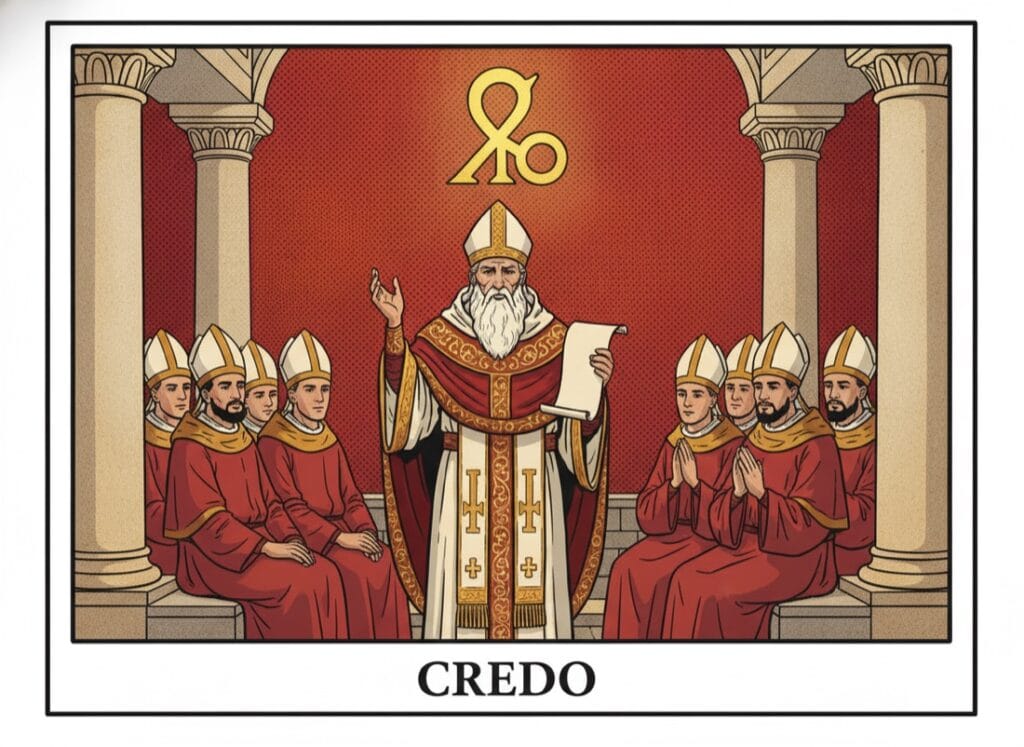
The Nicene Creed in Latin — the Credo — is the profession of faith recited at Sunday Mass. Beginning “Credo in unum Deum” (“I believe in one God”), it sets out the Church’s faith in the Holy Trinity, the Incarnation and the life of the world to come.
On this page you will find the full Latin text, a line-by-line English translation, the meaning, the origin and a pronunciation note:
- the full Latin text of the Nicene Creed (Credo)
- the English translation, line by line
- meaning, origin and ecclesiastical pronunciation
If you want not only to pray the Credo but also to read and understand the Latin, you will find it as a reading in the Lapicida app — opened up word by word, with a simplified entry stage to begin.
How does the Nicene Creed go in Latin?
The Nicene Creed begins “Credo in unum Deum, Patrem omnipotentem” (“I believe in one God, the Father almighty”) and ends “et vitam venturi saeculi. Amen.” (“and the life of the world to come. Amen.”). This is the Mass form, the Symbolum Nicaeno-Constantinopolitanum.
Nicene Creed — Latin text with a line-by-line translation
Here is the full Nicene Creed in the traditional Roman Mass form (Latin on the left, English on the right):
| Latin | English |
|---|---|
| Credo in unum Deum, Patrem omnipotentem, factorem caeli et terrae, visibilium omnium et invisibilium. | I believe in one God, the Father almighty, maker of heaven and earth, of all things visible and invisible. |
| Et in unum Dominum Iesum Christum, Filium Dei unigenitum, et ex Patre natum ante omnia saecula. | And in one Lord Jesus Christ, the only-begotten Son of God, born of the Father before all ages. |
| Deum de Deo, Lumen de Lumine, Deum verum de Deo vero, genitum non factum, consubstantialem Patri; per quem omnia facta sunt. | God from God, Light from Light, true God from true God, begotten, not made, consubstantial with the Father; through whom all things were made. |
| Qui propter nos homines et propter nostram salutem descendit de caelis. | Who for us men and for our salvation came down from heaven. |
| Et incarnatus est de Spiritu Sancto ex Maria Virgine, et homo factus est. | And was incarnate by the Holy Spirit of the Virgin Mary, and became man. |
| Crucifixus etiam pro nobis sub Pontio Pilato, passus et sepultus est, et resurrexit tertia die, secundum Scripturas, et ascendit in caelum, sedet ad dexteram Patris. | He was also crucified for us under Pontius Pilate, suffered and was buried, and rose again on the third day according to the Scriptures, and ascended into heaven, and sitteth at the right hand of the Father. |
| Et iterum venturus est cum gloria, iudicare vivos et mortuos, cuius regni non erit finis. | And he shall come again in glory to judge the living and the dead, and of his kingdom there shall be no end. |
| Et in Spiritum Sanctum, Dominum et vivificantem, qui ex Patre Filioque procedit. | And in the Holy Spirit, the Lord and giver of life, who proceeds from the Father and the Son. |
| Qui cum Patre et Filio simul adoratur et conglorificatur: qui locutus est per prophetas. | Who with the Father and the Son together is adored and glorified: who spoke through the prophets. |
| Et unam, sanctam, catholicam et apostolicam Ecclesiam. | And in one, holy, catholic, and apostolic Church. |
| Confiteor unum baptisma in remissionem peccatorum. | I confess one baptism for the forgiveness of sins. |
| Et expecto resurrectionem mortuorum, et vitam venturi saeculi. Amen. | And I await the resurrection of the dead, and the life of the world to come. Amen. |
Grammar note for learners: Credo in unum Deum uses credere in + accusative (Church Latin for “to believe in”), where classical Latin would take the dative. Watch the technical terms: genitum non factum (“begotten, not made”) and consubstantialem (“of one being with”).
Meaning: the profession of faith
The Nicene Creed confesses the one God in three Persons: the Father, maker of all; the Son, consubstantialem Patri (of one being with the Father), who became man, died, rose and will come again; and the Holy Spirit, qui ex Patre Filioque procedit (who proceeds from the Father and the Son). It closes with faith in the one Church, one baptism, and the resurrection of the dead. The Western form carries the Filioque (“and the Son”).
Learn Latin now. Our learning app:

How you read it in the app — word by word
In the Lapicida app the Credo is set up as a graded reading: first a simplified entry stage, then the full original — each line opened up word by word, with vocabulary help and form analysis. The long Creed becomes readable step by step.
Origin and pronunciation
The Nicene Creed was formulated at the Councils of Nicaea (325) and Constantinople (381) to confess the true divinity of the Son and the Holy Spirit. Its Latin Mass form, Credo in unum Deum, stands in the Missale Romanum; the Western Church adds the Filioque.
Pronunciation (Church Latin): Credo = “KREH-do”; caeli = “CHEH-lee” (c before ae is “ch”); consubstantialem = “kon-soob-stan-tsee-AH-lem” (ti before a vowel is “tsee”).
The Credo is part of the Ordinary of the Mass, alongside the Agnus Dei. See also the Te Deum and the Vulgate, the Latin Bible.
Frequently asked — the Nicene Creed in Latin
What is the Nicene Creed in Latin?
It is the Credo, the profession of faith recited at Mass, beginning ‘Credo in unum Deum’ (‘I believe in one God’). It confesses the Trinity, the Incarnation, and the life to come, and comes from the Councils of Nicaea (325) and Constantinople (381).
What does Credo in unum Deum mean?
‘I believe in one God.’ It is the opening of the Nicene Creed in its Latin Mass form, followed by ‘Patrem omnipotentem’ — ‘the Father almighty’.
What is the Filioque?
Filioque means ‘and the Son’. In the Western (Latin) Creed the Holy Spirit is said to proceed ‘ex Patre Filioque’ — ‘from the Father and the Son’. It is a distinctive feature of the Western form.
What does consubstantialem mean?
Consubstantialem Patri means ‘of one being (one substance) with the Father’. It affirms that the Son is fully God, the key teaching of the Council of Nicaea.
Learn Latin now. Our learning app: