
Latin Third Declension — Consonant, i-Stem & Mixed (rex, corpus, mare)

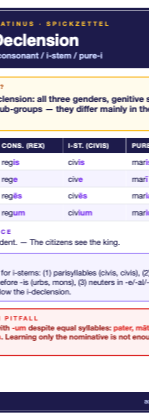
The third declension is the largest and most varied class — and the only one that holds all three genders. Because its nominatives look so different (rex, corpus, civis, mare), you recognise it not by the nominative but by the genitive singular in -is. It splits into three sub-groups. Part of the Learn Latin series.
- The three sub-groups: consonant, mixed (i-stems), pure i-declension
- Tables for rex, corpus, civis, urbs and mare
- The key question: genitive plural -um or -ium?
- Gender signals and common mistakes
What is the third declension?
The third declension holds Latin nouns with very different nominative endings but the genitive singular in -is (rex, regis). It contains masculines, feminines and neuters, and divides into a consonant, a mixed and a pure i-declension. It is the third of the five declensions.
The endings of the consonant declension
The consonant type is the basic case. Masculine/feminine and neuter differ only in nominative/accusative:
| Case | Masc./Fem. (rex) | Neuter (corpus) |
|---|---|---|
| Nom. sg. | rex | corpus |
| Gen. sg. | regis | corporis |
| Dat. sg. | regi | corpori |
| Acc. sg. | regem | corpus |
| Abl. sg. | rege | corpore |
| Nom. pl. | reges | corpora |
| Gen. pl. | regum | corporum |
| Dat./Abl. pl. | regibus | corporibus |
| Acc. pl. | reges | corpora |
How to spot it: the genitive singular in -is. Because the nominative varies so much, learn both forms together: rex, regis — corpus, corporis.

The tables of the three sub-groups
1. Consonant declension — rex (m.) and corpus (n.)
rex, regis m. — king
| Case | Singular | Plural |
|---|---|---|
| Nominative | rex | reges |
| Genitive | regis | regum |
| Dative | regi | regibus |
| Accusative | regem | reges |
| Ablative | rege | regibus |
corpus, corporis n. — body (neuter: nom. = acc., plural in -a)
| Case | Singular | Plural |
|---|---|---|
| Nom. / Acc. | corpus | corpora |
| Genitive | corporis | corporum |
| Dat. / Abl. | corpori / corpore | corporibus |
2. Mixed declension (i-stems) — civis and urbs
Like the consonant type, but the genitive plural ends in -ium. civis, civis m./f. — citizen · urbs, urbis f. — city
| Case | civis (sg / pl) | urbs (sg / pl) |
|---|---|---|
| Nominative | civis / cives | urbs / urbes |
| Genitive | civis / civium | urbis / urbium |
| Dative | civi / civibus | urbi / urbibus |
| Accusative | civem / cives | urbem / urbes |
| Ablative | cive / civibus | urbe / urbibus |
3. Pure i-declension — mare (neuters in -e/-al/-ar)
Neuters in -e, -al, -ar have three i-forms: ablative singular -i, nom./acc. plural -ia, genitive plural -ium. mare, maris n. — sea
| Case | Singular | Plural |
|---|---|---|
| Nom. / Acc. | mare | maria |
| Genitive | maris | marium |
| Dative | mari | maribus |
| Ablative | mari | maribus |
Likewise animal, animalis (abl. animali, pl. animalia, animalium). See the declension chart.
Learn Latin now. Our learning app:

The -ium question: mixed or consonant?
The most important distinction inside the third declension is the genitive plural: -um or -ium. The i-stems take -ium. Three rules of thumb reveal them:
- Parisyllables — same number of syllables in nominative and genitive singular: civis, civis · navis, navis · hostis, hostis → -ium.
- Two consonants before the ending -is: urbs, urbis · pars, partis · mons, montis · nox, noctis → -ium.
- Neuters in -e, -al, -ar: mare, animal, exemplar → pure i-declension (abl. sg. -i, plural -ia, gen. pl. -ium).
Important exceptions (consonant despite equal syllables, so -um): pater, mater, frater, canis, iuvenis, senex.
Note: the third-declension adjectives also follow the i-declension — ablative singular -i (forti), neuter plural -ia (fortia), genitive plural -ium (fortium).
Gender: all three — with signal endings
The third declension has masculines, feminines and neuters. The nominative ending often hints at the gender (with exceptions):
| Gender | typical endings | examples |
|---|---|---|
| masculine | -or, -os, -er | victor, mos, pater |
| feminine | -as, -is, -x, -io, -s after a consonant | civitas, navis, pax, ratio, urbs |
| neuter | -us (gen. -oris/-eris), -en, -e, -al, -ar | corpus, genus, nomen, mare, animal |
Because the rules have many exceptions, learn the gender and genitive together with the word — the way the dictionary gives it.
The cases in a sentence
| Case | Latin | English |
|---|---|---|
| Nominative | Rex populum regit. | The king rules the people. |
| Genitive | Vox regis clara est. | The voice of the king is clear. |
| Dative | Miles regi paret. | The soldier obeys the king. |
| Accusative | Cives regem vident. | The citizens see the king. |
| Ablative | Rex cum militibus venit. | The king comes with the soldiers. |
A neuter plural: Corpora militum fortia sunt. — The bodies of the soldiers are strong. And an i-stem ablative: Naves in mari navigant. — The ships sail on the sea.
Common mistakes
- Genitive plural -um vs -ium: consonant regum, but i-stem civium, urbium, marium. Always check the three i-stem rules.
- Neuter plural -a vs -ia: consonant corpora, pure i-stem maria, animalia.
- Ablative singular -e vs -i: consonant and mixed rege, cive; pure i-neuters in -i (mari, animali).
- Learning only the nominative: rex, corpus, iter, nomen look completely different — without the genitive (regis, corporis, itineris, nominis) you cannot find the stem.
- Declining adjectives as consonant stems: fortis follows the i-declension — forti (abl. sg.), fortium (gen. pl.), not forte/fortum.
Frequently asked questions
What is the third declension in Latin?
The third declension is the largest noun class. Its nouns have very different nominatives but all share the genitive singular in -is (rex, regis). It contains masculines, feminines and neuters.
How do I recognise the third declension?
By the genitive singular in -is. Because the nominative varies, learn the nominative and genitive together, e.g. corpus, corporis.
What is the difference between consonant and i-declension?
The genitive plural: consonant stems end in -um (regum), i-stems (mixed declension) in -ium (civium, urbium). Pure i-neuters in -e, -al, -ar also have ablative singular -i and plural -ia (maria).
When is the genitive plural -ium instead of -um?
With i-stems: 1) parisyllables with equal syllable count (civis, civis), 2) words with two consonants before -is (urbs, urbis), 3) neuters in -e, -al, -ar. Exceptions with -um are pater, mater, frater, canis, iuvenis.
Which genders does the third declension have?
All three: masculine (often -or, -os, -er), feminine (often -as, -is, -x, -io) and neuter (often -us with genitive -oris/-eris, -en, -e, -al, -ar). There are many exceptions, so learn the gender too.
Practise the third declension actively
Lapicida Latinus makes you type the forms instead of just ticking boxes — forms trainer, sentence quiz and reading in one app. Start free, full version from €19.99/year.
Learn Latin now. Our learning app: