
Latin Words with Multiple Meanings: Find the Right One in Context
Latin words with multiple meanings are the most common trap in translation. res means “thing”, but in res publica it is the state, in res gestae the deeds and in res familiaris the family property. Plug in the first meaning from the dictionary every time and you translate past the sense.
Here you’ll learn why a Latin word has so many meanings, which ten words trip people up most often, and how to find the right meaning in the sentence. To practise, the Lapicida app has the trainer Sensus.
Why does a Latin word have several meanings?
In short: many Latin words are ambiguous. One Latin word often covers a broader field of meaning than one English word. For res English needs five words, and only the sentence settles which one is meant. You find the right meaning by reading the whole sentence first, then asking who does what, and watching for fixed phrases. Choosing the one fitting meaning out of several is called disambiguation.


Ten Latin words that trip you up almost every time
These ten words have especially many meanings, and they turn up in almost every text. The example sentences come from Sensus. Where an author is named, the sentence is in the original.
- res: thing, state, property, deed, circumstances
Caesar magnas res gerit.
Caesar accomplishes great things. - causa: reason, lawsuit, for the sake of
Iulia patris causa tacet.
Julia keeps silent for her father’s sake. - gratia: thanks, favour, charm, influence
Dumnorix gratia et largitione apud Sequanos plurimum poterat. (Caesar)
Through influence and generosity, Dumnorix had great power among the Sequani. - fides: loyalty, trust, protection, faith
Lupus Ariovisto fidem servat.
Lupus stays loyal to Ariovistus. - animus: mind, courage, attitude, intention
Iulia animum non amittit.
Julia does not lose heart. - consilium: plan, advice, decision, council of war
Caesar consilium Iuliae audit.
Caesar listens to Julia’s advice. - ratio: reason, way, consideration
Cato iram ratione vincit.
Cato overcomes anger with reason. - petere: head for, attack, ask for, strive for
Milites hostes petunt.
The soldiers attack the enemy. - capere: take, capture, grasp, take prisoner
Iulia sententiam patris non capit.
Julia does not grasp her father’s opinion. - acies: battle line, edge, eyesight, sharpness of mind
Hostes in acie stant.
The enemy stand in battle line.
Many of these words are among the most frequent in Latin. Which ones those are is shown in our list of the most common Latin words; the Dickinson College core vocabulary lists them with all their meanings.
How to find the right meaning in the sentence
- Read the whole sentence first. Don’t translate the difficult word first. Read on to the predicate; then you know what the sentence is about.
- Ask: who does what? Identify subject, predicate and object. In Milites hostes petunt the soldiers are the subject and the enemy the object, so petere means “attack” here. How to find sentence parts reliably is in Identifying sentence elements in Latin.
- Watch for fixed phrases. Some combinations settle the meaning on their own: res publica (the state), gratias agere (to thank), consilium capere (to make a decision), exempli gratia (for example).
- Mind the subject area. In a battle, acies is the battle line. With a sword it is the edge. With cleverness it is sharpness of mind.
- Read the whole dictionary entry. The first meaning is only the most common one. Check which fits your sentence and try it out. How long such an entry can be is shown by the entry for res in Wiktionary; Logeion searches several dictionaries at once.
Translating as a whole – words, forms, sentence parts – is the subject of Learn to translate Latin.
Practise word meanings in context
Sensus shows you real sentences and asks: which meaning fits here? Short, no time pressure, and a mistake never sends you back to zero.
Learn Latin now. Our learning app:

Sensus: practise word meaning in context
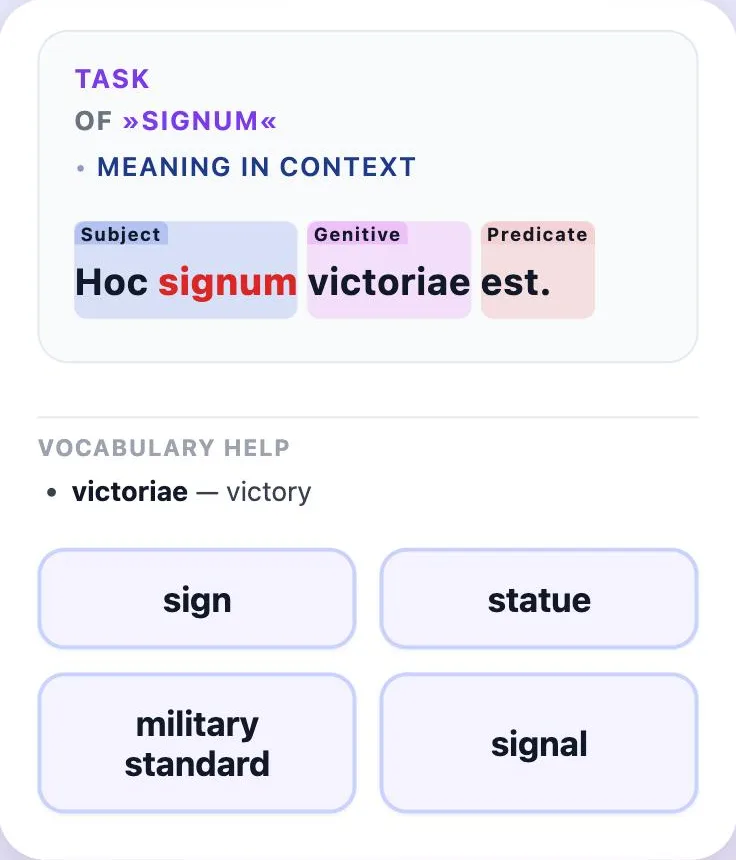
In the Lapicida app the trainer for this is called Sensus. It shows you a sentence, highlights a word and asks for the meaning that fits here. In Hoc signum victoriae est, signum is neither a statue nor a military standard but a sign: “This is the sign of victory.” Choose wrong and Sensus says “Not quite”, and you keep looking until it’s right.
Every meaning is a card of its own with its own progress: res as the state and res as wealth are practised separately. What you often get right comes back less often. Sensus asks in four ways:
- Choose the meaning: one sentence, four meanings, one fits.
- From meaning to Latin word: the meaning is given, you find the Latin word for the gap.
- Find the right sentence: two sentences with the same word, one meaning is asked for.
- Match: two sentences, two meanings, you pair them up.
The two-sentence tasks only come once you already know a word. Then you have to tell meanings apart instead of just recognising one. Sentences can be read aloud, with the word you are hearing highlighted.
What you can practise for free
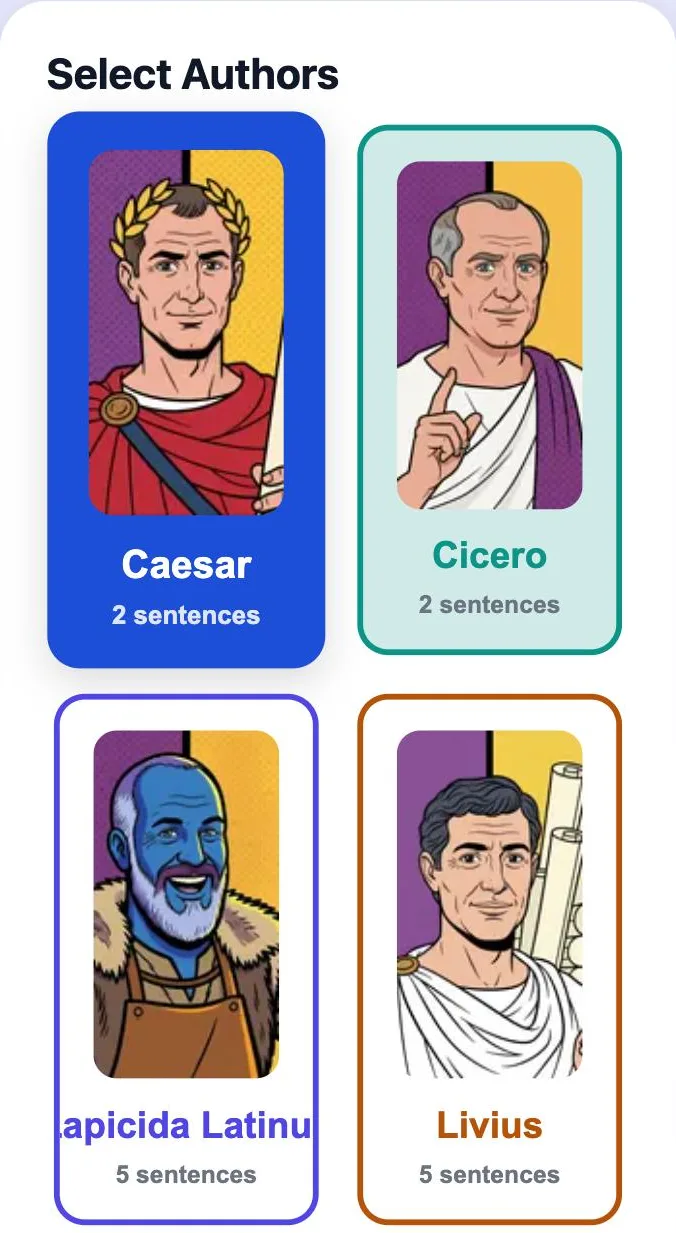
Without a licence you practise with 12 words in 15 short sentences, including res, causa, vis, acies and petere. The authors’ sentences there are simple sentences in their style; the app labels them as such.
With a licence it is 69 words with 248 meanings in over 700 sentences (as of October 2026), from our reading texts to original sentences by Caesar, Cicero, Sallust, the Vulgate and Luther. Which sentences you get depends on your progress in the sentence quiz: you only practise meanings in sentences whose structure you already know. All texts in the app are listed in all readings at a glance.
Why meanings stick better in a sentence
A vocabulary equation like “res = thing” often doesn’t help you in a text. In a sentence, though, you see what gives the meaning away: the predicate, the object, the fixed phrase. When you compare two sentences with the same word, you have to look closely – and that effort makes the knowledge stick.
Why words stick better in a sentence than in a list is explained in Learning Latin vocabulary in context. The research project CALLIDUS looked into this for Latin; what it found is in Context-based vocabulary learning.
Telling meanings apart is the second step. The first is knowing the words at all. How to learn vocabulary for good is in Learning Latin vocabulary. How Sensus works in detail is in the Sensus guide.
FAQ: Latin words with multiple meanings
Why do Latin words have so many meanings?
A Latin word often covers a broader field of meaning than an English one. res, for example, can mean thing, state, property, deed or circumstances; only the sentence settles which meaning is meant.
How do I find the right meaning of a Latin word?
Read the whole sentence first, then ask who does what. Watch for fixed phrases such as res publica, and read the whole dictionary entry, not just the first meaning.
Which Latin words have especially many meanings?
For example res, causa, gratia, fides, animus, consilium, ratio, petere, capere and acies. They occur in almost every text and trip people up especially often.
Should I learn every meaning of a word by heart?
Learn the basic meaning and the two or three most common other ones first. Work out the rest from the sentence. Checking which meaning fits matters more than a long list.
Is Sensus free?
You can try Sensus without a licence with 12 words in 15 short sentences. With a licence you practise 69 words with 248 meanings in over 700 sentences, including original sentences by Caesar, Cicero and Sallust.
Read the sentence first, then choose the meaning
With these steps you find the right meaning even for res and causa. You can practise it in Sensus, part of the Latin app by Lapicida.
Learn Latin now. Our learning app: