Latin Declension Tool & Chart — Decline Nouns, Adjectives & Pronouns
Type a noun or adjective and get the full Latin declension table instantly – all six cases in singular and plural, and for adjectives in masculine, feminine and neuter. Genitive, declension and gender come automatically from our vocabulary database; the endings are colour-highlighted, because they decide the meaning of the sentence. Below you will also find a complete declension chart for every class.
What is declension?
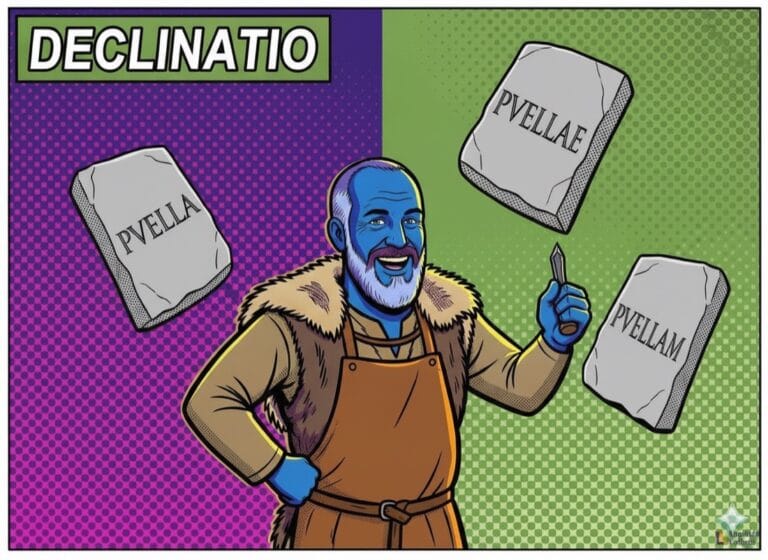
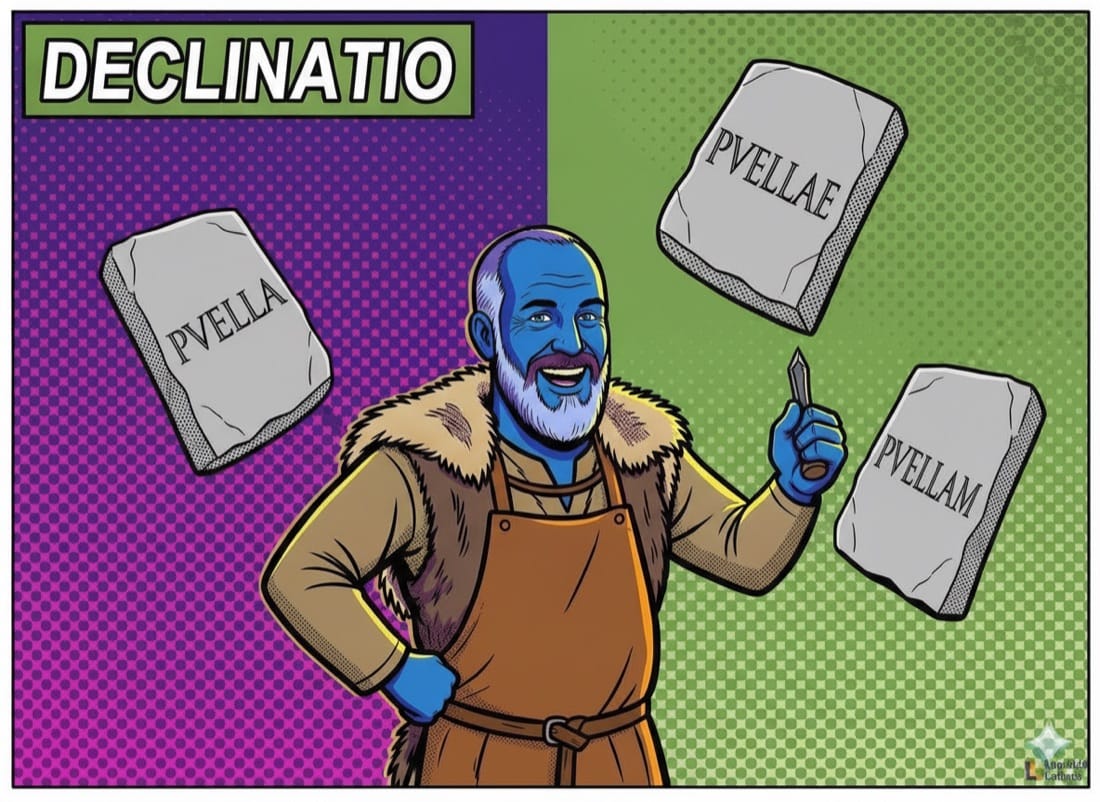
Declension means that a noun, adjective or pronoun changes its ending depending on the role it plays in the sentence. That role is the case; on top of it come number (singular/plural) and gender (masculine, feminine, neuter). English mostly relies on word order and prepositions; in Latin the role sits in the ending itself – a single letter can turn the whole sentence around. That is exactly what makes Latin so precise: the form reveals the function.
The five declensions
Latin nouns belong to one of five declensions. The 3rd declension splits further into three groups: consonant stems (rex), mixed / i-stems (civis, urbs) and pure i-stems (mare, turris). You tell the class from the genitive singular – which is why you always learn vocabulary with its genitive. Full charts for every class are below.
How to recognise the declension
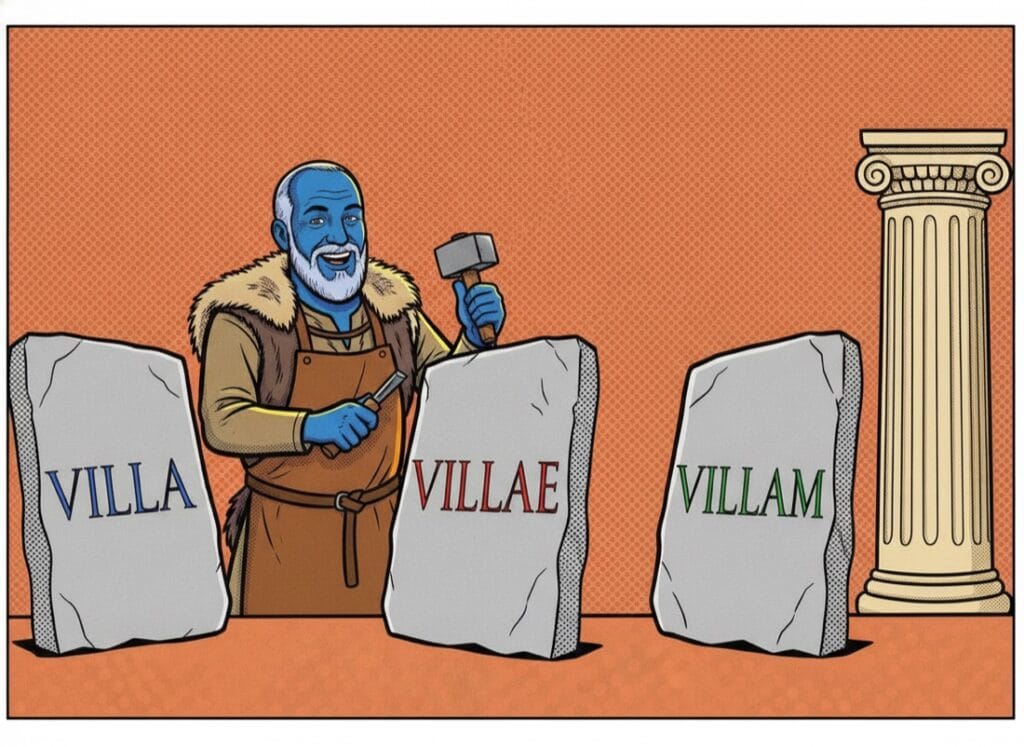
The key is the genitive singular: -ae → 1st declension (villa/villae), -i → 2nd declension (dominus/domini, bellum/belli), -is → 3rd declension (rex/regis), -us → 4th declension (manus/manus, where nominative and genitive are spelled alike and differ only in vowel length), -ei → 5th declension (res/rei).
Within the 3rd declension: mixed stems show equal syllable count in nominative and genitive (civis/civis) or two consonants before the genitive ending (urbs/urbis) – they take -e in the ablative singular but -ium in the genitive plural. Pure i-stems are recognised, for neuters, by the nominative endings -e, -al, -ar (mare, animal, exemplar; ablative singular -i, plural -ia), and for masculines/feminines by the small turris-group (turris, vis, sitis) with accusative -im and ablative -i.
The six cases and their function
- Nominative – the subject: “who or what?”
- Genitive – possession and belonging: “whose?”
- Dative – the indirect object: “to/for whom?”
- Accusative – the direct object: “whom or what?”
- Ablative – circumstances such as place, time and means: “by, with, from?”
- Vocative – direct address (usually the same as the nominative).
Common pitfalls
- Neuters: nominative and accusative are always identical. In the plural, 2nd-declension and consonant neuters end in -a (bella, corpora), but neuter i-stems end in -ia (maria, animalia).
- Many endings look alike: -ae can be genitive singular or nominative plural. Only context – and the genitive – decide.
- The three groups of the 3rd declension differ mainly in the genitive plural (-um vs. -ium), the ablative singular (-e vs. -i) and, for pure i-stems, the accusative singular (-em vs. -im).
Declining adjectives
Adjectives agree with their noun in case, number and gender (agreement). They follow either the a/o-declension (endings -us/-a/-um, like bonus) or the 3rd declension (like fortis). Third-declension adjectives almost all follow the i-declension: ablative singular in -i (forti), genitive plural in -ium (fortium), neuter plural in -ia (fortia). The tool always shows adjectives in all three genders.
Why colour the endings? Latin is systematic, not hard
Latin endings look confusingly alike – a, ae, am, arum. Similar things interfere with each other in memory. Separating them visibly from the stem eases the working memory. The point: Latin is not a “hard” language, but an unusually systematic one. This tool makes that system visible – stem plus ending, clearly separated.
Learn Latin now. Our learning app:

Full declension chart
Every class with one model word, fully declined – for reference and printing:
| Case | Singular | Plural |
|---|---|---|
| Nominative | villa | villae |
| Genitive | villae | villarum |
| Dative | villae | villis |
| Accusative | villam | villas |
| Ablative | villa | villis |
| Case | Singular | Plural |
|---|---|---|
| Nominative | dominus | domini |
| Genitive | domini | dominorum |
| Dative | domino | dominis |
| Accusative | dominum | dominos |
| Ablative | domino | dominis |
| Case | Singular | Plural |
|---|---|---|
| Nominative | bellum | bella |
| Genitive | belli | bellorum |
| Dative | bello | bellis |
| Accusative | bellum | bella |
| Ablative | bello | bellis |
| Case | Singular | Plural |
|---|---|---|
| Nominative | rex | reges |
| Genitive | regis | regum |
| Dative | regi | regibus |
| Accusative | regem | reges |
| Ablative | rege | regibus |
| Case | Singular | Plural |
|---|---|---|
| Nominative | corpus | corpora |
| Genitive | corporis | corporum |
| Dative | corpori | corporibus |
| Accusative | corpus | corpora |
| Ablative | corpore | corporibus |
| Case | Singular | Plural |
|---|---|---|
| Nominative | civis | cives |
| Genitive | civis | civium |
| Dative | civi | civibus |
| Accusative | civem | cives |
| Ablative | cive | civibus |
| Case | Singular | Plural |
|---|---|---|
| Nominative | mare | maria |
| Genitive | maris | marium |
| Dative | mari | maribus |
| Accusative | mare | maria |
| Ablative | mari | maribus |
| Case | Singular | Plural |
|---|---|---|
| Nominative | manus | manus |
| Genitive | manus | manuum |
| Dative | manui | manibus |
| Accusative | manum | manus |
| Ablative | manu | manibus |
| Case | Singular | Plural |
|---|---|---|
| Nominative | res | res |
| Genitive | rei | rerum |
| Dative | rei | rebus |
| Accusative | rem | res |
| Ablative | re | rebus |
| Case | Singular | Plural |
|---|---|---|
| Nominative | cornu | cornua |
| Genitive | cornus | cornuum |
| Dative | cornu | cornibus |
| Accusative | cornu | cornua |
| Ablative | cornu | cornibus |
Adjective patterns
| Case | m | f | n |
|---|---|---|---|
| Singular | |||
| Nom. | bonus | bona | bonum |
| Gen. | boni | bonae | boni |
| Dat. | bono | bonae | bono |
| Acc. | bonum | bonam | bonum |
| Abl. | bono | bona | bono |
| Plural | |||
| Nom. | boni | bonae | bona |
| Gen. | bonorum | bonarum | bonorum |
| Dat. | bonis | bonis | bonis |
| Acc. | bonos | bonas | bona |
| Abl. | bonis | bonis | bonis |
| Case | m | f | n |
|---|---|---|---|
| Singular | |||
| Nom. | fortis | fortis | forte |
| Gen. | fortis | fortis | fortis |
| Dat. | forti | forti | forti |
| Acc. | fortem | fortem | forte |
| Abl. | forti | forti | forti |
| Plural | |||
| Nom. | fortes | fortes | fortia |
| Gen. | fortium | fortium | fortium |
| Dat. | fortibus | fortibus | fortibus |
| Acc. | fortes | fortes | fortia |
| Abl. | fortibus | fortibus | fortibus |
Frequently asked questions
How do you decline a Latin noun?
Determine the declension and gender (from the genitive singular), form the stem and add the endings of that class – for all six cases in singular and plural. The tool above does this automatically.
How do I know which declension a word belongs to?
From the genitive singular: -ae (1st), -i (2nd), -is (3rd), -us (4th), -ei (5th). That is why vocabulary is always learned with the genitive.
Can I decline adjectives too?
Yes. Adjectives follow the a/o- or the 3rd declension and are shown in masculine, feminine and neuter.
You might also like our Latin conjugation tool, the Roman numeral converter and our printable cheat sheets.
Learn Latin now. Our learning app: