Latin Forms Practice: Declension and Conjugation in Context
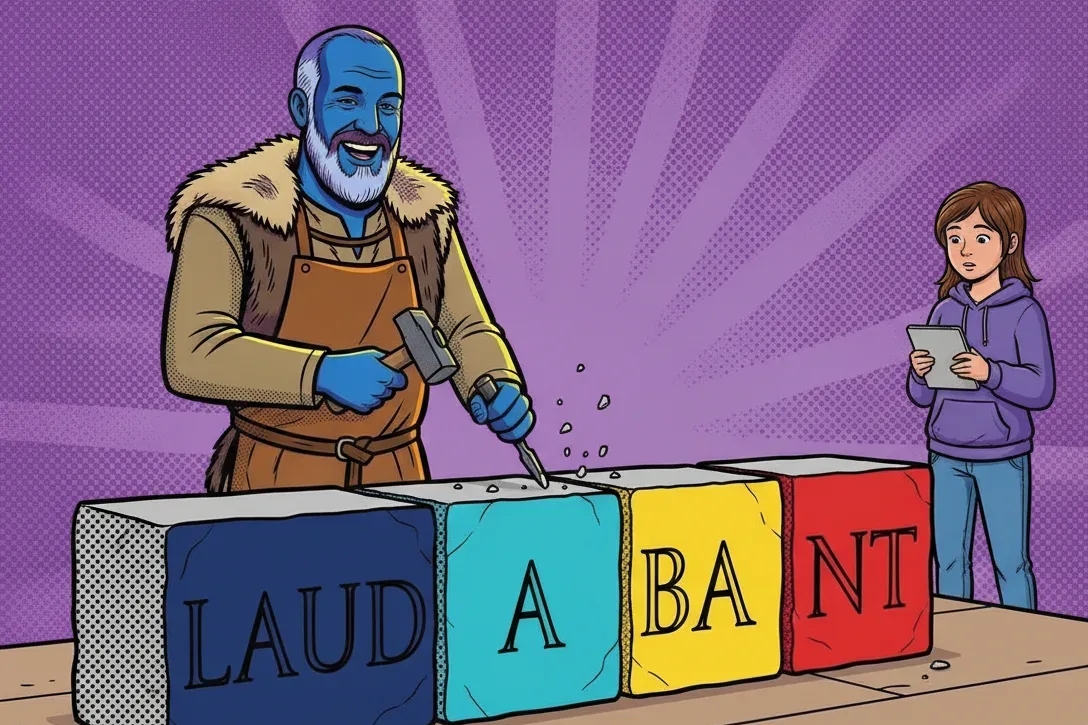
villae, laudabant, militibus: in Latin, almost everything lives in the ending. Read the ending and you know who acts, when it happens and to whom. Skip it and you are guessing. That is why Latin forms practice is the step between learning vocabulary and translating.
The Lapicida forms trainer does not drill as many words as possible. It drills a few common ones – and on each of them every ending, always inside a Latin sentence.
How do you practise Latin forms best?
On a few words you will meet again and again – and on each of them all the endings. In a sentence rather than in a table, and with new words only once the current ones stick. First you identify (parse) ready-made forms, in the end you build them yourself.





The principle: a few common words, every ending
Many Latin drills rely on volume: lots of different exercises on lots of different words. We deliberately don’t. Decline twenty words once each and you half-know twenty words. Practise every ending on one word and you can read any word of that declension. So you practise on words that are common in Latin: of the 31 nouns in the forms trainer, 29 are among the 1,000 most frequent words in the Dickinson College Commentaries core vocabulary.
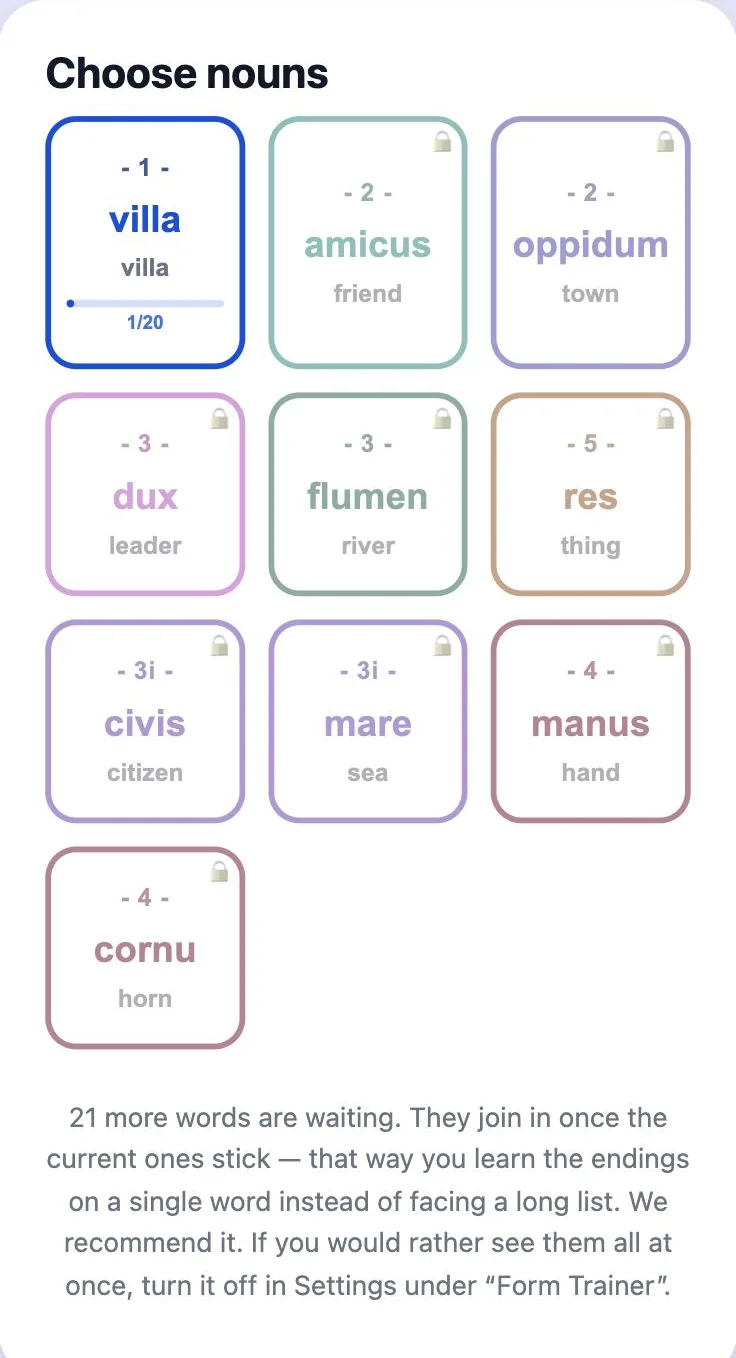
New words join one at a time. You start with one word per declension. The next one joins once the current one sticks – after at least 20 cards, if you made no more than two mistakes in the last ten. Early mistakes no longer count by then.
If you would rather see all words at once, switch this off in the settings. We don’t recommend it: on a single word you see the endings, in a long list you only see the list.
Your course filters what you see. Pick a course preset – the Lapicida path by year of Latin or the grammar sequence of your course – and the trainer only shows what you have already covered: the declensions for nouns, the tenses, moods and voices for verbs. If the imperfect hasn’t come up yet, you won’t practise it yet. That keeps you from being overwhelmed. All sentences and exercises are written by Lapicida Latinus.
And every form sits in a sentence. For almost every form there is a Latin example sentence in which it really occurs. That is the point of the whole approach: in a text you never meet a row of a table, you meet a word in a sentence.
What a form tells you – and why you have to parse it
A Latin form is built from pieces. At the front is the stem, which carries the meaning. At the back is the ending, which tells you the word’s role in the sentence. Verbs often have a tense sign in between, such as -ba- for the imperfect.
The example villae shows the real difficulty: many endings are ambiguous. Only the sentence tells you which reading is meant. How the cases work in a sentence is explained in Latin cases. Without the app, the Perseus word study tool at Tufts University will parse a form for you.
Six trainers: what you practise
| Trainer | What you practise |
|---|---|
| Nouns | 1st, 2nd, 3rd, 4th and 5th declension villa, amicus, dux, manus, res |
| Adjectives | 1st/2nd and 3rd declension, comparison, adverbs magnus, fortis, melior |
| Verbs | all tenses, moods and voices, plus the compounds of esse and ire laudabant, adest, redibit |
| Participles | perfect passive, present active and future active participle laudatus, laudans, laudaturus |
| Demonstratives | hic, ille, is, idem, ipse huius, illam, eidem |
| Pronouns | personal, relative, interrogative and possessive pronouns cui, quorum, nobis |
With verbs, tense, mood and voice come on top of person and number – and they too are unlocked as your course moves on. The compounds of esse and ire are included: ad·est shows you that you don’t need a new paradigm, only the prefix is new. How verbs are built is explained in Latin verbs; how nouns change by case in Latin declension. Adjectives, participles and demonstratives have their own guides: Latin adjectives, Latin participles and hic, haec, hoc.
Sometimes the word, sometimes the ending, sometimes the parsing
The forms trainer does not always ask the same way. At first you get the form, say vill·is, and parse case, number and gender – for verbs person, number, tense, mood and voice. Later it turns the question round: you get the parsing, say “dative plural”, and build the form yourself – first only the ending, then the whole word, finally without a sentence to lean on. The surer you are, the more you write yourself.
Choose the form in a sentence. A Latin sentence has a gap, and below it are four forms. The wrong answers differ in exactly one feature: sometimes a different word, sometimes a different ending, sometimes a different tense. That is how you learn what to look at.
About every third card stays a parsing card – even when you are well advanced.
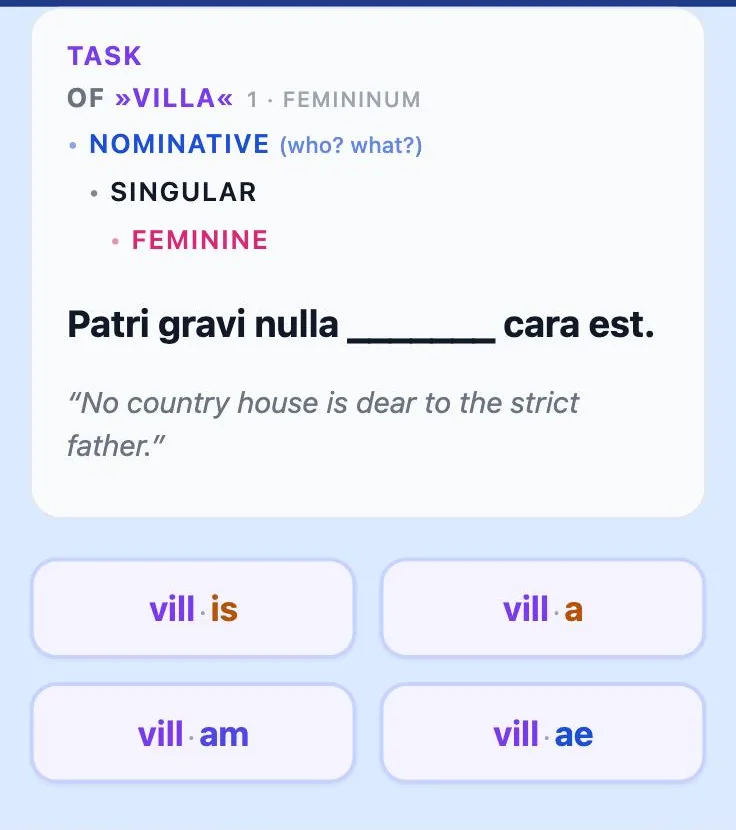
Try the forms trainer for free
No sign-up, in the browser or in the app: with the first declension and the verbs laudare and audire.
Learn Latin now. Our learning app:

Colours, stem and ending, audio and pen
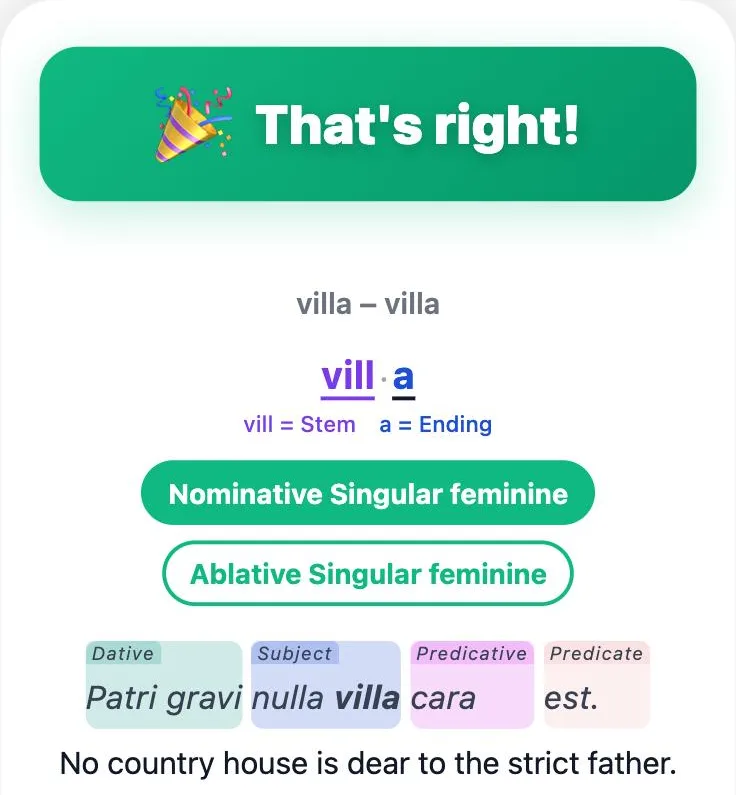
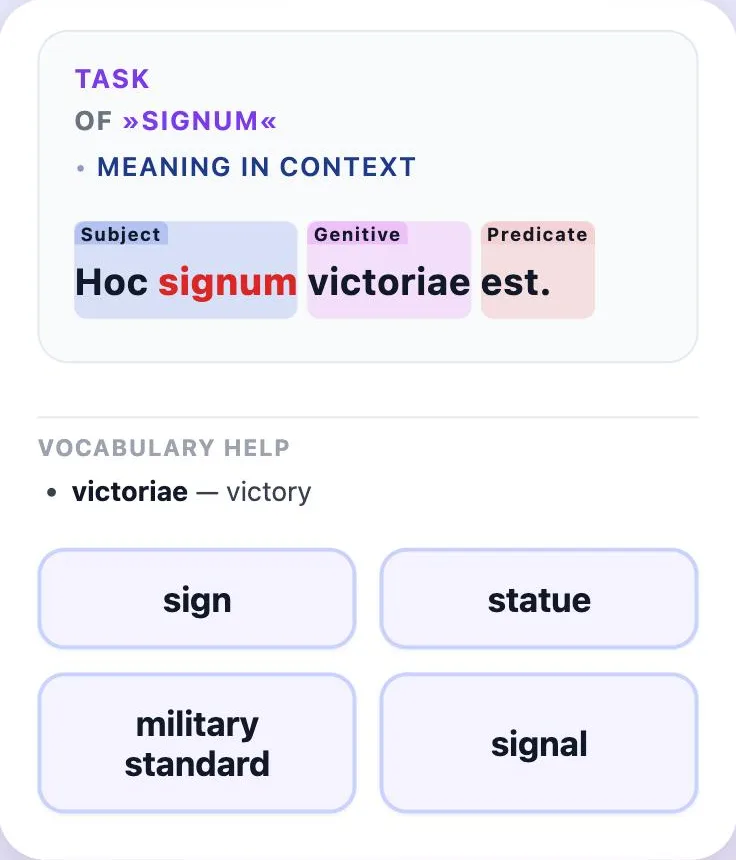
Colours and word breakdown. After every answer you see the form split into stem and ending, for verbs the tense sign as well. Every case has its colour. Below are all the readings that fit this ending, and the sentence with its sentence parts. With the “word analysis” switch the breakdown already shows in the task – for many learners with dyslexia this is exactly the help they need.
The whole paradigm. Under the result you see the table of the word. The form you were asked for is marked, and forms that look the same are highlighted – so you see where the risk of mixing them up lies.
Audio. With the full version you hear the form on the result card.
Pen. In the apps for iPhone, iPad and Android you can write endings and forms with a pen or your finger, on a wax tablet. Handwriting is recognised on your device, not on a server. The pen is part of the full version; in the web version you type.
Brick by brick. This is the building mode. You type every form yourself, and from one task to the next exactly one feature changes: first the person, then the number, then the tense, then the word. laudo becomes laudas, then laudatis, then laudabatis. Every correct form adds a brick to your wall, every wrong one takes one away.
Typical mistakes when learning Latin forms
- Reciting tables top to bottom. In a text, villis doesn’t come after villae – it comes on its own. Practise recognising a form without the row before it.
- Reading the ending without the stem. -is is dative or ablative plural in villis, but nominative or genitive singular in civis.
- Overlooking forms that look the same. villae has three readings, templa two. Settle on the first and you often translate wrongly.
- Missing the tense sign. laudant, laudabant, laudabunt: all the weight lies on -ba- and -bu-.
- Too many new words at once. Decline ten new words at the same time and you learn vocabulary instead of endings.
Explain, look up, practise – which page for what
Explain: how the five declensions work is in Latin declension, how verbs are built in Latin verbs. The overview of the whole grammar is the hub Learn Latin.
Look up: the fastest way to find a single form is the declension tool or the conjugation tool – free and without sign-up. All endings at a glance are in the Latin declension table and the Latin conjugation chart. Outside Lapicida, Wiktionary helps, for example the entries for villa and laudo.
Practise: that is the forms trainer. How to train verb forms in particular – understand, practise in isolation, then in the sentence – is shown in Practise Latin verb forms.
On to the sentence and the text: you practise the words themselves in the vocabulary trainer, the role of a word in the sentence in the sentence quiz, and real texts from our own reading texts to Caesar are listed in all readings at a glance. How to work through a whole text sentence by sentence is in Learn to translate Latin. More on word analysis and help for dyslexia is in Learning Latin with dyslexia, all settings in the forms trainer guide.
FAQ: Latin forms practice
What is the best way to practise Latin forms?
On a few common words, with every ending of each, always in a sentence. Add new words only once the current ones stick. First identify ready-made forms, in the end build them yourself.
Why does the forms trainer use so few words?
Because you are meant to learn the endings, not the words. On one word you see all forms of a declension; after that you can read any word of that declension. The words themselves are common – almost all are among the 1,000 most frequent words in Latin.
Does it follow my course?
Yes. You pick a course preset, and the forms trainer only shows the declensions, tenses and moods you have already covered. All sentences and exercises are written by Lapicida Latinus.
What is free?
Without a licence you practise nouns of the first declension and the verbs laudare and audire in the indicative active, present and perfect. The full version opens all six trainers, all declensions, tenses and moods, plus audio and – in the apps – the pen.
Can I practise Latin declensions and conjugations online?
Yes. In the browser you use the web version, and there are apps for iPhone, iPad, Mac and Android. The pen is only available in the apps.
Latin forms practice – start for free
Start without signing up with the first declension and the verbs laudare and audire – in the web version or in the app. The full version opens all six trainers, all tenses, audio and pen. All trainers at a glance are on the Latin app page.
Learn Latin now. Our learning app: