Latin Sentence Analyzer — Parse Sentences into Their Parts

A Latin sentence analyzer shows you what a sentence is made of: which parts it has and what role each word plays. Type a sentence and the analyzer breaks it into subject, predicate, objects, adverbials and more, colour-codes every part, and shows the dictionary form, parsing and meaning of each word. Ambiguous endings such as -ae or -is are flagged with a ? and explained. Below we show, with a question method, a table and worked examples, how to parse any Latin sentence with confidence.
What does it mean to parse a Latin sentence?
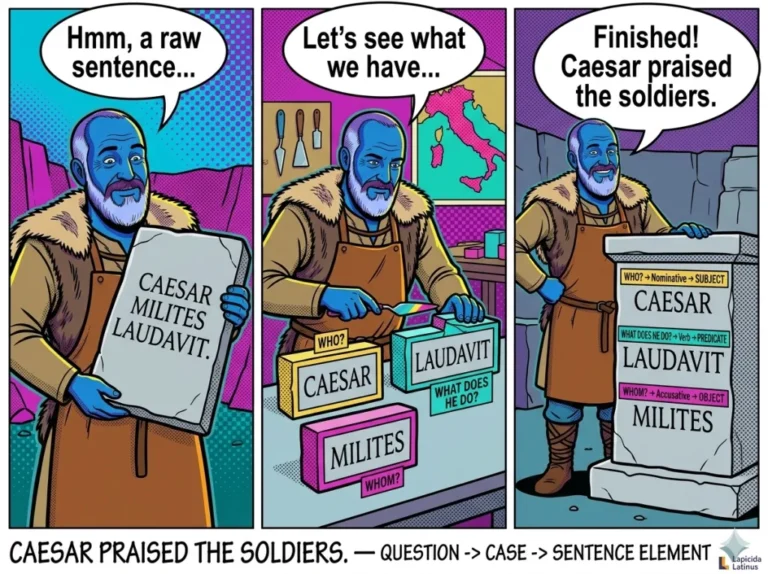
Parsing a sentence means recognising the role each word plays. In English word order usually shows that role; in Latin it is carried by the ending. The same word form can be subject, object or attribute depending on its case. Once you can spot the parts reliably, you can translate any sentence – even when the words seem scattered. That is why sentence analysis is the key to reading Latin. To review which case does which job, see our guide to Latin cases.
The parts of a Latin sentence — with the question method
Each part can be found with a fixed question, and usually goes with a specific case. This table is the heart of sentence analysis:
| Sentence part | Question | Case / form | Example |
|---|---|---|---|
| Subject | who? what? | nominative | puella – the girl |
| Predicate | what does X do / happen? | finite verb | dat – (he/she/it) gives |
| Accusative object | whom? what? | accusative | rosam – the rose |
| Dative object | to whom? | dative | poetae – to the poet |
| Genitive object | of what? whom? | genitive | meminit rerum – he recalls the events |
| Ablative object | with what? (only uti, frui …) | ablative | gladio utitur – he uses a sword |
| Adverbial | when? where? how? why? | bare ablative / adverb | nocte – at night; gladio – with a sword |
| Prepositional phrase | where? where to? with what? | preposition + case | in silva – in the wood; ad urbem – to the city |
| Attribute | which? whose? | agreeing / genitive | magna silva; rosa poetae |
| Predicative | as what? | agreeing (nom./acc.) | Caesar imperator; Iulia laeta |
| Participle | doing / done what? | participle (PC) | victus – defeated; currens – running |
| Ablative absolute | when? because? | noun + participle in abl. | hostibus victis – the enemy having been defeated |
How to analyze a Latin sentence — step by step
A reliable order, the same one the analyzer above follows:
- Find the predicate first. The verb is the anchor of the sentence; everything hangs off it. Note person, number, tense and voice.
- Identify the subject. Ask “who or what?” – the nominative word that agrees with the predicate. In Latin the subject is often already inside the verb ending.
- Place the objects. Accusative = whom/what, dative = to whom, genitive = whose. The verb’s valency helps decide which case does which job.
- Attach adverbials and attributes. Prepositional phrases, bare ablatives and genitive attributes answer how, where and whose.
- Check ambiguous endings. -ae, -is, -i fit several cases – only the sentence structure decides. This is exactly where the colour-coded analysis helps.
Learn Latin now. Our learning app:

Three sentences fully parsed
Here is the finished analysis of three sentences – every part colour-coded, with dictionary form and parsing. The colours match the tool above. Watch the ?: that marks an ambiguous ending, where only the sentence structure decides.
- Subject
- Predicate / predicative
- Accusative object
- Dative object
- Genitive
- Ablative object
- Adverbial
- Prepositional phrase
- Participle
- Ablative absolute
Puella poetae rosam dat.
- Puella — dictionary form puella, nominative sg (the girl)
- poetae — dictionary form poeta, -ae m., dative sg (to the poet)
- rosam — dictionary form rosa, accusative sg (the rose)
- dat — dictionary form dare, 3rd person sg present (he/she/it gives)
Translation: The girl gives the poet a rose.
Miles gladio hostem necat.
- Miles — dictionary form miles, nominative sg (the soldier)
- gladio — dictionary form gladius, ablative sg (with a sword)
- hostem — dictionary form hostis, accusative sg (the enemy)
- necat — dictionary form necare, 3rd person sg present (he/she/it kills)
Translation: The soldier kills the enemy with a sword.
Hostibus victis Caesar in castra rediit.
- Hostibus — dictionary form hostis, ablative pl (the enemy)
- victis — dictionary form vincere (victus), perfect passive participle, ablative pl (defeated)
- Caesar — dictionary form Caesar, nominative sg (Caesar)
- in — dictionary form in, preposition (into)
- castra — dictionary form castra, accusative pl (the camp)
- rediit — dictionary form redire, 3rd person sg perfect (he returned)
Translation: When the enemy had been defeated, Caesar returned to the camp.
The tricky cases — where analysis really helps
Most endings are unambiguous. The skill lies in the homographs – identically spelled forms that fit several cases. Here the ending does not decide; the verb’s valency and the sentence structure do.
Dative or genitive? The ending -ae
-ae is genitive singular, dative singular and nominative plural of the first declension. The same word poetae plays a different role in different sentences: in “puella poetae rosam dat” it is a dative object (“to the poet”), because dare governs the dative. In “rosa poetae” it is a genitive attribute (“the poet’s rose”), because it expresses possession and depends on a noun. The endings -i (e.g. domini = genitive sg or nominative pl) and -is behave the same way. Never trust the ending alone – check which verb governs and what makes sense.
Ablative of means or ablative object?
A bare ablative without a preposition is almost always an adverbial – the ablative of means (“with what?”, gladio necat), of time (“when?”, nocte), of manner, of cause and so on. A true ablative object exists only with the handful of verbs that actually govern the ablative: uti (use), frui (enjoy), fungi (perform), potiri (take possession of), vesci (feed on). So “gladio utitur” is an ablative object, while “gladio hostem necat” is an adverbial of means. Many tools blur this distinction – our analysis deliberately follows classroom grammar.
Hyperbaton: one part in two places
Normally what belongs together stands together. In poetry – above all in Vergil’s hexameter – it is different: hyperbaton deliberately splits words that form a single sentence part. An adjective and its noun then frame the verb, as in “magno … aestu” (“by a great surge”) wrapped around iactatur.
For the analysis this is decisive: magno and aestu are one part, not two – a single ablative phrase, here an adverbial. Parse the pieces separately and you tear the sense apart. In curated, annotated texts the tool recognises such split groups and marks both pieces as the same part. To parse verse safely, resolve the hyperbaton first and mentally push the words back together.
One reading, not every possibility
A dictionary happily lists every theoretically possible parse of a form: poetae “genitive sg, dative sg or nominative pl”. That is correct – but it leaves the real work to you. To translate, you do not need the list of all cases; you need the one reading that fits the sentence.
That is what the analyzer delivers: it commits to the parse that agrees with the predicate and the structure, and gives its reason. Only where the sentence genuinely stays ambiguous does it show a ? and list the alternatives openly. That combination – a clear decision, but honest at real doubt – is the difference between looking up and understanding.
Why colour-coded parts? Latin is systematic, not hard
Latin endings are often ambiguous: -ae can be genitive or dative singular or nominative plural; -is covers several cases. Such look-alikes make learning harder. Separating the parts visually and flagging ambiguous forms openly eases the memory load and makes translating safer – the same principle powers our declension tool and conjugation tool. Latin is not a “hard” language, just an unusually systematic one.
Frequently asked questions
How do I parse a part of a Latin sentence?
Ask for its role: who/what? (subject, nominative), whom/what? (accusative object), to whom? (dative object), whose? (genitive). Find the predicate, the verb, first, then the subject and objects. The ending reveals the case, and the analyzer above makes it visible automatically.
How do I tell whether an ending is dative or genitive?
The ending alone is not enough: -ae is dative, genitive and nominative plural at once. What decides is the verb valency and the sense. If the verb governs the dative (e.g. dare, dicere), it is a dative object. If the word expresses possession and depends on a noun, it is a genitive attribute.
When is an ablative an object and when an adverbial?
A bare ablative without a preposition is almost always an adverbial (with what, when, how). A true ablative object exists only with the verbs that govern the ablative: uti, frui, fungi, potiri, vesci. gladio utitur is an ablative object; gladio necat is an adverbial of means.
What is a hyperbaton?
A hyperbaton deliberately splits words that form one sentence part, above all in poetry. magno and aestu belong together even with a verb standing between them. For parsing they count as one part, not two.
What do I do with ambiguous endings?
Endings like -ae, -is or -i fit several cases. Then structure decides: which case agrees with the predicate and the other parts? The analyzer flags such spots with a question mark and explains the choice.
Is the sentence analyzer free?
Yes. Free and without sign-up you can analyze up to 10 sentences a day. For more, the full version offers unlimited analyses and the complete trainer.
You might also like our declension tool for nouns & adjectives, the conjugation tool for verbs, the overview of all Latin tools and our printable cheat sheets. To go deeper: Latin cases, the accusative and infinitive (AcI) and the ablative absolute. Questions? [email protected]
Learn Latin now. Our learning app: