Latin test tomorrow? How to use tonight

Latin test tomorrow, and it feels as if you haven’t understood a thing? You’re not alone – under every Latin explainer video there are comments like “I have my test tomorrow and I still don’t get it”. The good news: one evening won’t make up for half a year. But it is enough to secure the marks that are easiest to get. You don’t need a marathon, you need a plan.
Whether it’s a class test, a GCSE paper or a chapter quiz: the plan is the same, and it fits into 90 minutes of revision.
Latin test tomorrow – what should you do?
Latin test tomorrow: spend 10 minutes finding out what’s on it. Then three blocks of 25 minutes: the vocabulary of the chapter, the new forms and one practice sentence in five steps. After that, stop – sleep will help you more tomorrow than an extra hour of cramming.
What’s on your test?
Tick the grammar topics your test covers. For each one you get a free cheat sheet and an explanation – and, where learners often get it wrong, the most common mix-up with a short help.
Step 1 – Find out what’s on it (10 minutes)
Before you learn anything, write down on a piece of paper:
- Which chapters or stages? Usually the last one or two – in the Cambridge Latin Course the last stages, in Wheelock the last chapters.
- Which new grammar? Almost every test checks the topic you covered most recently – for example the perfect tense, participles or the ablative absolute.
- What does the test look like? Most Latin tests have a passage to translate and a question part (identify forms, grammar questions, sometimes questions on the story).
Not sure? Check your exercise book, your last homework or ask in the class chat. These 10 minutes are the most important of the evening: they stop you from spending two hours learning the wrong thing.
Step 2 – Three blocks of 25 minutes
Block 1: The vocabulary of the chapter
Vocabulary is the safest investment of the evening. If you know the words in the passage, you’re halfway there.
- Take only the vocabulary of the chapters being tested, not the whole word list.
- Cover and test yourself – don’t just read. What you “know” while reading you often can’t recall tomorrow. Sort into two piles: know it / don’t know it yet. Go through the second pile twice more.
- For verbs, learn the principal parts at the same time (capio, capere, cepi, captum) – you need them when translating.
Testing yourself is quicker in the Lapicida app: it quizzes the words and brings back the ones you don’t know yet.
Block 2: The new forms
The test almost always checks the forms that were new most recently. Learn them so that you recognise them, not just recite them:
- Write the table out once from memory and compare.
- Look for the markers: how do you recognise the imperfect (-ba-), the future (-bi- in the 1st and 2nd conjugation, otherwise -a-/-e-), the subjunctive (present -a-, in the 1st conjugation -e-; imperfect -re-; perfect -eri-; pluperfect -isse-)?
- Then practise the other way round: see a form → identify it (person, number, tense, mood, voice – or case, number, gender).
You’ll find the tables for free on our Latin cheat sheets. Look up any single form in the declension chart and the conjugation tool.
Block 3: One practice sentence in five steps
Take a sentence from the last chapter that you’ve already translated in class and translate it again – using the five steps below. Do this with two or three sentences and the method will work tomorrow on an unseen passage too.
The sentence analyzer breaks down any sentence for you; what the sentence parts are is explained in Latin sentence elements.
Translating in five steps
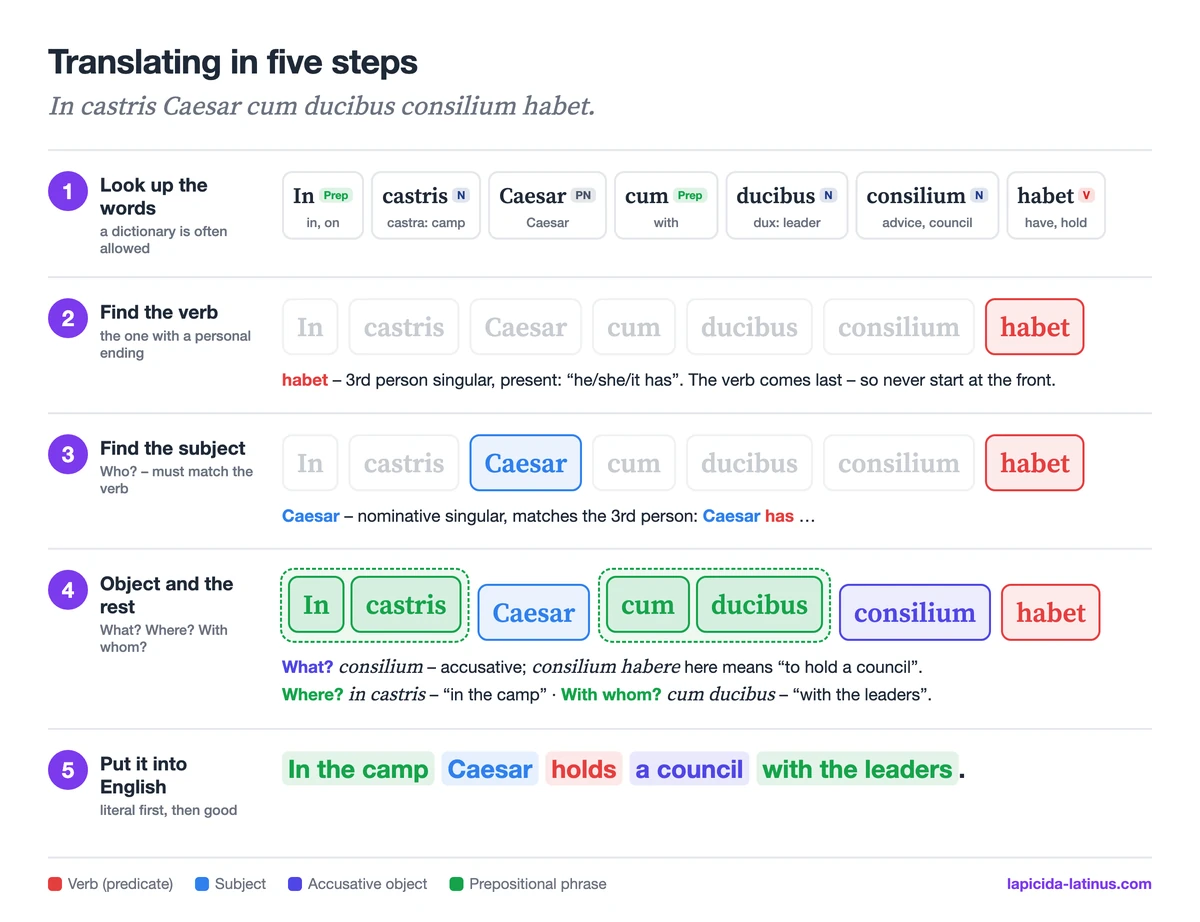
Using a sentence of the kind you might meet in your first or second year of Latin:
In castris Caesar cum ducibus consilium habet.
- Look up the words. Look up what you don’t know – in many tests you may use a dictionary or word list. castris comes from castra (“camp”, plural only), ducibus from dux (“leader”), habet from habere (“to have, to hold”).
- Find the verb. Which verb has a personal ending? habet – 3rd person singular, present: “he/she/it has”.
- Find the subject. Who is doing it? A nominative singular that matches the 3rd person: Caesar.
- Object and the rest. What does he have? consilium – accusative. consilium habere here means “to hold a council”, not “to have advice”. Then the rest: in castris – “in the camp” (where?), cum ducibus – “with the leaders” (with whom?).
- Put it into English – literal first, then good: “In the camp Caesar holds a council with the leaders.”
The most important point: don’t translate word by word from the front. Sort out the words first, then build the sentence from the verb. Latin likes to put the verb at the end – if you start at the front, you’re guessing.
Practise tonight instead of just reading
Vocabulary, the new forms, a few sentences with sentence parts: in Lapicida you practise all three in one go – free and without signing up.
Learn Latin now. Our learning app:

The most common mistakes in a Latin test
- Translating word by word from the front instead of sorting out the words first and then finding the verb.
- Guessing the case: -is can be dative or ablative plural – or genitive singular of the 3rd declension (urbis); -a can be nominative or ablative singular of the 1st declension or a neuter plural. Check the context first.
- Missing the tense: a perfect translated as a present costs a mark in almost every sentence.
- Taking the first meaning in the dictionary even though it makes no sense in the sentence.
- Forgetting agreement: an adjective belongs to the noun it agrees with in case, number and gender – not to the one next to it.
- Leaving sentences out instead of writing a literal translation. Even a clumsy translation earns marks.
- No time left to check at the end.
In the test itself
- Read the whole passage first. The title and introduction (usually in English) tell you what it’s about.
- Sentence by sentence with the five steps. If you get stuck on one, mark it and move on.
- Don’t forget the questions. Identifying forms and grammar questions are often the safest marks.
- Ten minutes to check: does every verb match its subject? Is the tense right? Does the English make sense?
And then: sleep
After the three blocks, stop. While you sleep, your brain consolidates what you learned in the evening (memory consolidation) – an extra hour awake will help you less tomorrow than an hour of sleep. Put your pens, dictionary (if allowed) and a water bottle out tonight, so there’s nothing to think about in the morning.
So it isn’t one evening next time
Once the test is over, start on the next chapter straight away, ten minutes a day – vocabulary and a few forms. Then you won’t be in emergency mode before the next test. How to learn Latin for the long run is in our guide to learning Latin.
FAQ: Latin test tomorrow
Is one evening enough to revise for a Latin test?
To catch up on everything, no. To secure the safe marks, yes: the vocabulary of the chapter, the new forms and the method for translating. If you practise these in a focused way for one evening, you usually do much better than without a plan.
Should I learn vocabulary or grammar first?
First find out what’s on the test, then vocabulary. Without the words, even the best grammar won’t help much with the passage. After that, the forms that were new most recently.
I don’t understand the new grammar at all – what now?
Learn the forms so that you recognise them, and practise two or three sentences from class with the five steps. A short explainer or our grammar page on the topic helps you understand it; recognising the forms is what earns marks in the test.
How do I translate a sentence I don’t understand?
First look up the words, then find the verb, then the subject, then the object and the rest, and finally put it into English. Write down a literal translation rather than nothing at all.
Should I stay up all night?
No. Sleep consolidates what you’ve learned. After 90 minutes of focused practice, stop – before a Latin test an hour of sleep helps you more than an extra hour of revision.
After the test is before the test
Ten minutes a day is enough to keep the next Latin test from becoming an emergency: vocabulary that comes back by itself, forms to identify and real sentences to translate. Start for free; the full version is $19.99 a year.
Learn Latin now. Our learning app: