Dyslexia in Latin Class — What Teachers and Parents Need to Know
Students with dyslexia face a paradoxical situation in Latin class: On the one hand, Latin is a language focused on reading, without the pressure to communicate orally—which suits many students with dyslexia. On the other hand, the traditional teaching approach (declension tables, alphabetical vocabulary lists, linear translation) places a systematic burden on students with dyslexia.
The difference lies not in the language—it lies in the method. The Lapicida Learning Methodology Overview summarizes which learning principles have been scientifically proven to help. This article is specifically aimed at teachers and parents: What can I change in the classroom? What resources are available? And how does Lapicida support preparation for tests?
What helps with dyslexia in Latin class?
Dyslexia and Latin Class: Color-coding by sentence component, sentence-based learning (instead of isolated tables), extra time on class tests, and digital tools with dyslexia support have been proven to help. Anne Friedrich (2017, Pegasus) and Katrin Sellin (BVL 2013) show that Latin is well-suited for students with dyslexia who think analytically—provided the right method is used. However, the traditional method of memorizing tables from charts causes long-term harm to students with dyslexia.
Why dyslexia poses special challenges in Latin class
According to Shöpping & Hulme (2012), dyslexia (ICD-10 F81.0) affects about 5–15% of all students. At its core is a weakness in phonological processing: the automated decoding of written characters is slower and requires a relatively large amount of energy. In Latin class, students with dyslexia encounter three specific pitfalls. Further background on the research: Federal Association for Dyslexia and Dyscalculia (BVL).
| Problem | Why it has a greater impact in cases of dyslexia | Solution |
|---|---|---|
| Similar endings (a-declension) | Ranschburg inhibition: similar items interfere with one another in memory. a, ae, ae, am, and are nearly identical. | Color coding: each case is assigned its own color |
| Isolated tables | Fragmented skills: Rules from the table can be recalled but cannot be applied in a sentence (Sellin 2013). | Sentence-based learning: Endings always in context |
| Linear translation from left to right | Students with dyslexia lose their train of thought because the sentence structure isn’t provided until the end. Maximum cognitive load. | Predicate-first strategy: Verb as an anchor |
Key phrase for teachers: “Dyslexia in Latin class is not an intelligence problem—it is a method problem.” Those who are aware of these three pitfalls can take targeted countermeasures.
Practical Methods for Teaching Latin to Students with Dyslexia
Anne Friedrich (2017) and Katrin Sellin (BVL 2013) recommend specific methods for teaching Latin to students with dyslexia that can be implemented in everyday classroom settings:
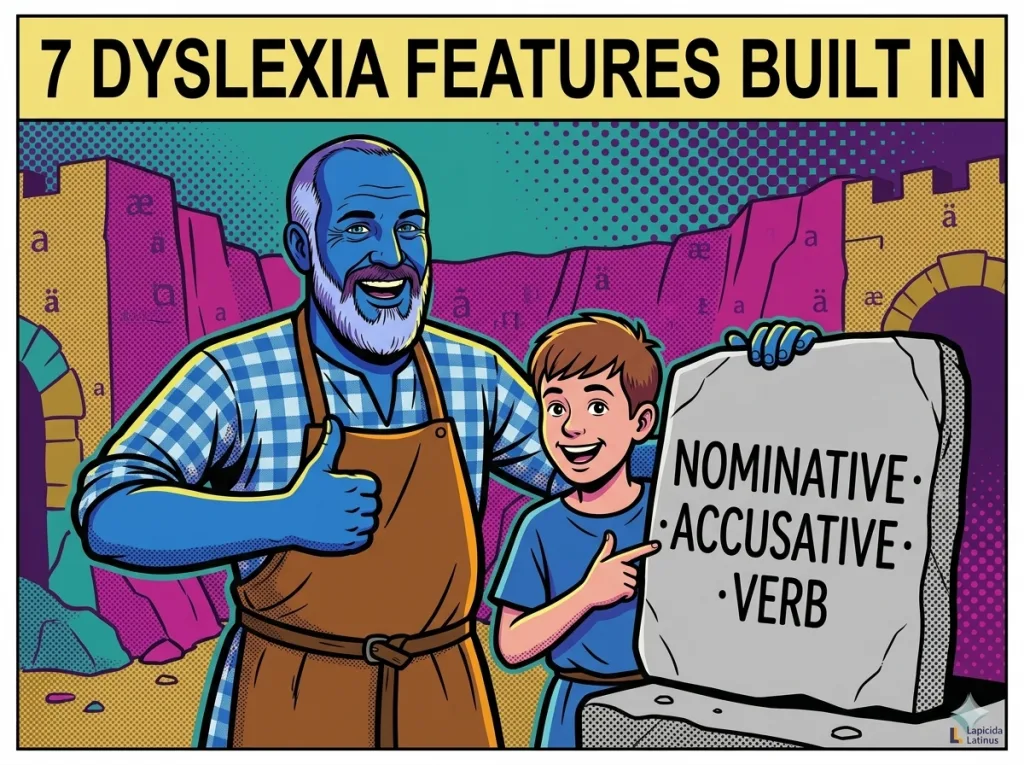
1. Introduce color coding. Each case is assigned a specific color—even in handwriting lessons. Subject (nominative) blue, object (accusative) indigo, dative orange. The brain processes colors in parallel with reading: The case is recognizable before the ending is fully decoded. Students with dyslexia benefit from this particularly—but so do all others.
2. Predicate first. In translation lessons, always identify the verb first: read the personal ending → note the person, number, and tense → then look for the subject and objects. This strategy breaks the linear flow of reading and immediately provides a stable anchor. Katrin Sellin explicitly identifies this as a core technique for students with dyslexia.
3. Font size and line spacing. All worksheets should be at least 12pt, with 1.5 line spacing. Prefer sans-serif fonts (Arial, Verdana). This significantly reduces visual crowding—letters and endings blur less.
4. Do not have students read aloud. Unsupported reading aloud in front of the class massively increases stress levels among students with dyslexia and reduces their willingness to learn. Alternatives: silent reading, partner work, individual oral exams.
5. Practice in sentences—not in lists. Memorizing vocabulary lists alphabetically is particularly ineffective for students with dyslexia (fragmented learning, no context). Better: Always introduce vocabulary within a sentence and practice it within a sentence. The meaning emerges from the context—this reduces the burden on working memory.
6. Praise even small progress. Students with dyslexia often have a history of learning marked by failure. According to Friedrich (2017), targeted positive feedback—even for partial achievements—is a learning lever in its own right.
Learn Latin now. Our learning app:

Digital Tools: Lapicida as a Classroom Resource
Lapicida Latinus is the only Latin learning app that directly integrates features specifically designed for students with dyslexia. For teachers, the Lapicida Latin app model offers a concrete digital supplement to classroom instruction.
| Lapicida Feature | Benefits in the Classroom |
|---|---|
| Color-coding by sentence component | Digitally supports the color-coding introduced in the classroom—consistent colors across all exercise modes |
| OpenDyslexic + Letter Spacing | Students with dyslexia can customize the font display |
| Sentence Quiz (3,100 original Latin sentences) | Trains the “predicate-first” strategy directly using the original text—14 syntax areas |
| Officina (Teacher Portal) | Learning profiles, progress tracking, confusion matrix, homework assignments with due dates |
| Fully offline | No Wi-Fi required — works in class even without internet access |
The Officina Teacher Portal is free for all teachers. It shows at a glance where students with dyslexia are struggling: Which cases are systematically confused? Which conjugation forms are still missing? This diagnostic tool enables targeted support—instead of guesswork. All methodological background information is available at lapicida-latinus.de/de/latein-lernen/.
More blog posts on this topic:






Frequently Asked Questions: Dyslexia in Latin Class
Is Latin suitable for students with dyslexia?
Yes—if the method is right. As a language focused on reading without the pressure of oral communication, Latin offers clear advantages for students with dyslexia. The phonetic spelling (a 1:1 correspondence between letters and sounds) eliminates one of the biggest hurdles for students with dyslexia. The only problem is the traditional rote memorization of tables—not the language itself.
As a teacher, am I allowed to provide accommodations?
Generally, yes—the exact regulations vary by state. Typical accommodations include: up to 50% extra time, shorter translation passages, and alternative exam formats (oral vocabulary tests). Important: Accommodations do not require an official diagnosis—an educational assessment by the teacher may suffice. Information on state regulations is available from the Federal Association for Dyslexia and Dyscalculia.
What is the difference between accommodations and grade protection?
Accommodations: same performance requirements, adjusted conditions (time, format, assistive devices) — no note on the report card. Grade protection: different grading criteria (e.g., spelling errors are not counted) — appears on the report card depending on the state. Both are legitimate and useful tools—they are not mutually exclusive.
How do I explain Ranschburg inhibition to students with dyslexia?
Explanation for students: “Your brain has trouble learning very similar things at the same time—that’s normal. That’s why we use colors as additional cues. Blue always indicates the subject, and indigo always indicates the object. The color helps your brain before it has to read the ending.”
What font size should I use for worksheets?
At least 12pt, preferably 14pt. Line spacing 1.5. Prefer sans-serif fonts (Arial, Verdana)—with serif fonts like Times New Roman, similar letters (i, l, 1) blur together more for students with dyslexia. Plenty of white space between the tasks helps with visual navigation.
How can I use Lapicida for free as a teacher?
The Officina teacher portal is included with the Officina teacher licence. Create classes, configure student profiles, view learning progress, assign reading as homework—all without a subscription. The class license (pricing on request) unlocks the full version for 25 students.
Lapicida for Your Class — Free Teacher Portal
Learn Latin now. Our learning app: