
Salve Regina in Latin — Text, Translation & Meaning
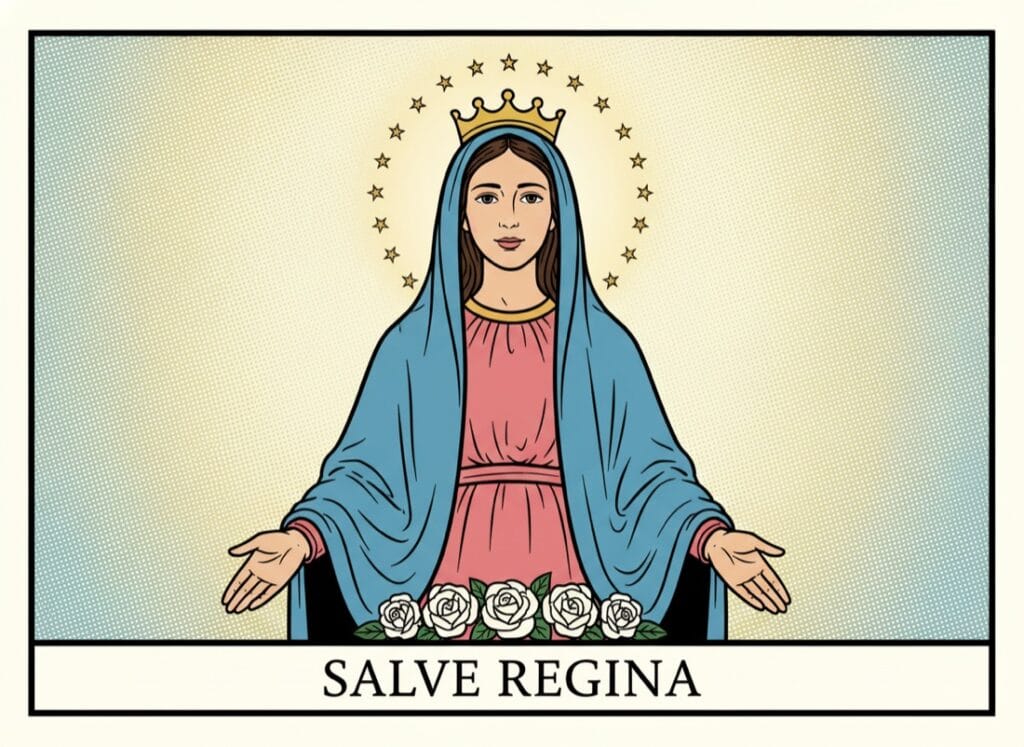
The Salve Regina (“Hail, Holy Queen”) is the best known of the four Marian antiphons — the great prayer to Mary that the Church in the Roman rite sings to close the day (Compline) from Trinity Sunday until Advent, and that concludes the Rosary.
On this page you will find the full Latin text, a line-by-line English translation, the meaning, the origin and a pronunciation note:
- the full Latin text of the Salve Regina
- the English translation, line by line
- meaning, origin (Breviarium Romanum) and ecclesiastical pronunciation
If you want not only to pray the Salve Regina but also to understand and read the Latin, you will find it as a reading in the Lapicida app — opened up word by word.
How does the Salve Regina go in Latin?
The Salve Regina begins with the words “Salve, Regina, mater misericordiae” — “Hail, Queen, Mother of mercy.” It is the traditional Marian antiphon from the Breviarium Romanum and ends with the three invocations “O clemens, o pia, o dulcis Virgo Maria” — “O clement, O loving, O sweet Virgin Mary.”
Salve Regina — Latin text with a line-by-line translation
Here is the full Salve Regina in its received liturgical form (Latin on the left, English on the right):
| Latin | English |
|---|---|
| Salve, Regina, mater misericordiae, | Hail, Queen, Mother of mercy, |
| vita, dulcedo, et spes nostra, salve. | our life, our sweetness, and our hope, hail. |
| Ad te clamamus, exsules filii Hevae. | To thee we cry, the banished children of Eve. |
| Ad te suspiramus, gementes et flentes in hac lacrimarum valle. | To thee we sigh, mourning and weeping in this valley of tears. |
| Eia, ergo, advocata nostra, illos tuos misericordes oculos ad nos converte. | Turn then, our advocate, thine eyes of mercy toward us. |
| Et Iesum, benedictum fructum ventris tui, nobis post hoc exsilium ostende. | And after this our exile show unto us Jesus, the blessed fruit of thy womb. |
| O clemens, O pia, O dulcis Virgo Maria. | O clement, O loving, O sweet Virgin Mary. |
Grammar note for learners: the address is in the vocative (Regina, advocata, Virgo Maria), the requests in the imperative (salve “hail,” converte “turn,” ostende “show”). Exsules filii Hevae is in apposition to the “we” — “we, the banished children of Eve.”
Meaning: the great prayer to Mary
The Salve Regina calls on Mary as Regina (Queen) and mater misericordiae (Mother of mercy). The one who prays sees himself as an exsul — an exile, a “child of Eve” in the earthly “valley of tears” — and asks Mary for her intercession (advocata nostra) and to show him Christ at the last. It is thus a prayer of longing and consolation; the three closing invocations o clemens, o pia, o dulcis are the best-known words of the whole text.
Learn Latin now. Our learning app:

How you read it in the app — word by word
In the Lapicida app the Salve Regina is set up as a reading: the full Latin text, every line opened up word by word — with vocabulary help, form analysis and translation. So you understand not only what you pray but also how the Latin is built. Open the reading in the app.
Origin and pronunciation
The Salve Regina arose in the High Middle Ages (11th century) and is traditionally associated with Hermann of Reichenau (Hermannus Contractus). It is one of the four Marian closing antiphons of Compline and stands as such in the Breviarium Romanum. Its solemn chant melody (tonus solemnis) is especially well known.
Pronunciation (Church Latin): c before e/i sounds like “ch” — dulcedo = “dul-CHÉ-do”; misericordiae keeps a hard c before o (“mi-se-ri-COR-di-ae”). The H in Hevae is silent (“É-vae”). In Classical Latin c is always “k” and ae is “ai.”
The Salve Regina concludes the Rosary in Latin; the other two core prayers are the Pater Noster and the Ave Maria.
Frequently asked — Salve Regina
What does Salve Regina mean in English?
Salve Regina means ‘Hail, Holy Queen’ (literally ‘Hail, Queen’). It is the opening of the best-known Marian antiphon and addresses Mary as Queen and Mother of mercy (mater misericordiae).
When is the Salve Regina prayed?
The Salve Regina is one of the four Marian closing antiphons of Compline and is sung in the Roman rite from Trinity Sunday until Advent. It also concludes the Rosary.
Where does the Salve Regina come from?
The Salve Regina arose in the 11th century and is traditionally associated with Hermann of Reichenau (Hermannus Contractus). It stands as a Marian antiphon in the Breviarium Romanum.
What does ‘O clemens, O pia, O dulcis Virgo Maria’ mean?
These three closing invocations mean ‘O clement, O loving, O sweet Virgin Mary’. They are the best-known part of the prayer and are sung solemnly.
Learn Latin now. Our learning app: