The Churer Model in Latin Class: Practicing Latin Independently
The Churer Model, developed by Swiss educator Reto Thöny, puts the student at the center: short guided sessions, independent study time, and the teacher acting as a coach rather than a lecturer. In Latin classes—with their high intensity of practice and diverse learning levels—this model proves particularly effective.
“School must be both a training camp and a place for human development.”
Hans Saner
What is the Churer Model, explained simply?
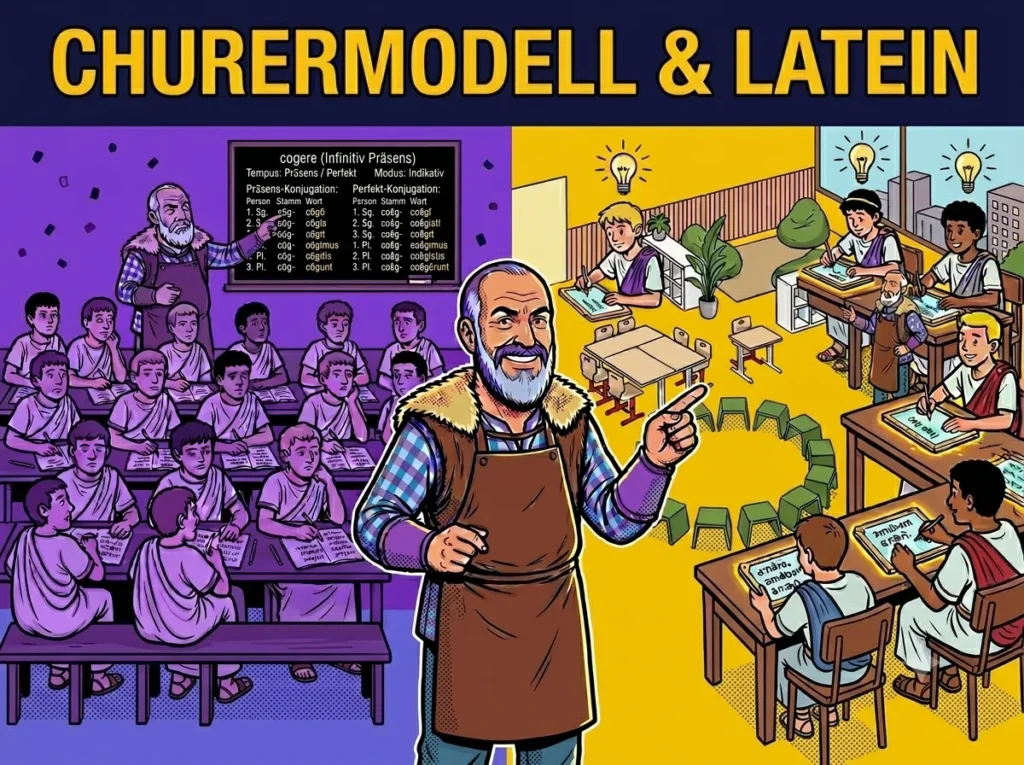
The Chur Model is a teaching concept developed by Swiss educator Reto Thöny. It combines short periods of group instruction with longer periods of independent work (EVA). The teacher acts as a coach and provides individualized guidance rather than delivering lecture-style instruction. Learn more on the official website: churermodell.ch.
| Principle | Description |
|---|---|
| Short Input Phases | New content is introduced concisely in a circle (max. 10–15 minutes) |
| EVA Phases | Introduction → Processing (independent work) → Evaluation |
| Internal differentiation | Differentiated tasks for different levels, without separating students by ability |
| The Classroom as an Educator | Various learning spaces in the classroom: individual work, group work, consultation table |
Why is Latin a particularly good fit for the Churer model?
Compared to other school subjects, Latin has a characteristic that fosters independent learning: there is no pressure to speak.
In English or Spanish class, students need an interaction partner to use the foreign language. In Latin class, they practice morphological analysis, identifying sentence components, and declension patterns—all activities that can be done excellently on their own and at their own pace.
- A student who hasn’t yet mastered the a-declension can review that specific topic during the EVA phase
- A student who can already analyze ACI constructions moves on during the same lesson
- The teacher no longer has to teach the “lowest common denominator”
- Heterogeneous learning levels—a reality in every classroom—become a strength rather than a problem
[Lapicida] aims to foster a sense of responsibility, provides confidence, creates learning success, and thus motivates students. It is precisely these kinds of tools—combined with learning with and from one another and reflecting on one’s own learning—that will transform instruction and ease the burden on teachers.
Reto Thöny, founder of the Chur Model
Jetzt Latein lernen. Unsere Lern-App:

EVA Phases in Latin Class: Here’s How It Works in Practice
A typical lesson in the Chur Model Latin class is divided into three phases—with the processing phase taking up the largest portion:
- Introduction (I) — 10 to 15 minutes: You explain a new grammar rule or answer questions from the last homework assignment. Concise, clear, and focused.
- Processing (V) — 25 to 30 minutes: Students practice independently. Those practicing verb forms use the app or worksheets. Those identifying sentence components work with authentic Latin texts. You walk around the classroom, providing individualized guidance.
- Evaluation (A) — 5 to 10 minutes: Group reflection: What was difficult? What patterns did you notice? A brief summary for everyone.
Practical tip for getting started: Begin with one EVA phase per week—and keep the rest of the lessons traditional. This reduces the effort required for implementation and gives you time to get to know the model.
Independent doesn’t mean alone
EVA phases are not a retreat into individual work—on the contrary: especially in differentiated instruction, learning thrives on collaboration and learning from one another. Students analyze forms with learning partners of their own choosing, explain constructions to one another, and benefit from different approaches to solving problems. The app handles the individual practice component—each student at their own pace, at their own stage—but it does not replace the learning community; rather, it feeds into it: In the concluding reflection phase, students pool their results, and the teacher facilitates further collective thinking. Or, in short, in the spirit of the Churer model: You have to learn on your own—but not alone.
Officina: In-Class Differentiation with Real-Time Data
The Churer Model relies on the teacher knowing, during the processing phase, who to address. That’s exactly what Officina—the teacher dashboard from Lapicida Latinus—provides:
- “Where to Help?” cards: 5 automatically generated scenarios—who is falling behind, who is inactive, where are the class-wide weak spots
- Confusion Table: Which forms and sentence elements are most frequently misidentified
- Inactivity Alert: Triggered automatically after 7 days without practice—you receive a notification before a learning gap develops
- Learning Profiles: 9th grade practices the a-declension + present tense; 11th grade covers all constructions up to ACI—configurable with a single click
The Teacher License (€19.99/year) includes the full Officina dashboard. → Learn more about Officina
Frequently Asked Questions About the Churer Model in Latin Class
What is the Churer Model, explained simply?
The Churer Model is a teaching concept developed by Reto Thöny (Switzerland). It combines short input phases with longer periods of independent work (EVA). Students work at their own pace, and the teacher provides individual coaching rather than lecturing.
Can the Churer Model work in Latin classes?
Yes—it works particularly well. Latin doesn’t require speaking, so practicing verb forms, identifying sentence components, and reviewing vocabulary are tasks that can be done excellently through independent work. Diverse learning levels become a strength rather than a problem.
What are EVA phases?
EVA stands for Introduction, Processing, and Evaluation. The teacher provides a brief introduction (E), after which students work independently (V), followed by a group evaluation (A). The processing phase is the core: here, students practice at their own pace.
What is internal differentiation?
Internal differentiation means that students with different learning levels work on tasks at their respective levels in the same classroom—without being separated into different groups. In Latin class: Student A reviews declensions, while Student B practices ACI.
How long does an EVA phase last?
Typically: 15–25 minutes for the processing phase. Short, highly focused sessions are more effective than long blocks of practice. Apps like Lapicida are optimized for exactly this time frame—with clear progress indicators and automatically increasing difficulty.
How much does the teacher license with Officina cost?
The teacher license costs €19.99/year and includes the full Officina dashboard. Students purchase their own license (also €19.99/year) and join using a join code. A class license is available for schools.
Self-directed Latin learning—try it now
Jetzt Latein lernen. Unsere Lern-App: