Latin Conjugation Tool & Chart — Conjugate Verbs in All Tenses
Enter a verb and choose tense, mood and active/passive – the tool shows all six persons, singular and plural side by side. Each form is split into stem · tense/mood marker · personal ending and colour-coded, so you see how it is built. Below you will also find every conjugation as a chart.
What is conjugation?
Conjugation means a verb changes its form according to person (1st/2nd/3rd), number (singular/plural), tense, mood (indicative, subjunctive, imperative) and voice (active or passive). The ending tells you who acts, when and how – where English needs a helper verb, Latin packs it all into the single verb form.
The five conjugations
There are five conjugation classes, told apart by the infinitive: 1st (a-conjugation, -are: laudare), 2nd (e-conjugation, long -ēre: monere), 3rd (consonant, short -ere: mittere), the mixed 3rd in -io (capere) and the 4th (i-conjugation, -ire: audire). This is why verbs are learned with their principal parts, e.g. laudo, laudare, laudavi, laudatum.
The three stems
From the principal parts you get three stems that carry all the tenses: the present stem (from the infinitive – present, imperfect, future I), the perfect stem (from the 3rd principal part without -i, e.g. laudav- – perfect, pluperfect and future II in the active) and the participial stem (from the 4th principal part without -um/-us, e.g. laudat- – forms the perfect passive with esse and the participles).
The six tenses and their markers
On the present stem you build the present (laudo), the imperfect with the marker -ba- (laudabam) – in the 3rd, 4th and -io conjugation it is -eba- (mittebam, audiebam, capiebam) – and the future I (1st/2nd conjugation with -b-: laudabo; 3rd/4th with -a-/-e-: mittam, audiam). On the perfect stem you build the perfect (laudavi), the pluperfect with -era- (laudaveram) and the future II with -eri- (laudavero). The present subjunctive takes the marker -e- (1st conj.: laudem) or -a- (the others: mittam); the imperfect subjunctive is simply the infinitive + personal ending (laudarem) – a rule that even works for irregular verbs (essem, vellem).
Active and passive
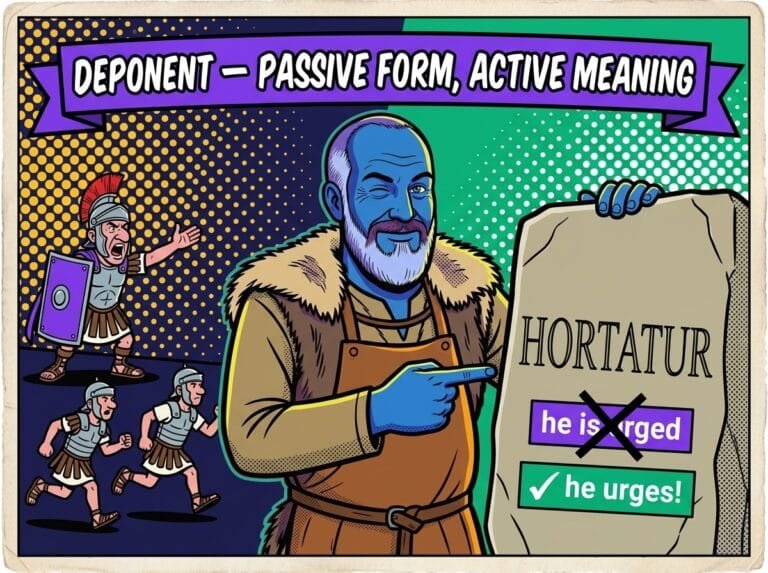
In the present system the passive is formed synthetically, with its own endings -r, -ris, -tur, -mur, -mini, -ntur (laudor, laudaris …). In the perfect system the passive is periphrastic: PPP + a form of esse. ⚠️ laudatus sum can express two things: the action – “I was praised” / “I have been praised” – or, when the resulting state is meant, “I am praised”. Context decides which reading applies. A small group, the deponents (e.g. sequi “to follow”), has only passive forms but active meaning.
Indicative, subjunctive, imperative
- Indicative – the factual mood: something actually happens.
- Subjunctive – possibility, wish, exhortation; often rendered with “may, could, should”.
- Imperative – the command, only in the 2nd person (lauda! “praise!”, laudate! “praise (pl.)!”).
Why colour stem · tense · person? Latin is systematic
A Latin verb form is a building set: stem + tense/mood marker + personal ending (laud·aba·mus). Once you see the three blocks, you don’t memorise blindly – you understand the form. That is exactly what this tool makes visible – Latin is not a “hard” language, but an unusually systematic one.
Learn Latin now. Our learning app:

The conjugations in the present
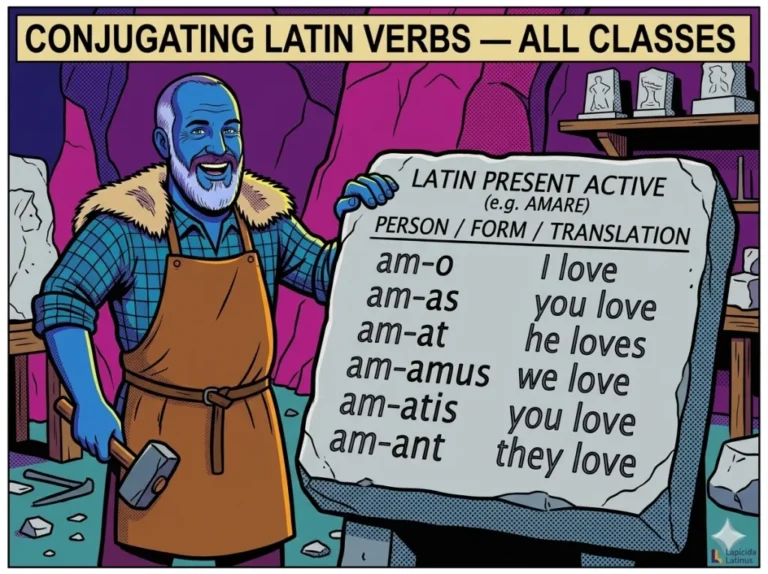
One model verb per conjugation, present indicative active – for reference:
| Person | Singular | Plural |
|---|---|---|
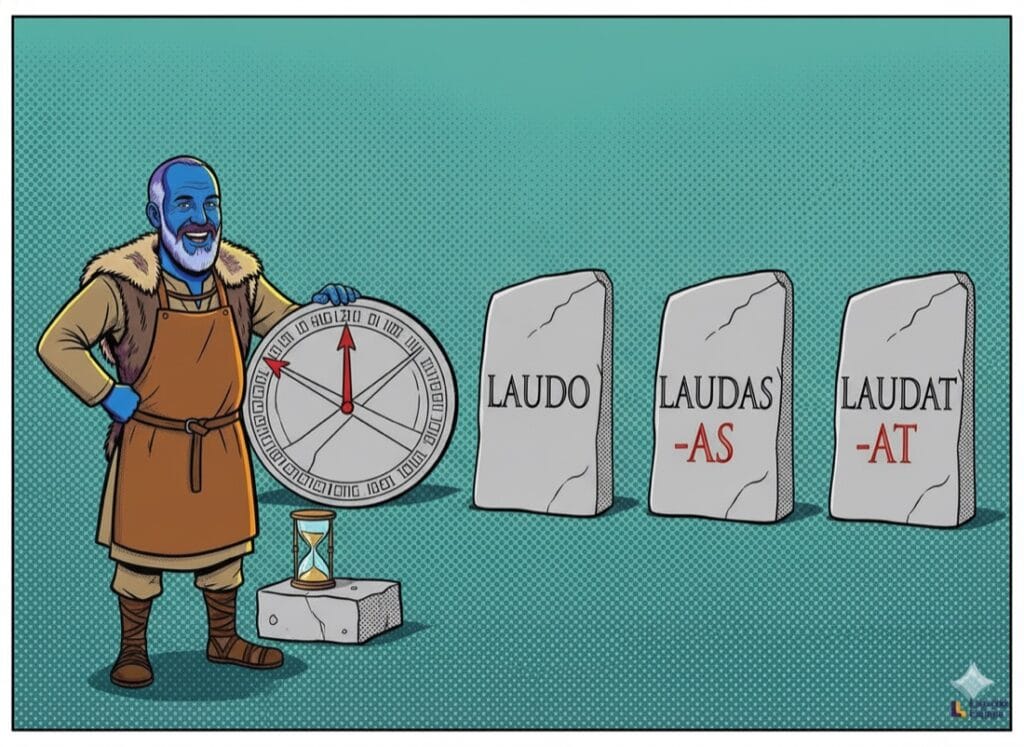
| 1st person | laudo | laudamus |
| 2nd person | laudas | laudatis |
| 3rd person | laudat | laudant |
| Person | Singular | Plural |
|---|---|---|
| 1st person | moneo | monemus |
| 2nd person | mones | monetis |
| 3rd person | monet | monent |
| Person | Singular | Plural |
|---|---|---|
| 1st person | mitto | mittimus |
| 2nd person | mittis | mittitis |
| 3rd person | mittit | mittunt |
| Person | Singular | Plural |
|---|---|---|
| 1st person | capio | capimus |
| 2nd person | capis | capitis |
| 3rd person | capit | capiunt |
| Person | Singular | Plural |
|---|---|---|
| 1st person | audio | audimus |
| 2nd person | audis | auditis |
| 3rd person | audit | audiunt |
| Person | Singular | Plural |
|---|---|---|
| 1st person | sum | sumus |
| 2nd person | es | estis |
| 3rd person | est | sunt |
One verb through all tenses
Here is laudare through all six tenses (indicative active):
| Person | Present | Imperfect | Future I | Perfect | Pluperfect | Future II |
|---|---|---|---|---|---|---|
| 1st sg. | laudo | laudabam | laudabo | laudavi | laudaveram | laudavero |
| 2nd sg. | laudas | laudabas | laudabis | laudavisti | laudaveras | laudaveris |
| 3rd sg. | laudat | laudabat | laudabit | laudavit | laudaverat | laudaverit |
| 1st pl. | laudamus | laudabamus | laudabimus | laudavimus | laudaveramus | laudaverimus |
| 2nd pl. | laudatis | laudabatis | laudabitis | laudavistis | laudaveratis | laudaveritis |
| 3rd pl. | laudant | laudabant | laudabunt | laudaverunt | laudaverant | laudaverint |
Conjugating deponent verbs and fieri
Deponent verbs have only passive forms but an active meaning. You learn them from the 1st person singular present (e.g. hortor “I urge") and the perfect (hortatus sum “I have urged"). A special case is fieri (“to become, happen"): it serves as the passive of facere, yet has active forms in the present (fio, fis, fit) and factus sum in the perfect.
| Person | Singular | Plural |
|---|---|---|
| 1st person | hortor | hortamur |
| 2nd person | hortaris | hortamini |
| 3rd person | hortatur | hortantur |
| Person | Singular | Plural |
|---|---|---|
| 1st person | sequor | sequimur |
| 2nd person | sequeris | sequimini |
| 3rd person | sequitur | sequuntur |
| Person | Singular | Plural |
|---|---|---|
| 1st person | utor | utimur |
| 2nd person | uteris | utimini |
| 3rd person | utitur | utuntur |
| Person | Singular | Plural |
|---|---|---|
| 1st person | patior | patimur |
| 2nd person | pateris | patimini |
| 3rd person | patitur | patiuntur |
| Person | Singular | Plural |
|---|---|---|
| 1st person | morior | morimur |
| 2nd person | moreris | morimini |
| 3rd person | moritur | moriuntur |
| Person | Singular | Plural |
|---|---|---|
| 1st person | nascor | nascimur |
| 2nd person | nasceris | nascimini |
| 3rd person | nascitur | nascuntur |
| Person | Singular | Plural |
|---|---|---|
| 1st person | fio | fimus |
| 2nd person | fis | fitis |
| 3rd person | fit | fiunt |
| Headword (1st sg. pres.) | Infinitive | Perfect (1st sg.) | Meaning |
|---|---|---|---|
| hortor | hortari | hortatus sum | to urge, encourage |
| sequor | sequi | secutus sum | to follow |
| utor | uti | usus sum | to use (+ abl.) |
| patior | pati | passus sum | to suffer, endure, allow |
| morior | mori | mortuus sum | to die |
| nascor | nasci | natus sum | to be born |
| fio | fieri | factus sum | to become, be made, happen |
Frequently asked questions
How do you conjugate a Latin verb?
Determine the conjugation (from the infinitive), build the present, perfect and PPP stems from the principal parts, and add the tense/mood marker and the personal ending. The tool above does this for every tense, mood and for active/passive automatically.
How do I recognise the conjugation?
From the infinitive: -are (1st), long -ēre (2nd), short -ere (3rd), -ere with 1st person in -io (3rd in -io), -ire (4th). That is why verbs are learned with their principal parts.
Are irregular verbs included?
Yes. Verbs such as esse, posse, ire, velle and ferre and their compounds are fully stored and shown correctly.
You might also like our Latin declension tool, the Roman numeral converter and our printable cheat sheets.
Learn Latin now. Our learning app: