
Latin Numbers — Cardinal Numbers, Ordinal Numbers, and Roman Numerals
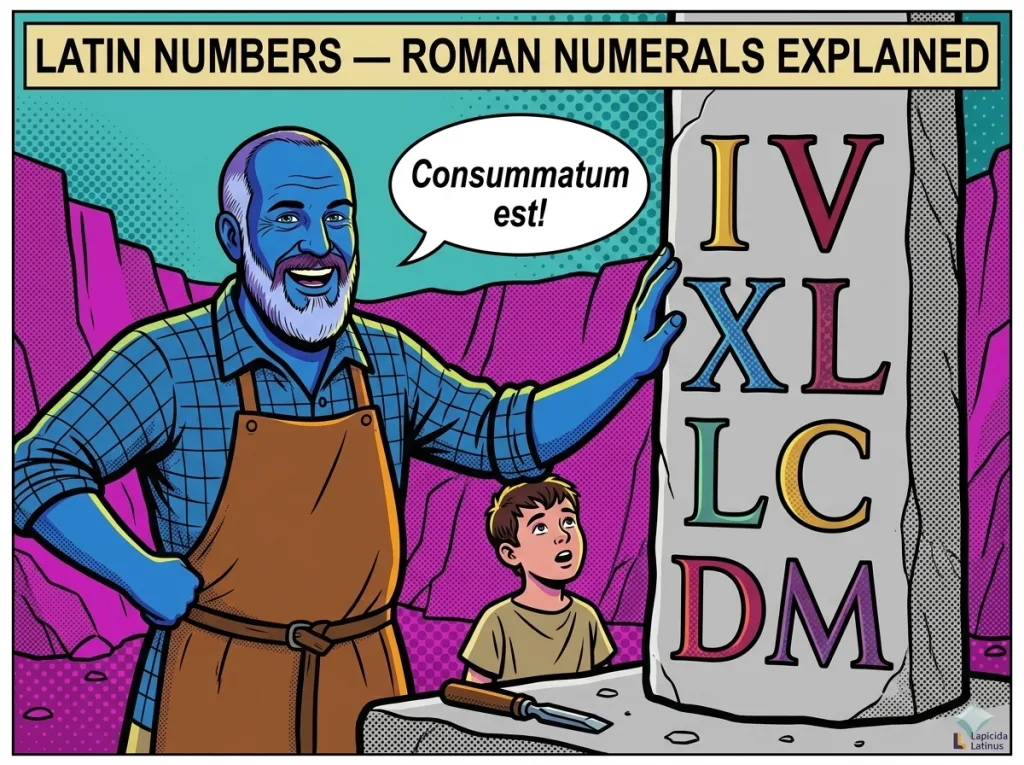
Whether in Latin class, when translating ancient texts, or on inscriptions—Latin numerals are everywhere. This reference gives you all the important Latin numbers at a glance: cardinal numbers (1–1,000), ordinal numbers (the first, the second…), and Roman numerals with explanations.
- Latin cardinal numbers 1–1000 with pronunciation
- Ordinal numbers (primus, secundus, tertius…)
- Roman numerals — table and calculation rules
- Common Mistakes with Latin Numbers

What are the numbers in Latin? (1–10)
| Number | Latin (cardinal) | Pronunciation | Ordinal |
|---|---|---|---|
| 1 | unus, una, unum | u-nus | primus, -a, -um |
| 2 | duo, duae, duo | du-o | secundus / alter |
| 3 | tres, tria | trěs | tertius |
| 4 | quattuor | kwat-tu-or | quartus |
| 5 | quinque | kwin-kwe | quintus |
| 6 | sex | seks | sextus |
| 7 | septem | sep-tem | septimus |
| 8 | octo | ok-to | octavus |
| 9 | novem | no-wem | nonus |
| 10 | decem | de-kem | decimus |
Latin Cardinal Numbers 11–1000
| Number | Latin | Number | Latin |
|---|---|---|---|
| 11 | undecim | 20 | viginti |
| 12 | duodecim | 30 | triginta |
| 13 | tredecim | 40 | quadraginta |
| 14 | quattuordecim | 50 | quinquaginta |
| 15 | quindecim | 60 | sexaginta |
| 16 | sedecim | 70 | septuaginta |
| 17 | septendecim | 80 | octoginta |
| 18 | duodeviginti | 90 | nonaginta |
| 19 | undeviginti | 100 | centum |
| — | — | 1000 | mille |
Compound numbers: In Latin, the larger number comes first: viginti et unus (21) or unus et viginti (both are possible). The use of “et” is optional.

Latin ordinal numbers — the first, the second…
Ordinal numbers indicate sequence (the first, the second, the third). They are declined like normal adjectives of the a/o-declension (primus, prima, primum = like magnus, magna, magnum). In class, they appear in dates, ranks, and lists.
| Number | Ordinal number (m) | Ordinal number (f) | Ordinal number (n) |
|---|---|---|---|
| 1. | prīmus | prīma | prīmum |
| 2. | secundus | secunda | secundum |
| 3. | tertius | tertia | tertium |
| 4. | quārtus | quārta | quārtum |
| 5. | quīntus | quīnta | quīntum |
| 6. | sextus | sexta | sextum |
| 7. | septimus | septima | septimum |
| 8. | octāvus | octava | octavum |
| 9. | nōnus | nona | nōnum |
| 10. | decimus | decima | decimum |
| 20. | vīcēsimus | vīcēsima | vīcēsimum |
| 100. | centēsimus | centēsima | centēsimum |
Example: Iulia prima puella in classe est. (Julia is the first girl in the class.) — prima agrees with puella (nom. sing. f.).
Declension of unus, duo, and tres
The numbers 1–3 and the thousands (milia) are declined. 4–100 and mille (1,000) are invariable. Special cases:
unus (1) is declined as a pronominal adjective: genitive ūnīus, dative ūnī — for all three genders.
| Case | Masculine | Feminine | Neuter |
|---|---|---|---|
| Nom. | ūnus | ūna | ūnum |
| Gen. | ūnīus | ūnīus | ūnīus |
| Dat. | ūnī | ūnī | ūnī |
| Acc. | ūnum | ūnam | ūnum |
| Abl. | ūnō | ūnā | ūnō |
duo (2) has its own archaic declension pattern: Nom. duō (m/n), duae (f) — Gen. duōrum/duārum — Dat./Abl. duōbus/duābus — Acc. duō/duōs (m), duās (f), duō (n).
tres (3) is declined according to the i-declension: Nom./Acc. trēs (m/f), tria (n) — Gen. trium — Dat./Abl. tribus.
Distributive numbers (singulī, bīnī, ternī…) indicate distribution: “one each,” “two each,” “three each.” Required for Pluralia tantum: bīna castra = two camps (not duo castra, since castra exists only in the plural).
Roman numerals — Table and rules for calculation
| Roman | Value | Roman | Value |
|---|---|---|---|
| I | 1 | L | 50 |
| V | 5 | C | 100 |
| X | 10 | D | 500 |
| — | — | M | 1000 |
Basic Rules:
- Addition: Symbols to the right that are the same or smaller are added: VIII = 8, XII = 12
- Subtraction: The smaller symbol to the left of the larger one is subtracted: IV = 4, IX = 9, XL = 40, XC = 90, CD = 400, CM = 900
- Repetition: A symbol may appear no more than three times in a row: III = 3 (not IIII)
- Cannot be subtracted: V, L, and D are never subtracted (no VX, LC, or DM)
Examples: MMXXVI = 2026 | MCMXCIX = 1999 | XLII = 42 | MDCCCLXXXVIII = 1888 (the longest four-digit year)
Learn Latin now. Our learning app:

Common mistakes with Latin numbers
- unus, una, unum are declined: These are the only numbers that are declined in Latin (1–3). unus is treated like a pronoun (genitive: unius, dative: uni).
- duo vs. duae: duo for masculine/neuter, duae for feminine. A common mistake involves gender assignment.
- mille vs. milia: mille (1,000) is indeclinable. The plural milia, on the other hand, is declinable: tria milia militum = 3,000 soldiers.
- Subtraction with Roman numerals: Only I before V and X, X before L and C, C before D and M—do not combine them arbitrarily.
More blog posts on this topic:






Frequently Asked Questions — Latin Numbers
How do you write 2026 in Latin?
As a Roman numeral: MMXXVI. As a numeral phrase: duo milia viginti sex.
Are Roman numerals inflected?
Only the numbers 1–3 and the thousands (milia) are declined. 4–100 and mille (1,000) are indeclinable.
What is the difference between cardinal and ordinal numbers?
Cardinal numbers indicate quantity: tres milites (three soldiers). Ordinal numbers indicate order: tertius miles (the third soldier). Ordinal numbers are declined like normal adjectives of the a/o declension.
What are the ordinal numbers in Latin?
The ordinal numbers 1–10 are: prīmus, secundus, tertius, quārtus, quīntus, sextus, septimus, octāvus, nōnus, decimus. They are declined like adjectives of the a/o declension.
Why is “unus” declined differently?
Unus (and the other pronominal adjectives such as solus, nullus, totus) take the ending -īus in the genitive singular and -ī in the dative for all three genders—unlike normal adjectives of the a/o declension.
Learn Latin — the systematic way
Learn Latin now. Our learning app: