Catholic Prayers in Latin — Text, Translation & Pronunciation

The great Catholic prayers in Latin are the shared inheritance of the Roman rite — the Pater Noster, the Ave Maria, the Gloria Patri, the Credo and the chants of the Mass. This page brings them together: for each prayer you will find the full Latin text, a line-by-line English translation, the meaning and a pronunciation note.
And you can do more than read them: in the Lapicida app each prayer is a graded Latin reading, opened up word by word — so you understand not only what you pray but how the Latin is built.
What are the main Catholic prayers in Latin?
The core Catholic prayers in Latin are the Pater Noster (Our Father), the Ave Maria (Hail Mary), the Gloria Patri (Glory Be), the Salve Regina (Hail Holy Queen), the Credo (Nicene Creed), the Agnus Dei (Lamb of God), the Te Deum and the Requiem aeternam. Together they form the prayers of the Rosary and the chants of the traditional Latin Mass.
The Catholic prayers in Latin — one by one
The prayers of the Rosary
- Pater Noster — the Our Father, the prayer the Lord himself taught (Matthew 6).
- Ave Maria — the Hail Mary, the great prayer to the Mother of God.
- Gloria Patri — the Glory Be, the little doxology to the Holy Trinity.
- Salve Regina — the Hail Holy Queen, which closes the Rosary.
The chants of the Mass
- Credo — the Nicene Creed, the profession of faith (“Credo in unum Deum”).
- Agnus Dei — the Lamb of God, sung at the breaking of the bread.
Hymns and the Mass for the Dead
- Te Deum — the great hymn of praise and thanksgiving.
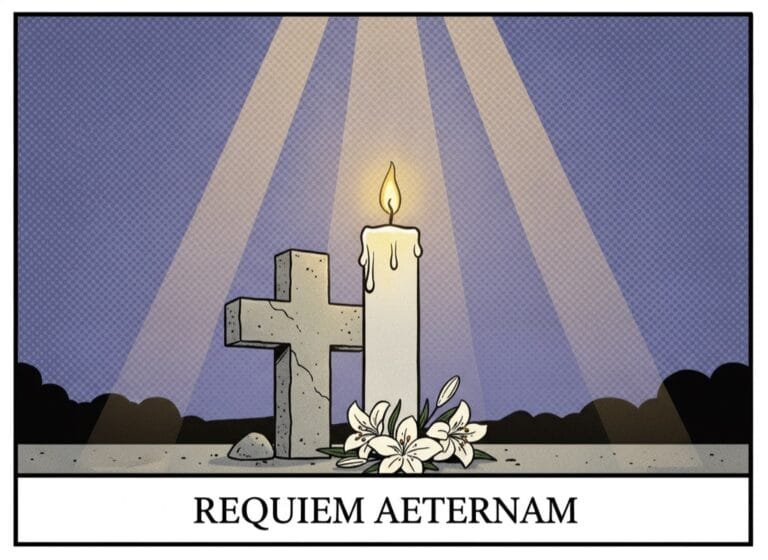
- Requiem aeternam — the Introit of the Requiem Mass, the prayer for the dead.
How the prayers fit together
The Rosary weaves three of these prayers together: each decade opens with one Pater Noster, followed by ten Ave Marias and a Gloria Patri, and the whole Rosary closes with the Salve Regina. The Latin Mass gathers the others: the Credo is professed after the Gospel, and the Agnus Dei is sung before Communion. The Te Deum crowns moments of thanksgiving, and the Requiem aeternam opens the Mass for the Dead.
Learn Latin now. Our learning app:

Read the prayers in the app — word by word
Every prayer above is set up in the Lapicida app as a graded Latin reading: the full traditional text, each line opened up word by word — with vocabulary help, form analysis and translation, from a gentle entry stage up to the unchanged original. It is the easiest way to move from praying the Latin to truly reading it. Start reading in the app.
Praying in Latin: a note on pronunciation
These prayers are prayed in Church (ecclesiastical) Latin, the Italianate pronunciation of the Roman rite. The main rules: c before e/i/ae/oe sounds like “ch” (caeli = “CHEH-lee”); g before those vowels is soft “j”; ti before a vowel is “tsee” (gratia = “GRAH-tsee-ah”); gn is “ny” (Agnus = “AH-nyoos”). Classical Latin differs — there c is always “k” and ae is “ai.”
Frequently asked — Catholic prayers in Latin
What are the main Catholic prayers in Latin?
The Pater Noster (Our Father), Ave Maria (Hail Mary), Gloria Patri (Glory Be), Salve Regina (Hail Holy Queen), Credo (Nicene Creed), Agnus Dei (Lamb of God), Te Deum and Requiem aeternam. Together they form the Rosary and the chants of the traditional Latin Mass.
What prayers are in the Latin Rosary?
Each decade of the Rosary uses the Pater Noster, ten Ave Marias and the Gloria Patri; the whole Rosary closes with the Salve Regina. All four are on this page with full Latin text and translation.
Can I learn to read these Latin prayers, not just recite them?
Yes. In the Lapicida app each prayer is a graded reading, opened up word by word with vocabulary and grammar help, so you can move from reciting the Latin to actually reading and understanding it.
Learn Latin now. Our learning app:
Pater Noster · Ave Maria · Gloria Patri · Salve Regina · Credo · Agnus Dei · Te Deum · Requiem aeternam · The Vulgate · Learn Latin