Latin Prepositions — Accusative, Ablative and in/sub

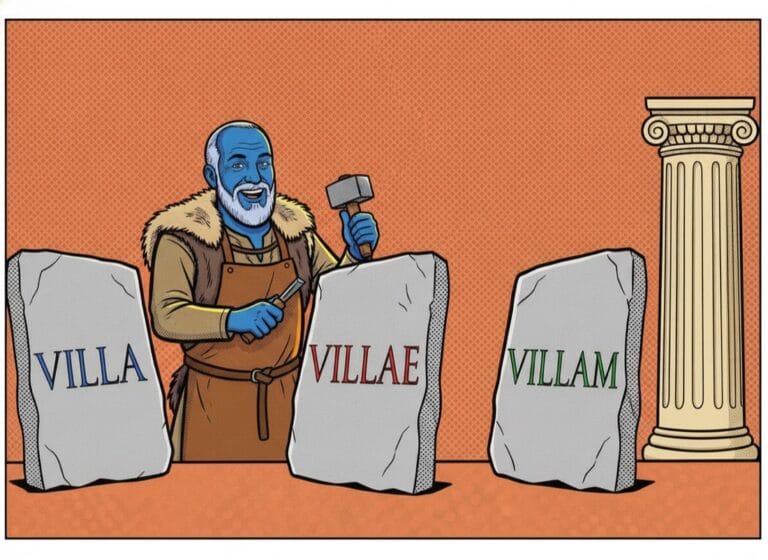
in urbem or in urbe? With Latin prepositions, a single letter decides whether someone is going into the city or already there. The good news: almost every preposition has one fixed case. Only two switch – and this article shows them in a single sentence.
- which prepositions take the accusative, which the ablative
- in and sub: where to? or where?
- the two traps ex urbe and apud amicum
- what a prepositional phrase does in the sentence

Which Latin prepositions take the accusative and which the ablative?
Accusative: ad, ante, apud, circum, contrā, inter, ob, per, post, propter, trāns. Ablative: ā/ab, ē/ex, dē, cum, sine, prō, prae. Only in and sub take both: accusative for where to?, ablative for where?. Marcus in urbem it – he goes into the city. Marcus in urbe est – he is in the city.
Prepositions with the accusative
Eleven prepositions always take the accusative – whether someone moves or stays put:
| Preposition | Meaning | Example |
|---|---|---|
| ad | to, towards, at | ad urbem – to the city |
| ante | before, in front of | ante urbem – in front of the city |
| apud | at, near, at the house of | apud amīcum – at the friend’s |
| circum | around | circum urbem – around the city |
| contrā | against | contrā hostēs – against the enemy |
| inter | between, among | inter amīcōs – among friends |
| ob | because of | ob eam rem – for that reason |
| per | through | per urbem – through the city |
| post | after, behind | post urbem – behind the city |
| propter | because of | propter perīculum – because of the danger |
| trāns | across | trāns flūmen – across the river |
Prepositions with the ablative
Seven prepositions always take the ablative:
| Preposition | Meaning | Example |
|---|---|---|
| ā / ab | from, away from | ab urbe – from the city |
| ē / ex | out of | ex urbe – out of the city |
| dē | down from, about | dē mūrō – down from the wall |
| cum | with | cum amīcō – with the friend |
| sine | without | sine amīcō – without the friend |
| prō | in front of, for | prō urbe – for the city |
| prae | before | prae sē – in front of oneself |
ā and ē usually come before consonants, ab and ex before vowels. And cum is not always a preposition: followed by a verb instead of a noun in the ablative, it introduces a clause – see cum clauses.
Practise prepositions in whole sentences
In the Sentence Quiz you mark prepositional phrases in real sentences – in the area “Prepositional phrases”. Lapicida shows you at once whether preposition and case match.
Learn Latin now. Our learning app:

in and sub: where to? or where?
Only these two prepositions switch case. The question decides – and in the sentence only the ending changes:
| one sentence, changed | question | case |
|---|---|---|
| Marcus in urbem it. – Marcus goes into the city. | where to? | accusative |
| Marcus in urbe est. – Marcus is in the city. | where? | ablative |
| Marcus sub mūrum it. – Marcus goes under the wall. | where to? | accusative |
| Marcus sub mūrō est. – Marcus is under the wall. | where? | ablative |
Rule: every preposition has its own case. Only in and sub switch: where to? = accusative, where? = ablative.
The two traps: ex urbe and apud amīcum
Apply “movement = accusative, place = ablative” to every preposition and you get two wrong:
| one sentence, changed | question | case |
|---|---|---|
| Marcus ex urbe venit. – Marcus comes out of the city. | where from? (movement) | still ablative |
| Marcus apud amīcum est. – Marcus is at the friend’s. | where? (place) | still accusative |
ex always takes the ablative, apud always the accusative. “where to? or where?” only matters for in and sub.
The prepositional phrase in the sentence
Preposition and noun together form a prepositional phrase – in the sentence it is an adverbial: it tells where, where to, where from, with whom or when something happens. It is not an object, even with the accusative. More on all sentence elements: Latin sentence elements.
Without a preposition the ablative can do the same job – gladiō pugnat, he fights with a sword. The kinds are explained in Latin cases. The UK National Archives have a clear prepositions resource as well.
Frequently asked questions
Which Latin prepositions take the ablative?
ā/ab, ē/ex, dē, cum, sine, prō and prae – always. Plus in and sub when they answer the question where?
Which Latin prepositions take the accusative?
ad, ante, apud, circum, contrā, inter, ob, per, post, propter and trāns – always. Plus in and sub when they answer the question where to?
When does in take the accusative and when the ablative?
For where to? the accusative (in urbem – into the city), for where? the ablative (in urbe – in the city). The same goes for sub.
Does “movement = accusative” work for every preposition?
No, only for in and sub. ex urbe (out of the city) is movement and still ablative; apud amīcum (at the friend’s) is a place and still accusative.
All prepositions at a glance
All 18 prepositions, in and sub and the two traps on one A6 card: get the prepositions cheat sheet free as a PDF.
Learn Latin now. Our learning app: