Adeste Fideles — Latin Lyrics with English Translation and Meaning
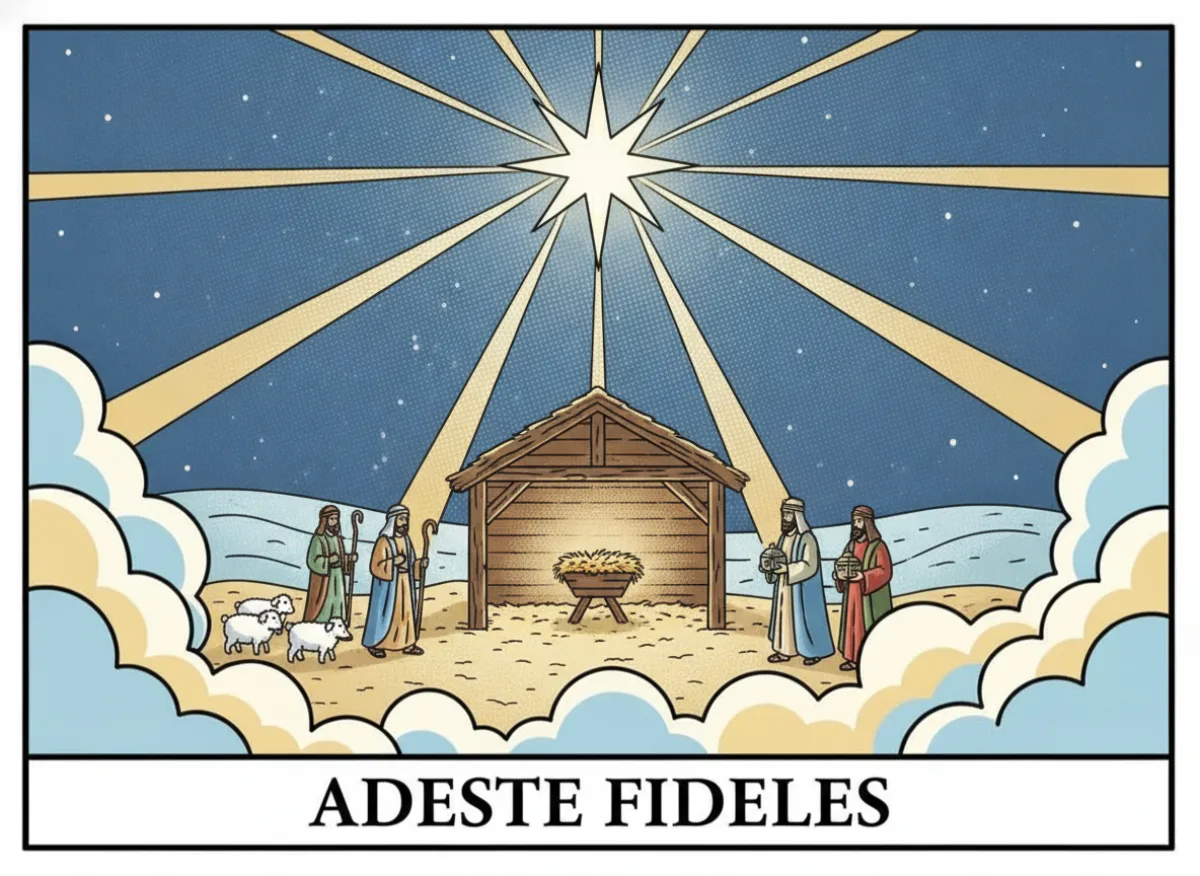
Adeste Fideles is the Latin original of “O Come, All Ye Faithful”, one of the best-loved Christmas carols in the world. Choirs still sing it in Latin, and many people know the first verse by heart without knowing exactly what the words say.
Here are the Adeste Fideles lyrics in Latin and English, translated literally, line by line:
- every Latin verse with a literal English translation (not the singing version)
- why there are two sets of verses, and which one your hymnal uses
- the grammar behind adeste, venite adoremus and natum, plus the pronunciation
What does “Adeste Fideles” mean?
Adeste Fideles means “Be present, ye faithful” or simply “Come, ye faithful”. The first verse calls all believers to Bethlehem: Adeste fideles, laeti triumphantes, venite, venite in Bethlehem – “Come, faithful ones, joyful and triumphant, come, come to Bethlehem.” The refrain Venite adoremus Dominum means “Come, let us adore the Lord.”
Adeste Fideles lyrics in Latin and English
The first verse is the same in every version. After each verse comes the refrain Venite adoremus, sung three times.
| Latin | English (literal) |
|---|---|
| 1 Adeste fideles, laeti triumphantes, | Be present, faithful ones, joyful and triumphant, |
| venite, venite in Bethlehem. | come, come to Bethlehem. |
| Natum videte | See the one who is born, |
| Regem angelorum. | the King of angels. |
| Venite adoremus, venite adoremus, | Come, let us adore, come, let us adore, |
| venite adoremus Dominum. | come, let us adore the Lord. |
Verses 2–4 by John Francis Wade (the English tradition)
These are the verses of the oldest manuscripts. Frederick Oakeley’s “O Come, All Ye Faithful” (1841) is a singing version of them – compare “God of God, Light of Light” and “Sing, choirs of angels”.
| Latin | English (literal) |
|---|---|
| 2 Deum de Deo, lumen de lumine, | God from God, light from light – |
| gestant puellae viscera, | a maiden’s womb carries him, |
| Deum verum, genitum non factum. | true God, begotten, not made. |
| 3 Cantet nunc io chorus angelorum, | Now let the choir of angels sing “io!”, |
| cantet nunc aula caelestium: | now let the court of heaven sing: |
| Gloria in excelsis Deo! | Glory to God in the highest! |
| 4 Ergo qui natus die hodierna, | So to you, who are born this day, |
| Iesu, tibi sit gloria, | Jesus, to you be glory, |
| Patris aeterni Verbum caro factum. | Word of the eternal Father, made flesh. |
Verses 2–4 of the French tradition
These three verses carry on the Christmas story: the shepherds, the child in swaddling clothes, the manger. English hymnals sometimes add them as “See how the shepherds” and “Child, for us sinners”.
| Latin | English (literal) |
|---|---|
| 2 En grege relicto, humiles ad cunas | Look, their flock left behind, to the lowly cradle |
| vocati pastores approperant. | the shepherds, called, hurry near. |
| Et nos ovanti gradu festinemus. | Let us too hasten with joyful step. |
| 3 Aeterni Parentis splendorem aeternum | The eternal splendour of the eternal Father |
| velatum sub carne videbimus, | we shall see veiled in flesh, |
| Deum infantem, pannis involutum. | God as an infant, wrapped in swaddling clothes. |
| 4 Pro nobis egenum et faeno cubantem | Him who is poor for us and lies on hay |
| piis foveamus amplexibus. | let us cherish with loving embraces. |
| Sic nos amantem quis non redamaret? | Who would not love in return the one who loves us so? |
The rare verse of the Magi
An eighth verse by an unknown author is rarely printed:
| Latin | English (literal) |
|---|---|
| Stella duce, Magi Christum adorantes, | Led by the star, the Magi, worshipping Christ, |
| aurum, tus et myrrham dant munera. | give gold, frankincense and myrrh as gifts. |
| Iesu infanti corda praebeamus. | Let us offer our hearts to the infant Jesus. |
Two lines may sound familiar: Deum de Deo, lumen de lumine … genitum non factum comes word for word from the Nicene Creed in Latin, and Gloria in excelsis Deo is what the angels sing in the Christmas story in Latin (Luke 2:14).
Who wrote Adeste Fideles – and why are there two versions?
The oldest manuscripts come from John Francis Wade (1711–1786), an English Catholic who lived in exile in Douai, France, and earned his living copying music. He included the hymn in his collection Cantus Diversi in 1751; an undated copy may be older (around 1743). Whether Wade wrote the words or only copied them is still unknown – earlier attributions to St Bonaventure or King John IV of Portugal have no evidence behind them.
In France, three different verses soon appeared. They are often credited to the Abbé Étienne-Jean-François Borderies, but that is not certain. All seven verses were first printed together in Paris in 1827. Hymnals still follow one line or the other:
| English tradition (Wade) | French tradition | |
|---|---|---|
| Verses 2–4 | Deum de Deo · Cantet nunc io · Ergo qui natus | En grege relicto · Aeterni Parentis · Pro nobis egenum |
| Content | Creed, choir of angels, greeting the child | Shepherds, God veiled in flesh, love for the child |
| In English | “O Come, All Ye Faithful” (Frederick Oakeley, 1841) | partly translated by William Thomas Brooke |
| In German | “Herbei, o ihr Gläub’gen” (Protestant hymnal) | “Nun freut euch, ihr Christen” (Catholic hymnal) |
The English carol is a singing version, not a translation: it has to fit the tune. That is why Adeste fideles becomes “O come, all ye faithful” and gestant puellae viscera (“a maiden’s womb carries him”) becomes “Lo, he abhors not the Virgin’s womb”.
A popular theory reads the hymn as a coded Jacobite song for the exiled Stuarts: Regem angelorum (“King of angels”) would hint at Regem Anglorum (“King of the English”). There is no proof for it. More on the history is on Wikipedia.
Understand the Latin, don’t just sing along
In Lapicida you read real Latin texts, opened up word by word, including passages from the Vulgate. The Latin readings in the app show the form and meaning of every word, and the forms trainer lets you practise verb forms like adoremus and videbimus.
Learn Latin now. Our learning app:

Adeste Fideles grammar and pronunciation
The hymn is a small grammar lesson. Almost every line commands, wishes or invites – and Latin has its own forms for that:
| Word in the hymn | Form | How to translate it |
|---|---|---|
| adeste, venite, videte | imperative plural of adesse, venire, videre | “be present, come, see” |
| adoremus, festinemus, foveamus | present subjunctive, 1st person plural (hortatory) | “let us adore / hasten / cherish” |
| cantet, sit | present subjunctive, 3rd person singular (jussive, wish) | “let him sing”, “be” |
| natum | participle of nasci (deponent), used as a noun | “the one who is born” |
| laeti triumphantes | adjective + present participle, describing the subject | “joyful and triumphant” |
| grege relicto | ablative absolute | “their flock having been left behind” |
| stella duce | ablative absolute without a participle | “with the star as leader” |
| videbimus | future of videre | “we shall see” |
| quis non redamaret? | imperfect subjunctive in a rhetorical question | “who would not love in return?” |
Three things are worth a second look. First, “in Bethlehem”: in with the accusative means “into, to”, but the place name does not change its ending. Second, natum: nasci (“to be born”) is a deponent verb – passive in form, so the participle natus simply means “born”. Third, the wishes: how you translate the subjunctive in a main clause depends on the person – “let us …” in the first person, “let him …” or “may … be” in the third. Grege relicto and stella duce are textbook examples of the ablative absolute.
How do you pronounce Adeste Fideles?
Choirs sing it in Ecclesiastical (Church) Latin, which follows Italian sounds (see our guide to Latin pronunciation):
| Latin | Church Latin | Rule |
|---|---|---|
| adeste fideles | ah-DESS-teh fee-DAY-lehs | stress on the second-to-last syllable when it is long |
| laeti | LAY-tee | ae sounds like the “e” in “bed” or “ay” |
| Regem angelorum | RAY-jem ahn-jeh-LOH-room | g before e or i sounds like “j” |
| caelestium | cheh-LESS-tsee-oom | c before e/i is “ch”, ti before a vowel is “tsee” |
| in excelsis | in ek-SHELL-sees | xc before e sounds like “ksh” |
| Iesu | YAY-soo | initial i before a vowel sounds like “y” |
In Classical Latin it sounds different: c and g are always hard (“kye-LESS-tee-oom”, “REH-gem”) and ae sounds like “eye”.
Frequently asked questions about Adeste Fideles
What does “Adeste Fideles” mean in English?
“Adeste Fideles” means “Be present, ye faithful” or “Come, ye faithful”. “Adeste” is the plural imperative of “adesse” (to be present, to come near); “fideles” means “faithful ones”.
What does “Venite adoremus Dominum” mean?
It means “Come, let us adore the Lord”. “Venite” is an imperative, “adoremus” a present subjunctive that invites everyone to act together.
Is “O Come, All Ye Faithful” a literal translation of Adeste Fideles?
No. Frederick Oakeley’s 1841 version is written to be sung, so it keeps the sense but not every word. For example, “gestant puellae viscera” literally means “a maiden’s womb carries him”.
Who wrote Adeste Fideles?
The oldest manuscripts are by John Francis Wade, who wrote the hymn down in 1751. Whether he composed the words himself is not known. Further verses were added later in France.
How many verses does Adeste Fideles have?
There are eight Latin verses: the shared first verse, three by Wade, three from the French tradition and a rare verse about the Magi. Most choirs sing four.
How do you pronounce Adeste Fideles?
In Church Latin: “ah-DESS-teh fee-DAY-lehs”. “Regem angelorum” sounds like “RAY-jem ahn-jeh-LOH-room”, because g before e and i is pronounced like “j”.
Read Latin texts yourself
Carol, prayer or Bible verse: with Lapicida you learn to read Latin yourself. For Advent, try Veni, Veni, Emmanuel, the Latin hymn behind “O Come, O Come, Emmanuel”.
Learn Latin now. Our learning app: