The Christmas Story in Latin — Luke 2, Text & Translation
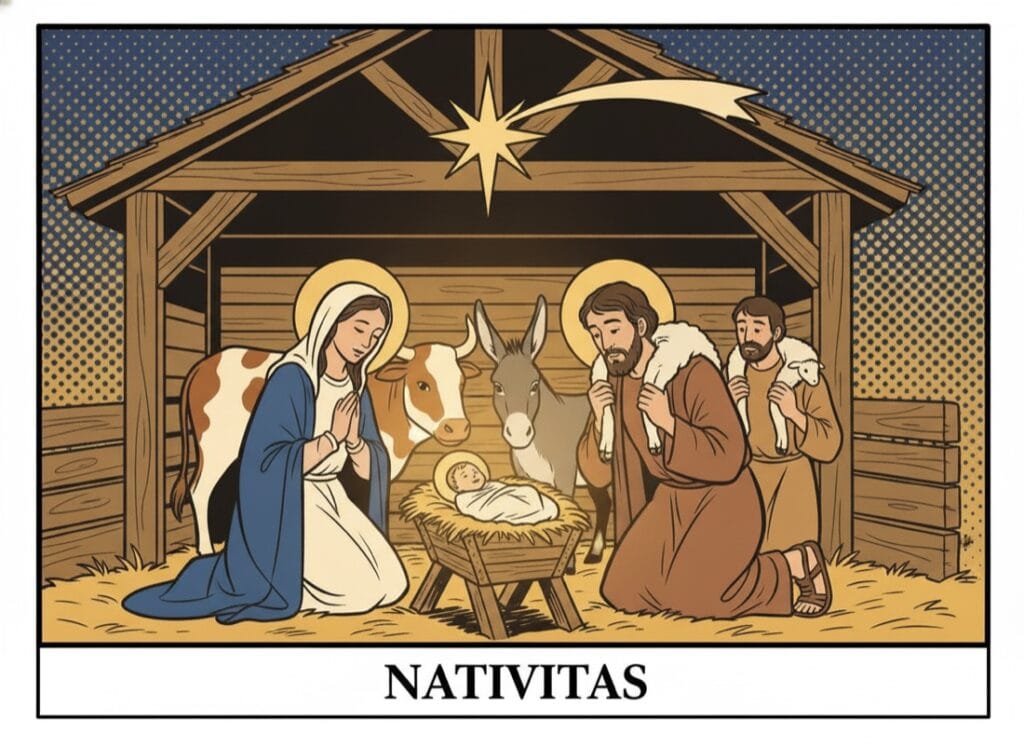
The Christmas story in Latin — the Nativity from the Gospel of Luke 2 in the Vulgate: the census of Augustus, the birth in Bethlehem, the shepherds and the angels’ song “Gloria in altissimis Deo.” It is one of the most familiar passages of the Bible, here in its original Latin.
On this page you will find the full Latin text, a line-by-line English translation, the meaning, the origin and a pronunciation note:
- the full Latin text of the Christmas story (Luke 2)
- the English translation, line by line
- meaning, origin (the Vulgate) and pronunciation
If you want not only to read the Christmas story but also to understand and translate the Latin, you will find it as a graded reading in the Lapicida app — opened up word by word.
How does the Christmas story go in Latin?
The Christmas story in Latin begins “Factum est autem in diebus illis exiit edictum a Caesare Augusto” (“And it came to pass in those days that a decree went out from Caesar Augustus”) and reaches its heart in the angels’ song, “Gloria in altissimis Deo, et in terra pax hominibus bonae voluntatis.”
The Christmas story (Luke 2) — Latin text with a line-by-line translation
Here is the Christmas Gospel, Luke 2:1–20, in the Latin of the Vulgate (Latin on the left, English on the right):
| Latin | English |
|---|---|
| Factum est autem in diebus illis exiit edictum a Caesare Augusto ut describeretur universus orbis. | And it came to pass in those days that a decree went out from Caesar Augustus that the whole world should be enrolled. |
| Haec descriptio prima facta est a praeside Syriae Cyrino. | This first census was made when Cyrinus was governor of Syria. |
| Et ibant omnes ut profiterentur, singuli in suam civitatem. | And all went to be enrolled, each into his own city. |
| Ascendit autem et Ioseph a Galilaea de civitate Nazareth in Iudaeam, in civitatem David, quae vocatur Bethlehem, eo quod esset de domo et familia David, ut profiteretur cum Maria desponsata sibi, uxore praegnante. | And Joseph also went up from Galilee, out of the city of Nazareth, into Judea, to the city of David, which is called Bethlehem, because he was of the house and family of David, to be enrolled with Mary his betrothed wife, who was with child. |
| Factum est autem cum essent ibi, impleti sunt dies ut pareret, et peperit filium suum primogenitum et pannis eum involvit et reclinavit eum in praesepio, quia non erat eis locus in diversorio. | And it came to pass, while they were there, the days were fulfilled that she should be delivered; and she brought forth her firstborn son, and wrapped him in swaddling clothes, and laid him in a manger, because there was no room for them in the inn. |
| Et pastores erant in regione eadem vigilantes et custodientes vigilias noctis super gregem suum. | And there were in the same country shepherds keeping watch and guarding the night watches over their flock. |
| Et ecce angelus Domini stetit iuxta illos, et claritas Dei circumfulsit illos, et timuerunt timore magno. | And behold, an angel of the Lord stood by them, and the glory of God shone around them, and they were struck with great fear. |
| Et dixit illis angelus: Nolite timere; ecce enim evangelizo vobis gaudium magnum, quod erit omni populo, | And the angel said to them: Do not be afraid; for behold, I bring you good news of great joy, which will be for all the people, |
| quia natus est vobis hodie Salvator, qui est Christus Dominus in civitate David. | for to you is born this day a Saviour, who is Christ the Lord, in the city of David. |
| Et hoc vobis signum: | And this shall be a sign to you: |
| invenietis infantem pannis involutum et positum in praesepio. | you will find a baby wrapped in swaddling clothes and lying in a manger. |
| Et subito facta est cum angelo multitudo militiae caelestis laudantium Deum et dicentium: | And suddenly there was with the angel a multitude of the heavenly host, praising God and saying: |
| Gloria in altissimis Deo, et in terra pax hominibus bonae voluntatis. | Glory to God in the highest, and on earth peace to men of good will. |
| Et factum est ut discesserunt ab eis angeli in caelum, pastores loquebantur ad invicem: Transeamus usque Bethlehem et videamus hoc verbum quod factum est, quod Dominus ostendit nobis. | And it came to pass, when the angels had departed from them into heaven, the shepherds said to one another: Let us go over to Bethlehem and see this thing that has come to pass, which the Lord has made known to us. |
| Et venerunt festinantes et invenerunt Mariam et Ioseph et infantem positum in praesepio. | And they came with haste and found Mary and Joseph and the infant lying in the manger. |
| Videntes autem cognoverunt de verbo quod dictum erat illis de puero hoc. | And when they saw it, they understood the word that had been told them concerning this child. |
| Et omnes qui audierunt mirati sunt et de his, quae dicta erant a pastoribus ad ipsos. | And all who heard it wondered at those things that were told them by the shepherds. |
| Maria autem conservabat omnia verba haec conferens in corde suo. | But Mary kept all these words, pondering them in her heart. |
| Et reversi sunt pastores glorificantes et laudantes Deum in omnibus, quae audierant et viderant, sicut dictum est ad illos. | And the shepherds returned, glorifying and praising God for all that they had heard and seen, as it had been told to them. |
Grammar note for learners: the passage is full of Factum est autem (“And it came to pass”), a Hebraism the Vulgate keeps to sound biblical. Watch the ablatives absolute (essent ibi, discesserunt… angeli) and the future passives in the angel’s promise (invenietis “you will find”).
Meaning: the birth of Christ
Luke 2 tells the birth of Jesus in Bethlehem during the census of Augustus: laid in a manger “because there was no room in the inn,” announced by an angel to the shepherds, and greeted by the heavenly host with Gloria in altissimis Deo — the words that became the Gloria of the Mass. It ends with Mary who “kept all these words, pondering them in her heart.”
Learn Latin now. Our learning app:

How you read it in the app — word by word
In the Lapicida app the Christmas story is set up as a graded reading: the full Latin text opened up word by word — with vocabulary help, form analysis and translation. A beautiful passage to read in Latin at Christmas. Open the reading in the app.
Origin and pronunciation
The Christmas story is the Gospel of Luke 2:1–20, read at the Mass of Christmas. This Latin text is the Vulgate of Saint Jerome (around AD 400).
Pronunciation (Church Latin): Gloria in altissimis = “GLOH-ree-ah in al-TEES-see-mees”; pax = “pahks”; voluntatis = “voh-loon-TAH-tees.” c before e/i is “ch”; Caesare = “CHEH-sa-reh.”
The angels’ song became the Gloria of the Mass; see also the Gloria Patri and the Beatitudes in Latin.
Frequently asked — the Christmas story in Latin
What is the Christmas story in Latin?
It is the Gospel of Luke 2:1-20 in the Vulgate — the birth of Jesus in Bethlehem, the shepherds and the angels’ song ‘Gloria in altissimis Deo’. The full Latin text with translation is on this page.
What does Gloria in altissimis Deo mean?
‘Glory to God in the highest.’ It is the song of the angels to the shepherds (Luke 2:14); the fuller line adds ‘et in terra pax hominibus bonae voluntatis’ — ‘and on earth peace to men of good will’. It became the Gloria of the Mass.
Where is the Christmas story in the Bible?
In the Gospel of Luke, chapter 2, verses 1 to 20. It is read at the Mass of Christmas. This page gives the Latin of the Vulgate with an English translation.
Is this the Latin read at Midnight Mass?
Yes — Luke 2 is the traditional Christmas Gospel. Reading it in Latin, word by word, is a beautiful way to prepare for Christmas.
Learn Latin now. Our learning app: