Te Deum in Latin — Text, Translation & Meaning
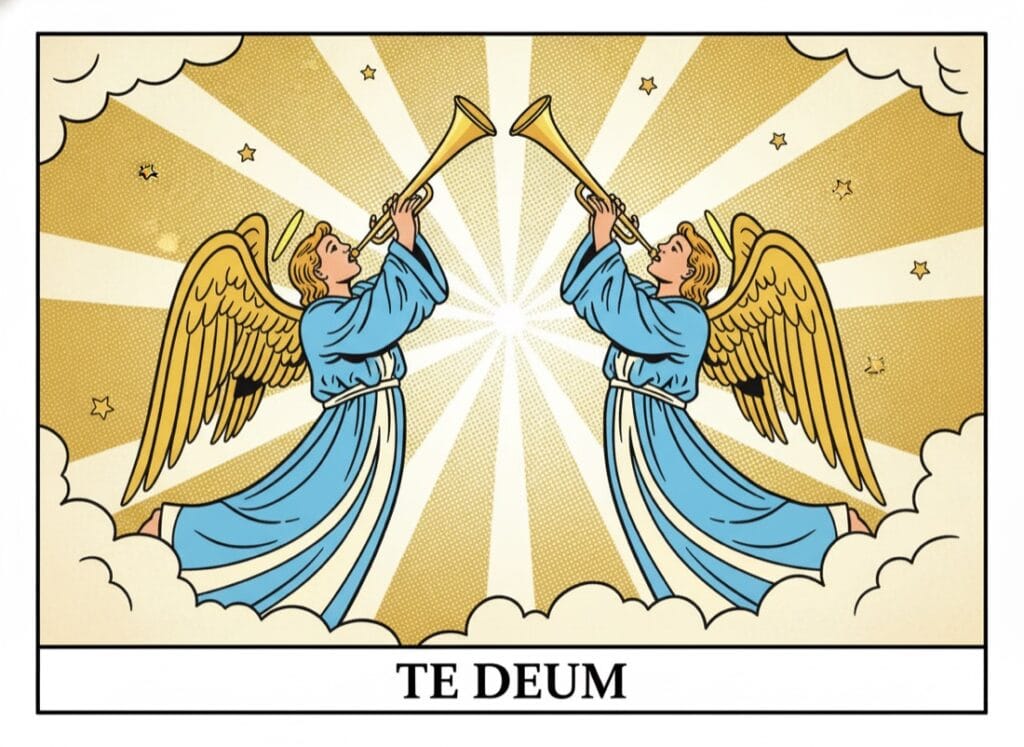
The Te Deum in Latin is the Church’s great hymn of praise and thanksgiving — “Te Deum laudamus” (“Thee, O God, we praise”). Sung on Sundays and feast days and at services of thanksgiving, it praises the Father, the Son and the Holy Spirit together with all the angels and saints.
On this page you will find the full Latin text, a line-by-line English translation, the meaning, the origin and a pronunciation note:
- the full Latin text of the Te Deum
- the English translation, line by line
- meaning, origin and ecclesiastical pronunciation
If you want not only to pray the Te Deum but also to read and understand the Latin, you will find it as a reading in the Lapicida app — opened up word by word, with a simplified entry stage to begin.
How does the Te Deum go in Latin?
The Te Deum begins “Te Deum laudamus: te Dominum confitemur” — “Thee, O God, we praise; thee, O Lord, we acknowledge.” It is the great hymn of thanksgiving of the Roman Church; this page gives the opening hymn to the Holy Trinity.
Te Deum — Latin text with a line-by-line translation
Here is the opening (Trinitarian) hymn of the Te Deum (Latin on the left, English on the right):
| Latin | English |
|---|---|
| Te Deum laudamus: te Dominum confitemur. | Thee, O God, we praise; thee, O Lord, we acknowledge. |
| Te aeternum Patrem omnis terra veneratur. | Thee, the everlasting Father, all the earth doth venerate. |
| Tibi omnes Angeli; tibi Caeli et universae Potestates; Tibi Cherubim et Seraphim incessabili voce proclamant: | To thee all the Angels, to thee the Heavens and all the Powers, to thee the Cherubim and Seraphim cry out with unceasing voice: |
| Sanctus, Sanctus, Sanctus, Dominus Deus Sabaoth. | Holy, Holy, Holy, Lord God of Hosts. |
| Pleni sunt caeli et terra maiestatis gloriae tuae. | Heaven and earth are full of the majesty of thy glory. |
| Te gloriosus Apostolorum chorus, Te Prophetarum laudabilis numerus, Te Martyrum candidatus laudat exercitus. | Thee the glorious choir of the Apostles, thee the praiseworthy company of the Prophets, thee the white-robed army of Martyrs doth praise. |
| Te per orbem terrarum sancta confitetur Ecclesia, Patrem immensae maiestatis: Venerandum tuum verum et unicum Filium; Sanctum quoque Paraclitum Spiritum. | Thee the holy Church throughout the world doth acknowledge: the Father of infinite majesty; thy adorable, true, and only Son; and also the Holy Spirit, the Comforter. |
Grammar note for learners: the hymn piles up datives and accusatives of the person praised — Te (“thee”) and Tibi (“to thee”) are repeated for emphasis at the head of each line. Sabaoth is an indeclinable Hebrew word (“of hosts / armies”).
Meaning: a hymn of praise and thanksgiving
The Te Deum is a hymn of jubilant praise: all creation — angels, heavens, powers, cherubim and seraphim — joins in the endless Sanctus (“Holy, Holy, Holy”), and the whole Church confesses the Father, the Son and the Holy Spirit (Paraclitum Spiritum, the Comforter). It is sung at moments of thanksgiving; “singing the Te Deum” has long meant giving solemn thanks.
Learn Latin now. Our learning app:

How you read it in the app — word by word
In the Lapicida app the Te Deum is set up as a graded reading: first a simplified entry stage, then the original hymn — each line opened up word by word, with vocabulary help and form analysis.
Origin and pronunciation
The Te Deum is an ancient Latin hymn (4th–5th century), traditionally called the “Ambrosian hymn” and once attributed to Saints Ambrose and Augustine. It stands in the Breviarium Romanum, sung at the end of Matins on feasts. This page gives its first part, the hymn to the Trinity (up to Paraclitum Spiritum).
Pronunciation (Church Latin): Te Deum = “teh DEH-oom”; caeli = “CHEH-lee”; Sabaoth = “SAH-ba-oth”; Cherubim = “KEH-roo-beem.”
See also the Nicene Creed (Credo), the Glory Be (Gloria Patri) and the Vulgate, the Latin Bible.
Frequently asked — the Te Deum in Latin
What does Te Deum laudamus mean?
‘Thee, O God, we praise.’ It is the opening of the Te Deum, the Church’s great hymn of praise and thanksgiving to the Holy Trinity.
When is the Te Deum sung?
On Sundays and feast days at the end of Matins, and at special services of thanksgiving — for a victory, an election, a jubilee. ‘To sing the Te Deum’ means to give solemn thanks.
Who wrote the Te Deum?
It is an ancient hymn of the 4th–5th century, traditionally called the ‘Ambrosian hymn’ and attributed to Saints Ambrose and Augustine, though its true author is unknown.
What is the Sanctus in the Te Deum?
‘Sanctus, Sanctus, Sanctus, Dominus Deus Sabaoth’ — ‘Holy, Holy, Holy, Lord God of Hosts’ — the cry of the angels (from Isaiah 6), taken up in the Te Deum and in the Mass.
Learn Latin now. Our learning app: