
qui quae quod — Table, Agreement Rule & Relative Pronoun

qui, quae, quod is the Latin relative pronoun (“who, which, that”). It introduces a relative clause and links it to a word in the main clause. The key is the agreement rule (case, number, gender). Part of the Learn Latin series by Lapicida.
- The full table (m/f/n, singular and plural)
- The Janus rule: where gender, number and case come from
- The special forms cuius, cui, quibus
- Relative pronoun against interrogative (quis? quid?)
What is qui, quae, quod?
qui, quae, quod is the relative pronoun. It stands at the head of a relative clause and refers to a word in the higher clause. How the relative clause connects to the main clause is explained on the relative-clauses page; here we focus on the forms.

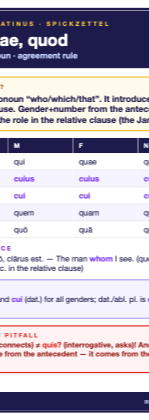
The table: qui, quae, quod
Singular
| Case | masculine | feminine | neuter |
|---|---|---|---|
| Nominative | qui | quae | quod |
| Genitive | cuius | cuius | cuius |
| Dative | cui | cui | cui |
| Accusative | quem | quam | quod |
| Ablative | quo | qua | quo |
Plural
| Case | masculine | feminine | neuter |
|---|---|---|---|
| Nominative | qui | quae | quae |
| Genitive | quorum | quarum | quorum |
| Dative | quibus | quibus | quibus |
| Accusative | quos | quas | quae |
| Ablative | quibus | quibus | quibus |
Note: the genitive cuius and dative cui hold for all genders; the dative and ablative plural are quibus throughout.
Learn Latin now. Our learning app:

The agreement rule — the key
The relative pronoun looks in two directions at once (like the god Janus):
- Gender + number come from the antecedent (the word in the main clause it refers to).
- Case comes from its role inside the relative clause (subject, object …).
Example: Vir, quem video, clarus est. — The man whom I see is famous. quem is masculine singular (from vir) but accusative (the object of video).
Reminder: qui/quae/quod = “relative-clause alert”. ⚠ Do not confuse it with the interrogative quis? quid? (“who? what?”) — that asks, the relative connects.
Common mistakes
- Applying agreement wrongly: do NOT copy the case from the antecedent — the case follows the role inside the relative clause.
- The merged quocum/quacum/quibuscum: “with whom” is often written quocum rather than cum quo.
- Connecting relative: at the start of a sentence Quod … often means not “which” but “and this / therefore” — a fresh main clause.
- quae is ambiguous: nom. sg. f., nom. pl. f. and nom./acc. pl. n. — the context decides.
Frequently asked questions
What does qui, quae, quod mean?
qui, quae, quod is the Latin relative pronoun: “who, which, that”. It introduces a relative clause.
How do you work out case, number and gender of the relative pronoun?
Gender and number come from the antecedent in the main clause; the case comes from the role inside the relative clause. That is the agreement (KNG) rule.
How do you decline qui, quae, quod?
The genitive cuius and dative cui hold for all genders; the dative and ablative plural are quibus. Otherwise it has its own form per gender (quem/quam/quod …).
What is the difference between qui and quis?
qui, quae, quod is the relative pronoun (it connects); quis? quid? is the interrogative pronoun (it asks: who? what?).
When do students learn qui, quae, quod?
Usually in the second year, together with the relative clause.
Master the Latin pronouns
Lapicida Latinus makes you type qui, quae, quod and all its forms instead of just ticking boxes — forms trainer, sentence quiz and reading in one app. Start free, full version from €19.99/year.
Learn Latin now. Our learning app: