is ea id — Table, Declension and the eius/suus Trap

is, ea, id is one of the commonest words in Latin — with two jobs: as a demonstrative pronoun (“this, that one”) and as the third-person personal pronoun (“he, she, it”). You spot it by the stem e-. Part of the Learn Latin series by Lapicida.
- The full table (m/f/n, singular and plural)
- The double function: “this” and “he/she/it”
- ⚠ The big trap: eius (of someone else) against suus (one’s own)
- Genitive eius, dative ei — the same for all genders
What is is, ea, id?
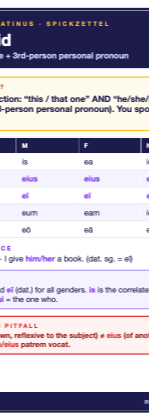
is, ea, id has two tasks: it points back to something already named (“this, that one”) and it serves as the third-person personal pronoun (“he, she, it”) that Latin otherwise lacks. It is one of the most important pronouns.

The table: is, ea, id
Singular
| Case | masculine | feminine | neuter |
|---|---|---|---|
| Nominative | is | ea | id |
| Genitive | eius | eius | eius |
| Dative | ei | ei | ei |
| Accusative | eum | eam | id |
| Ablative | eo | ea | eo |
Plural
| Case | masculine | feminine | neuter |
|---|---|---|---|
| Nominative | ei (ii) | eae | ea |
| Genitive | eorum | earum | eorum |
| Dative | eis (iis) | eis | eis |
| Accusative | eos | eas | ea |
| Ablative | eis | eis | eis |
Note: the genitive eius and dative ei are the same for all genders. In the plural there are the double forms ei/ii and eis/iis.
Learn Latin now. Our learning app:

Usage: “this” and “he/she/it”
| Role | Latin | English |
|---|---|---|
| personal pronoun | Is puellam amat. | He loves the girl. |
| anaphoric | Eam feminam laudo. | I praise that woman. |
| genitive (possession) | Eius pater venit. | His / her father is coming. |
| dative | Ei librum do. | I give him / her a book. |
| ablative | Cum eo ambulo. | I am walking with him. |
⚠ The key trap: eius against suus
This is the commonest mistake with is, ea, id. Both translate as “his/her” — but:
- suus = one’s OWN (reflexive, pointing back to the subject): Marcus suum patrem vocat. — Marcus calls his own father.
- eius = of SOMEONE ELSE (not reflexive): Marcus eius patrem vocat. — Marcus calls his (another person’s) father.
- Rule of thumb: suus = one’s own, eius = of someone else.
- In the ACI: “same subject = se, different = eum” — if the pronoun refers to the ACI subject use se, otherwise eum.
Frequently asked questions
What does is, ea, id mean?
is, ea, id has two functions: as a demonstrative pronoun “this, that one” and as the third-person personal pronoun “he, she, it”.
How do you decline is, ea, id?
The genitive (eius) and dative (ei) are the same for all genders. The stem is e- (eum, eam, eo …). In the plural there are the double forms ei/ii and eis/iis.
What is the difference between eius and suus?
suus means “his/her own” (it refers back to the subject); eius means “his/her” in the sense of “belonging to someone else”. Rule: suus = one’s own, eius = of another.
Why is is, ea, id used as a personal pronoun?
Latin has no separate third-person personal pronoun. is, ea, id steps in and then means “he, she, it”.
When do students learn is, ea, id?
Very early, usually in the first year, because it is one of the commonest words.
Master the Latin pronouns
Lapicida Latinus makes you type is, ea, id and all its forms instead of just ticking boxes — forms trainer, sentence quiz and reading in one app. Start free, full version from €19.99/year.
Learn Latin now. Our learning app:
See also: hic, haec, hoc · qui, quae, quod · Latin pronouns overview · Latin declension (Wikipedia).