Latin Second Declension (o-Declension) — Endings, Table (dominus, bellum)

The second declension (o-declension) is one of the largest classes. It holds masculine nouns in -us and -er (dominus, puer) and neuter nouns in -um (bellum, templum). With the first declension it forms the backbone of Latin morphology. Part of the Learn Latin series.
- All endings of the second declension — masculine and neuter
- Tables for dominus and bellum
- The two -er cases: puer (keeps e) and ager (drops e)
- Gender rule, the vocative in -e, and common mistakes
What is the second declension?
The second declension (o-declension) contains Latin nouns with the stem vowel -o-. You recognise it by the genitive singular in -i (dominus, domini). Masculines end in -us or -er, neuters in -um. It is one of the five declensions.
The endings of the second declension
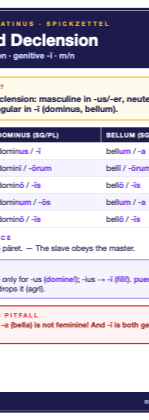
Masculine and neuter share most endings — they differ only in the nominative/accusative (neuter: identical, plural -a) and the vocative:
| Case | Masculine (-us) | Neuter (-um) |
|---|---|---|
| Nom. sg. | dominus | bellum |
| Gen. sg. | domini | belli |
| Dat. sg. | domino | bello |
| Acc. sg. | dominum | bellum |
| Abl. sg. | domino | bello |
| Nom. pl. | domini | bella |
| Gen. pl. | dominorum | bellorum |
| Dat./Abl. pl. | dominis | bellis |
| Acc. pl. | dominos | bella |
How to spot it: the genitive singular in -i. The dictionary shows dominus, domini.

The tables: dominus, puer, ager and bellum
dominus, domini m. — master, lord
| Case | Singular | Plural |
|---|---|---|
| Nominative | dominus | domini |
| Genitive | domini | dominorum |
| Dative | domino | dominis |
| Accusative | dominum | dominos |
| Ablative | domino | dominis |
| Vocative | domine | domini |
bellum, belli n. — war (neuter: nominative = accusative, plural in -a)
| Case | Singular | Plural |
|---|---|---|
| Nom. / Acc. | bellum | bella |
| Genitive | belli | bellorum |
| Dat. / Abl. | bello | bellis |
Two -er cases: puer keeps the e (puer, pueri), ager drops it (ager, agri) — the genitive shows the stem. The vocative in -e applies only to -us words (domine!); -ius words take -i (fili!). See the declension chart.
Learn Latin now. Our learning app:

Gender: masculine, neuter — and a few feminine outliers
Rule of thumb: nouns in -us / -er are masculine, nouns in -um are neuter. But a well-known group of feminine exceptions ends in -us:
- pirus (pear tree), fagus (beech) — trees are feminine
- Aegyptus, Corinthus — names of countries and towns in -us are feminine
- individual cases: humus (ground, f.)
For agreement, gender wins over ending: alta pirus (the tall pear tree), not altus pirus.
The cases in a sentence
| Case | Latin | English |
|---|---|---|
| Nominative | Dominus servos vocat. | The master calls the slaves. |
| Genitive | Villa domini ampla est. | The villa of the master is spacious. |
| Dative | Servus domino paret. | The slave obeys the master. |
| Accusative | Puer dominum salutat. | The boy greets the master. |
| Ablative | Puer stilo scribit. | The boy writes with a stylus. |
| Vocative | “Salve, domine!” | “Greetings, master!” |
And a neuter plural: Bella populos delent. — Wars destroy peoples. (bella = nominative plural)
Common mistakes
- -i is twofold: genitive singular and nominative plural end in -i (domini). The sentence decides.
- Confusing neuter plural -a with the first declension: bella is neuter plural (“wars”), not a feminine a-noun.
- Forming the vocative wrongly: only -us words take -e (domine); -ius words take -i (fili, not filie).
- -er stems: puer keeps the e, ager drops it — always check the genitive.
Frequently asked questions
What is the second declension in Latin?
The second declension (o-declension) contains masculine nouns in -us and -er (dominus, puer) and neuter nouns in -um (bellum). The genitive singular ends in -i.
How do I recognise the second declension?
By the genitive singular in -i, for example dominus, domini. That is why the dictionary lists the genitive.
What is the difference between masculine and neuter here?
Masculines end in -us or -er, neuters in -um. In the neuter, nominative and accusative are always identical and the plural ends in -a (bella).
When is the vocative -e and when -i?
Nouns in -us take the vocative -e (domine!); nouns in -ius take -i (fili!). It is the only form that differs from the nominative.
Why does puer keep the e but ager does not?
The stem shows in the genitive: puer, pueri keeps the e; ager, agri drops it. You need the genitive to decline them correctly.
Practise the declensions actively
Lapicida Latinus makes you type the forms instead of just ticking boxes — forms trainer, sentence quiz and reading in one app. Start free, full version from €19.99/year.
Learn Latin now. Our learning app:
See also: First declension · Third declension · All five declensions · Latin declension (Wikipedia).