Ave Maria in Latin — the Hail Mary Prayer, Text and Meaning
The Ave Maria — known in English as the Hail Mary — is one of the most famous prayers in the Latin language. Its words are drawn from the Gospel of Luke and have been prayed, chanted and set to music for centuries. This article is part of the Learn Latin section of Lapicida and gives the full Latin text, a line-by-line English translation, a word-by-word breakdown, and a short note on ecclesiastical pronunciation.
- The complete traditional Latin text (with macrons for pronunciation)
- A line-by-line Latin → English translation
- A word-by-word guide to the key phrases
- How it is used: the Rosary, the Angelus, and settings by Schubert and Gounod
The Ave Maria in Latin — the full text
Below is the complete traditional (ecclesiastical) Latin text of the Ave Maria. The marks over the vowels (macrons) show the long vowels; they are a learning aid and are not written in liturgical books.
Ave Maria, grātiā plēna, Dominus tēcum. Benedicta tū in mulieribus, et benedictus frūctus ventris tuī, Iēsus. Sāncta Marīa, Māter Deī, ōrā prō nōbīs peccātōribus, nunc et in hōrā mortis nostrae. Āmēn.
And here the same prayer set out line by line with its English translation:
| Latin | English |
|---|---|
| Ave Maria, grātiā plēna, Dominus tēcum. | Hail Mary, full of grace, the Lord is with thee. |
| Benedicta tū in mulieribus, | Blessed art thou amongst women, |
| et benedictus frūctus ventris tuī, Iēsus. | and blessed is the fruit of thy womb, Jesus. |
| Sāncta Marīa, Māter Deī, | Holy Mary, Mother of God, |
| ōrā prō nōbīs peccātōribus, | pray for us sinners, |
| nunc et in hōrā mortis nostrae. Āmēn. | now and at the hour of our death. Amen. |
Word by word: what the Latin phrases mean
The Ave Maria is short, and almost every word is worth knowing. The table below breaks down the key phrases so you can see exactly how the Latin maps onto the English.
| Latin | English |
|---|---|
| Ave | Hail (a greeting) |
| grātiā plēna | full of grace |
| Dominus tēcum | the Lord is with you |
| benedicta | blessed |
| frūctus ventris | fruit of the womb |
| ōrā prō nōbīs | pray for us |
| in hōrā mortis | at the hour of death |
A couple of details are worth noticing. Grātiā plēna uses the ablative grātiā (“with grace”) because in Latin plēnus (“full”) often takes the ablative. Ōrā is an imperative — a direct request, “pray!” — and prō nōbīs uses the preposition prō (“for, on behalf of”) with the ablative nōbīs (“us”).
How the Ave Maria grows out of the Bible
The first part of the Ave Maria is not freely composed: it comes almost word for word from Luke’s Gospel. Two greetings from the Annunciation grow into the prayer — the prayer on the left, its biblical source on the right (Vulgate):
Prayer (Ave Maria)
„Ave Maria, gratia plena, Dominus tecum“
Hail Mary, full of grace, the Lord is with you
„Benedicta tu in mulieribus, et benedictus fructus ventris tui, Iesus“
Blessed are you among women, and blessed is the fruit of your womb, Jesus
„Sancta Maria, Mater Dei, ora pro nobis peccatoribus…“
Holy Mary, Mother of God, pray for us sinners…
Biblical source (Vulgate, Luke 1)
Ave gratia plena: Dominus tecum: benedicta tu in mulieribus. (Lk 1:28 — angel Gabriel)
Hail, full of grace: the Lord is with you: blessed are you among women.
Benedicta tu inter mulieres, et benedictus fructus ventris tui. (Lk 1:42 — Elizabeth)
Blessed are you among women, and blessed is the fruit of your womb.
— a later liturgical addition, not from the Bible
So the Ave Maria is built from two Gospel greetings — the angel’s greeting (Luke 1:28) and Elizabeth’s greeting (Luke 1:42) — plus a later liturgical petition (Sancta Maria …).
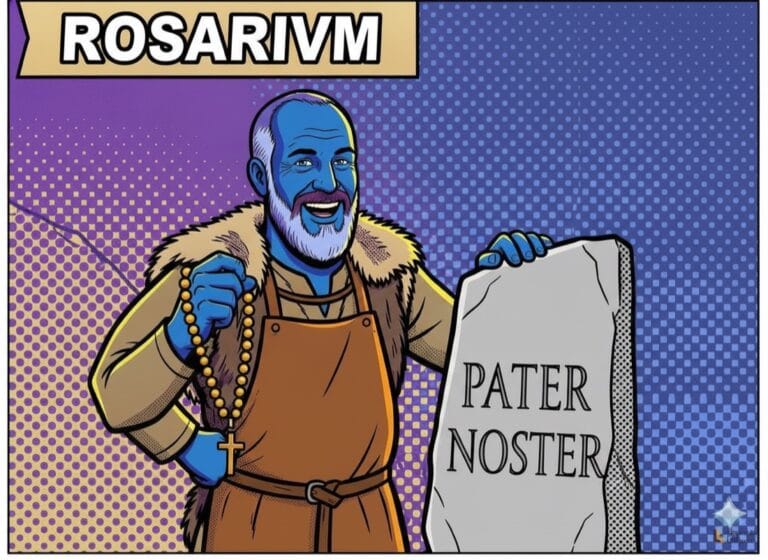
You can read the biblical source — the Annunciation to Mary (Luke 1:26–45) — as a Vulgate reading (Annuntiatio) in our app word by word. Together with the Pater Noster, the Ave Maria forms the heart of the Rosary in Latin.
How you learn Latin — Augustine’s »Tolle, lege«
„Tolle, lege — take up and read!” With these words the conversion of Augustine begins. That is exactly how you read real texts with us: first gently simplified, then up to the unchanged original. An example from the Confessions (Book 8):
Simplified · Level L18
„Ego sub quadam fico stravi me et dimisi habenas lacrimis.“
I threw myself down under a fig tree and gave free rein to my tears.
Original · Level L24 (Augustine, Conf. 8,12)
„Dicebam haec et flebam amarissima contritione cordis mei. Et ecce audio vocem … Tolle lege, tolle lege.“
I was saying these things and weeping in the most bitter contrition of my heart. And behold, I hear a voice …: Take up and read, take up and read.
And in the original the famous line follows: „Arripui, aperui, et legi” — „I seized it, opened it, and read.” That is how you read real text, adapted up to the original. Open the reading in the app.
Ecclesiastical pronunciation
The Ave Maria is normally sung and spoken in ecclesiastical (Church) Latin, which follows Italian-style pronunciation rather than the reconstructed classical sound. A few rules cover most of the prayer:
- c before e or i = “ch”: benedicta and Dominus tēcum keep a hard “k” before a consonant, but where c meets e or i (as in the wider liturgy) it softens to “ch” as in church.
- gr as in “grace”: grātiā begins with the same hard “gr” sound you hear in the English word grace.
- ae = “eh”: the diphthong ae in nostrae is pronounced as a single “eh” sound, like the e in met.
- ti before a vowel = “tsee”: grātiā is said “GRAH-tsee-ah” in Church Latin, not “GRAH-tee-ah”.
If you want the full set of rules for both the classical and the ecclesiastical systems, see the guide to Latin pronunciation.
Learn Latin now. Our learning app:

When and how the Ave Maria is used
- The Rosary: the Ave Maria is the prayer repeated most often on the beads of the Rosary, grouped into decades of ten.
- The Angelus: traditionally prayed three times a day (morning, noon and evening), the Angelus includes the Ave Maria after each of its verses.
- Musical settings: the words have inspired countless composers. Franz Schubert’s melody (originally “Ellens dritter Gesang”) is now sung to the Latin text, and Charles Gounod built his famous Ave Maria over a prelude by J. S. Bach.
Because it is short, structured and endlessly repeated, the Ave Maria is one of the first Latin texts many learners can read fluently — a good bridge into longer prayers and, eventually, the wider world of Latin.
Frequently asked questions — the Ave Maria
What is the Ave Maria?
The Ave Maria is a traditional Latin prayer to the Virgin Mary. Its opening words are taken from the Gospel of Luke, and it is one of the most widely prayed and most often set to music of all Latin prayers. In English it is known as the Hail Mary.
What does ‘gratia plena’ mean?
Gratia plena means full of grace. Gratia is the ablative of gratia (grace) and plena is the feminine form of plenus (full), which in Latin often takes the ablative. The phrase describes Mary as being full of grace.
Is the Ave Maria the same as the Hail Mary?
Yes. Ave Maria is simply the Latin name of the prayer, and Hail Mary is its English name. Ave means Hail and Maria means Mary, so the two are the same prayer in two languages.
Learn Latin now. Our learning app:
About the author
Andreas Blankenstein is the founder of Lapicida Latinus — and dyslexic himself. When he had to catch up on his Latinum in record time, one thing became clear: endless table-cramming fails exactly the people who learn differently. That is why Lapicida trains grammar in the context of real authorial texts, colour-coded and in short steps. More about Andreas and the Lapicida method →