hic haec hoc — Latin Demonstrative Pronoun: Table & Usage

hic, haec, hoc means “this” — the Latin demonstrative pronoun for what is near (in space, time or thought, close to the speaker). It changes for case, number and gender and belongs to the core vocabulary from the very first year. Part of the Learn Latin series by Lapicida.
- The full table (m/f/n, singular and plural)
- The special forms huius and huic, and the attached -c
- hic (this, near) against ille (that, far)
- ⚠ The pronoun hic vs. the adverb hic (“here”)
What is hic, haec, hoc?
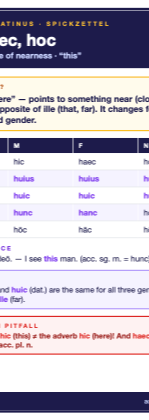
hic, haec, hoc is the demonstrative pronoun of nearness: “this (one here)”. It points to something close to the speaker and stands against ille (that, far away). Like all Latin pronouns, it agrees with its noun in case, number and gender.

The table: hic, haec, hoc
Singular
| Case | masculine | feminine | neuter |
|---|---|---|---|
| Nominative | hic | haec | hoc |
| Genitive | huius | huius | huius |
| Dative | huic | huic | huic |
| Accusative | hunc | hanc | hoc |
| Ablative | hoc | hac | hoc |
Plural
| Case | masculine | feminine | neuter |
|---|---|---|---|
| Nominative | hi | hae | haec |
| Genitive | horum | harum | horum |
| Dative | his | his | his |
| Accusative | hos | has | haec |
| Ablative | his | his | his |
Note: the genitive huius and the dative huic are the same for all three genders. The attached -c (from -ce, “here”) survives in almost every form (hunc, hanc, hoc).
Learn Latin now. Our learning app:

Usage: near against far
hic (this, near) pairs with ille (that, far) — like “here” and “there”. They often appear together: hic … ille … = “the one … the other …”.
| Case | Latin | English |
|---|---|---|
| Nominative | Hic vir fortis est. | This man is brave. |
| Genitive | Liber huius pueri novus est. | This boy’s book is new. |
| Dative | Huic feminae credo. | I trust this woman. |
| Accusative | Hunc librum lego. | I am reading this book. |
| Ablative | Cum hac amica ambulo. | I am walking with this friend. |
Common mistakes
- Pronoun hic vs. adverb hic: the same word is also the adverb “here” (place). Only the sentence decides: hic vir = “this man”, hic manet = “he stays here”.
- haec is ambiguous: nominative singular feminine, but also nominative/accusative plural neuter. The context settles it.
- huius / huic for every gender: do not invent “huae” or “huo” — genitive and dative singular are the same for m/f/n.
- hoc as nominative, accusative AND ablative: vowel length (short hoc / long hōc) and the sentence keep them apart.
Frequently asked questions
What does hic, haec, hoc mean?
hic, haec, hoc is the Latin demonstrative pronoun of nearness and means “this”. It points to something close to the speaker.
How do you decline hic, haec, hoc?
The genitive and dative singular are the same for all genders: huius and huic. Otherwise it has its own form per gender (hunc/hanc/hoc in the accusative), with an attached -c.
What is the difference between hic and ille?
hic means “this (near)”, ille means “that (far)”. Together, hic … ille … often means “the one … the other …”.
Is hic a pronoun or an adverb?
Both. As a pronoun hic means “this”; as an adverb it means “here”. Only the context shows which is meant.
When do students learn hic, haec, hoc?
Usually in the first or second year, together with the other demonstratives (is ea id, ille, iste).
Master the Latin pronouns
Lapicida Latinus makes you type hic, haec, hoc and all its forms instead of just ticking boxes — forms trainer, sentence quiz and reading in one app. Start free, full version from €19.99/year.
Learn Latin now. Our learning app:
See also: is, ea, id · qui, quae, quod · Latin pronouns overview · Latin declension (Wikipedia).