
Agnus Dei in Latin — Text, Translation & Meaning
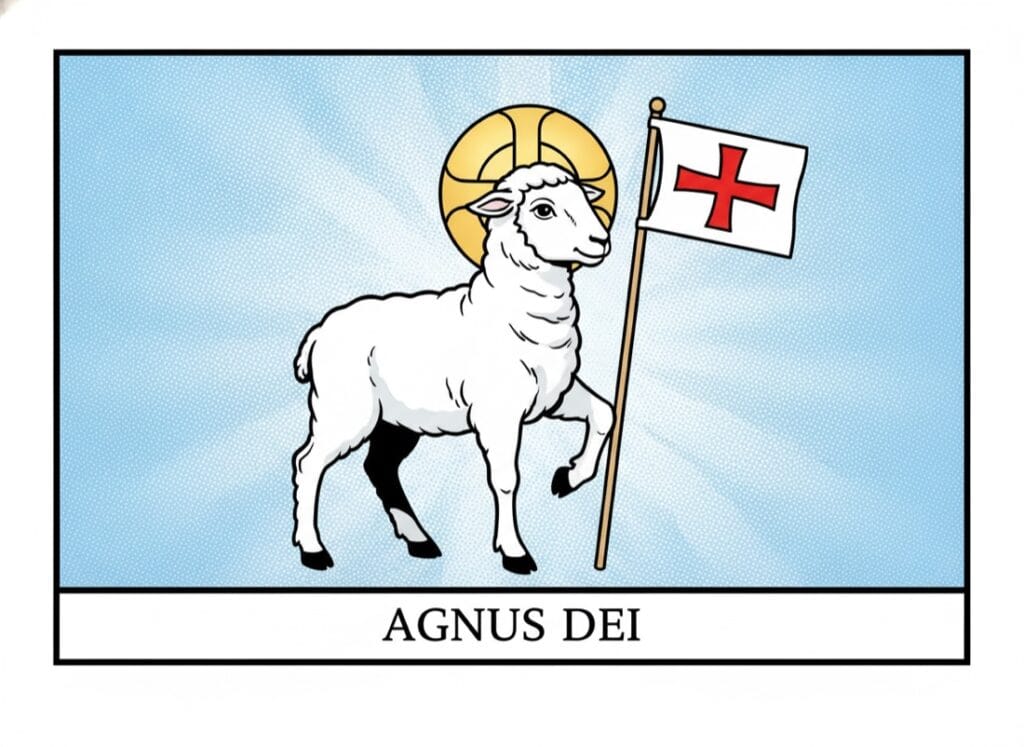
The Agnus Dei in Latin (“Lamb of God”) is one of the oldest chants of the Mass — the threefold invocation of Christ as the Lamb of God, sung at the breaking of the bread just before Communion.
On this page you will find the full Latin text, a line-by-line English translation, the meaning, the origin and a pronunciation note:
- the full Latin text of the Agnus Dei
- the English translation, line by line
- meaning, origin and ecclesiastical pronunciation
If you want not only to pray the Agnus Dei but also to read and understand the Latin, you will find it as a reading in the Lapicida app — opened up word by word.
How does the Agnus Dei go in Latin?
The Agnus Dei is prayed three times: “Agnus Dei, qui tollis peccata mundi, miserere nobis” (twice) — “Lamb of God, who takest away the sins of the world, have mercy on us” — and a third time ending “dona nobis pacem” (“grant us peace”).
Agnus Dei — Latin text with a line-by-line translation
Here is the full Agnus Dei as sung in the Mass (Latin on the left, English on the right):
| Latin | English |
|---|---|
| Agnus Dei, qui tollis peccata mundi, miserere nobis. | Lamb of God, who takest away the sins of the world, have mercy on us. |
| Agnus Dei, qui tollis peccata mundi, miserere nobis. | Lamb of God, who takest away the sins of the world, have mercy on us. |
| Agnus Dei, qui tollis peccata mundi, dona nobis pacem. | Lamb of God, who takest away the sins of the world, grant us peace. |
Grammar note for learners: Agnus Dei is a vocative of address (“O Lamb of God”); qui tollis is a relative clause with a 2nd-person verb (“you who take away”); miserere and dona are imperatives (“have mercy,” “grant”).
Meaning: Christ, the Lamb of God
The Agnus Dei takes up the words of John the Baptist in John 1:29: “Behold the Lamb of God, who takes away the sin of the world.” Christ is the Lamb whose sacrifice takes away sin; the threefold cry asks twice for mercy and, the third time, for peace. In a Requiem Mass the third line becomes dona eis requiem (“grant them rest”).
Learn Latin now. Our learning app:

How you read it in the app — word by word
In the Lapicida app the Agnus Dei is set up as a reading: the full Latin text opened up word by word — with vocabulary help, form analysis and translation. A gentle first step into the Latin of the Mass. Open the reading in the app.
Origin and pronunciation
The Agnus Dei was introduced into the Ordo Missae (the order of Mass) around the 7th century and stands in the Missale Romanum. It is sung during the fractio panis, the breaking of the consecrated bread.
Pronunciation (Church Latin): gn sounds like the “ny” in canyon — Agnus = “AH-nyoos”; peccata = “pek-KAH-ta”; miserere = “mee-zeh-REH-reh.”
The Agnus Dei is part of the Ordinary of the Mass, alongside the Nicene Creed (Credo). See also the Vulgate, the Latin Bible.
Frequently asked — the Agnus Dei in Latin
What does Agnus Dei mean in English?
Agnus Dei means ‘Lamb of God’. It addresses Christ as the Lamb who takes away the sins of the world, echoing John the Baptist in John 1:29.
When is the Agnus Dei sung?
It is sung near the end of the Mass, during the breaking of the bread (the fraction), just before Holy Communion.
Why is the Agnus Dei said three times?
The first two invocations ask ‘miserere nobis’ (have mercy on us) and the third asks ‘dona nobis pacem’ (grant us peace). In a Requiem Mass the third becomes ‘dona eis requiem’ (grant them rest).
Where does the Agnus Dei come from?
The words come from John 1:29. As a chant it entered the order of Mass around the 7th century and belongs to the Ordinary of the Roman Mass.
Learn Latin now. Our learning app: