Latin Pronunciation — Why We Use Italian as a Model for Sound
Veni, vidi, vici. Three words that everyone knows—and on which no one can agree as to how they should be pronounced in Latin. Schools, churches, and classical studies have developed different traditions over the centuries. Anyone who wants to learn Latin with audio today faces a real problem: there is no official Latin TTS.
In this article, we explain how the three main pronunciation traditions differ, why audio support makes scientific sense when learning Latin—and how Lapicida solves the TTS problem by using Italian as a sound proxy. And why we deliberately follow the German school pronunciation in doing so.
- The three pronunciation traditions: Classical, school pronunciation, and Ecclesiastical Latin
- Why Audio Has Been Proven to Improve Latin Learning
- Why Italian works as a TTS proxy (and where its limitations lie)
- The preprocessing rules that correct c, g, ae, and j
How is Latin pronounced?
Latin pronunciation is not uniform: In German schools, the standard school pronunciation is used (c = /k/, v = /w/ in Classical Latin but /v/ in German); in church settings, the church pronunciation is used (c before e/i = /tsch/); and in classical studies, the reconstructed Classical pronunciation is used. Lapicida follows the German school pronunciation—the standard by which students in Germany learn Latin.
School Pronunciation, Classical Latin, Church Latin—A Comparison of Three Traditions
Anyone who Googles “correct” Latin pronunciation will quickly find contradictions. This is because, historically, there has never been a neutral authority that established a standard for Latin pronunciation. Instead, three main traditions developed regionally and institutionally, which coexist today.
| Characteristic | German school pronunciation | Classical (reconstructed) | Ecclesiastical Latin |
|---|---|---|---|
| c before e/i | /k/ — Cicero = Kikero | /k/ — Kikero | /tʃ/ — Tschitschero |
| v | /v/ as in Vater | /w/ as in “water” (English) | /v/ as in Vater |
| ae | /ä/ or /e/ | /ai/ (diphthong) | /e/ |
| g before e/i | /g/ hard | /g/ hard | /dʒ/ soft |
| Vowel length | rarely distinguished | distinguishes meaning | not distinguished |
| Usage | High School, Germany | Classical Philology, University | Church, Vatican |
For school instruction in Germany, the standard pronunciation is mandatory—and that is precisely why it forms the basis for Lapicida. Students should hear what they learn in class. We make an exception for vowel length (short vs. long vowels, such as ā vs. a): While it is etymologically significant, it plays hardly any role in German school instruction—and cannot be reliably implemented by a TTS system.
Why Audio Improves Latin Learning
Language is processed in the brain not only visually but also phonologically. Even when you only read vocabulary, you still activate your phonological working memory—but only internally, silently, and without control over the correct pronunciation. When you also hear the words, you anchor the word form more deeply.
- Phonological Loop: Baddeley’s working memory model (1986) shows that auditory and visual encoding use independent channels. Combining both engages more memory resources—and leads to better recall.
- Vocabulary with Phonetic Cues: Words that have been heard are recognized more quickly than those learned purely visually—especially with unfamiliar scripts or unusual sound combinations such as ae, qu, and ph.
- Reading Fluency: Those who can read Latin texts aloud (or correctly in their heads) read faster—because decoding requires less cognitive effort.
For a learning app, this means: Audio isn’t just a gimmick, but a learning channel in its own right. In Lapicida’s reading feature, audio is therefore integrated directly into the sentence display—each sentence can be played before you translate it.
Learn Latin now. Our learning app:

Why Italian Works as a Pronunciation Proxy for Latin
Latin is a dead language—there are no native speakers, no official TTS engine, and no commercial speech synthesis. So we asked ourselves: Which living language comes closest to the sound of standard German as taught in schools?
Italian. The answer didn’t surprise us, given the linguistic relationship: Italian is the Romance language with the highest lexical overlap with Latin—linguistic estimates put the percentage of shared word roots at 75–80%. But what’s more important for TTS is the sound: Italian has pure, short vowels (no umlauts, no schwa), a clear /r/, and—after preprocessing—consonant phonemes that are nearly identical to those of standard German pronunciation.
What preprocessing solves: Raw Italian TTS would mispronounce Latin because Italian has different phonetic rules. A brief preprocessing step standardizes the critical points:
| Latin | Problem without preprocessing | Rule | Result |
|---|---|---|---|
| Cicero | Cicero (Italian: c before i = /tʃ/) | c before e/i → k | Kikero ✅ |
| caelum | tschaelum | c before a/o/u remains unchanged; ae → e | kelum ✅ |
| gentes | dschangtes (Italian g before e = /dʒ/) | g before e/i → gh | ghentes ✅ |
| iustitia | correct (j → i already in Latin) | j → i | iustitia ✅ |
| Gloria | correct | "g" before "a," "o," or "u" remains hard | Gloria ✅ |
A conscious decision: v remains /v/. Classical Latin pronounces v as /w/ (veni = "weni"). The German school pronunciation, on the other hand, uses /v/ as in "Vater." We follow the school pronunciation—not because /w/ would be wrong, but because students in Germany learn exactly this /v/ in class. Lapicida is a learning tool for the German school context.
Honest limitations: No TTS proxy is perfect. Vowel lengths (short a vs. long ā) are not distinguished. Word stress follows Italian rules, not Latin pronunciation. And with rare consonant clusters, the sound may seem unnatural. We consider this an acceptable compromise: better to have consistent, learning-friendly audio than none at all. Those who wish to study classical pronunciation can find specialized resources—such as the Wikipedia overview of Latin pronunciation as taught in schools.
The audio feature is directly integrated into the “Learn Latin” workflow: vocabulary from the reading passages is automatically added to the vocabulary trainer—with the same TTS audio that the learner heard while reading.
More blog posts on this topic:






Frequently Asked Questions About Latin Pronunciation
Which pronunciation is “correct” for Latin?
There is no single “correct” Latin pronunciation. The reconstructed classical pronunciation used in classical studies, the German school pronunciation, and Ecclesiastical Latin are three equally valid traditions with different historical contexts. In German schools, the school pronunciation is considered the standard.
Why does Lapicida always pronounce the “c” as “k”?
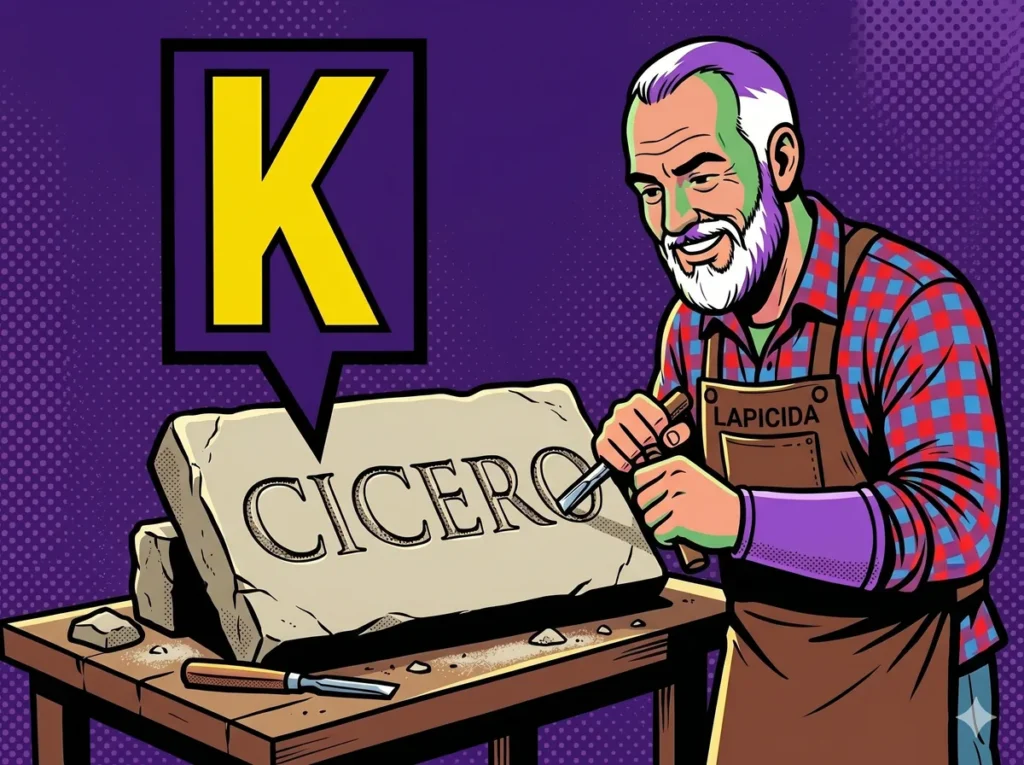
In the German school pronunciation, “c” is always pronounced as /k/—even before “e” and “i.” Cicero is pronounced “Kikero” here, not “Tschitschero.” Lapicida follows this standard because our target audience is students in Germany who learn exactly this pronunciation in class.
Why does the Latin audio in Lapicida sound like Italian?
Because that’s what it is—with some adjustments. There is no native Latin TTS. With a 75–80% lexical overlap, Italian is the Romance language closest to Latin. Automatic preprocessing corrects the critical sound differences (c/k, g/gh, ae/e, j/i) so that the result matches the pronunciation taught in German schools.
Why is “v” pronounced as /v/ and not as /w/ in Lapicida?
The reconstructed classical pronunciation uses /w/ for v (veni = 'weni'). German school pronunciation, on the other hand, pronounces v as /v/, as in 'Vater'. Since Lapicida is a tool for German school instruction, we follow school pronunciation—not the classical reconstruction.
Does audio really help with learning Latin?
Yes. Phonological working memory (Baddeley 1986) processes auditory and visual information through separate channels. When you hear and see vocabulary, you anchor it more deeply than through reading alone. Especially with unfamiliar sound combinations like ae, qu, or ph, a consistent sound pattern helps with recognition and retention.
Listen to and learn Latin—with the right app
Learn Latin now. Our learning app: