The Most Common Latin Words — 50 You Already Half-Know

English took roughly 60% of its vocabulary from Latin — directly or through French — which means you already half-know a surprising number of common Latin words. You don’t have to learn thousands of them either: a few hundred high-frequency words unlock most of a simple Latin text. This article is part of the Learn Latin section of Lapicida and collects 50 of the most useful Latin words, grouped by theme, with the English derivative that gives each one away.
- Function words carry the most weight — et, in, est, non appear on almost every line
- Many nouns and verbs live on in English: aqua → aquarium, video → video
- A few hundred frequent words cover most of a simple text
- Remembering them works best in context, not by flashcard cramming
Function words: the highest-frequency Latin words
These are the small connective words that hold every Latin sentence together. They are short, they repeat constantly, and once they are automatic you can read the skeleton of almost any sentence. Learn this group first — it pays back faster than any other.
| Latin | English | English derivative |
|---|---|---|
| et | and | — |
| in | in / on | in |
| est | (he/she/it) is | — |
| non | not | non- |
| sum | I am | — |
| qui | who / which | — |
| ad | to / towards | ad- (advance) |
| cum | with | — |
| sed | but | — |
| ut | so that | — |
| si | if | — |
| autem | however | — |
| enim | for / indeed | — |
| atque | and also | — |
| per | through | per (percent) |
📸 SCREENSHOT HERE (block can be hidden/replaced): Vocabulary trainer – one high-frequency word card (e.g. et or non) with the answer revealed. Just the screen, in a row.
People, society and the world around you
Nouns for people and nature come up again and again in stories, histories and everyday sentences — and most of them have left a fingerprint in English. Read down the third column and you will see how much you can already guess.
| Latin | English | English derivative |
|---|---|---|
| homo | human being | human |
| vir | man | virile |
| mulier | woman | — |
| rex | king | regal |
| populus | people | popular |
| amicus | friend | — |
| deus | god | deity |
| dominus | lord / master | dominate |
Nature and world: the next set is even friendlier to English speakers — nearly every word here is the root of a familiar term.
| Latin | English | English derivative |
|---|---|---|
| aqua | water | aquarium |
| terra | earth | terrain |
| ignis | fire | ignite |
| sol | sun | solar |
| luna | moon | lunar |
| caelum | sky / heaven | celestial |
| mare | sea | marine |
| silva | forest | — |
These everyday nouns are exactly the kind of vocabulary you meet first in the Latin vocabulary section — and once the noun is familiar, learning its forms and cases is far less daunting.
Big ideas and common verbs
The great abstract nouns — love, life, death, time, war and peace — are the heart of Latin literature, and most of them survive in English through words like vital, mortal and temporal.
| Latin | English | English derivative |
|---|---|---|
| amor | love | amorous |
| vita | life | vital |
| mors | death | mortal |
| tempus | time | temporal |
| bellum | war | belligerent |
| pax | peace | — |
| veritas | truth | verify |
| virtus | virtue / courage | virtue |
Common verbs: a handful of verbs do most of the work in any sentence. Notice how many of them you already carry in English — video is literally “video”.
| Latin | English | English derivative |
|---|---|---|
| dico | I say | dictate |
| facio | I do / make | factory |
| video | I see | video |
| habeo | I have | habit |
| venio | I come | convene |
| amo | I love | — |
| possum | I can / am able | possible |
| do | I give | donate |
Handy adjectives: finally, a small set of adjectives you will meet constantly — big, good, bad, all, new, many.
| Latin | English | English derivative |
|---|---|---|
| magnus | big | magnify |
| bonus | good | bonus |
| malus | bad | malice |
| omnis | all / every | omni- |
| novus | new | novel |
| multus | much / many | multiple |
📸 SCREENSHOT HERE (block can be hidden/replaced): Sentence quiz – a short sentence using common words (e.g. with amo or magnus) with a word highlighted in colour. Just the screen, in a row.
Learn Latin now. Our learning app:

How to actually remember them
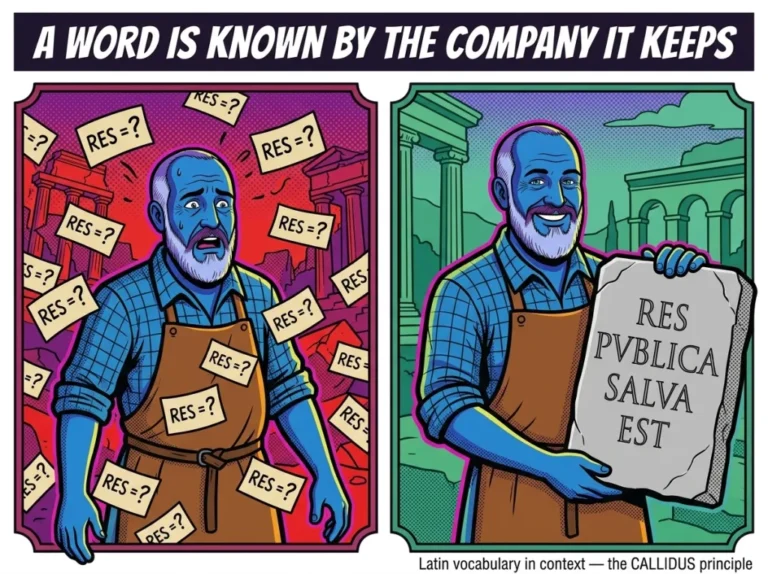
Staring at a list once does very little. What sticks is spaced repetition — meeting each word again at growing intervals, just before you would have forgotten it — combined with seeing the word in context rather than in isolation. A word like amor is far easier to keep when it sits inside a real sentence you understand than when it floats alone on a flashcard.
- Start with the function words. et, in, est, non repeat on nearly every line, so each repetition compounds.
- Anchor to the English derivative. Tie aqua to “aquarium” and the meaning is almost free.
- Space it out. Short, frequent sessions beat one long cram — that is what spaced repetition is built for.
- See the word working. Meet it inside a sentence, not as a bare pair on a card.
This is exactly the approach Lapicida is built on: instead of endless flashcard cramming, common words come back on an adaptive schedule and always inside real sentences, so the vocabulary and the reading grow together.
About the author
Andreas Blankenstein is the founder of Lapicida Latinus — and dyslexic himself. When he had to catch up on his Latinum in record time, one thing became clear: endless table-cramming fails exactly the people who learn differently. That is why Lapicida trains grammar in the context of real authorial texts, colour-coded and in short steps. More about Andreas and the Lapicida method →
Frequently asked questions — common Latin words
What are the most common Latin words?
The highest-frequency Latin words are small function words: et (and), in (in/on), est (is), non (not), qui (who/which), cum (with), ad (to) and sed (but). They appear on almost every line, so learning them first gives you the fastest return.
How many Latin words do I need to read simple Latin?
You do not need thousands. A few hundred high-frequency words cover most of the running text in a simple passage, because a small set of function words and common nouns and verbs keeps repeating. Master those first and the rest can be looked up as you go.
Do I already know Latin words?
Yes. English took roughly 60% of its vocabulary from Latin, so you already half-know many words through their English derivatives: aqua gives aquarium, video gives video, vita gives vital, and mors gives mortal.
Build your Latin vocabulary now
Learn Latin now. Our learning app: