Latin Words for Love, Death and Fire — the Most Powerful Vocabulary
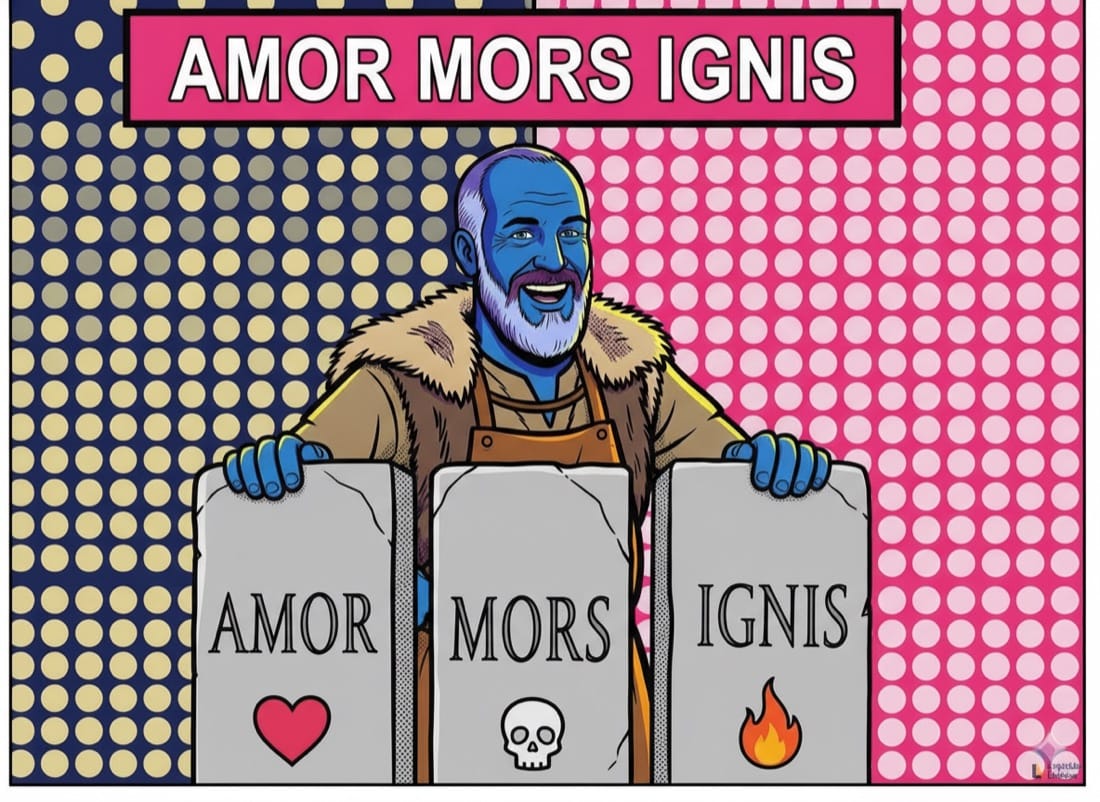
Few languages carry as much weight in so few syllables as Latin. The Latin word for love is amor; the Latin word for death is mors; the Latin word for fire is ignis. These are the words behind our mottoes, tattoos, poetry and half of English itself. This article is part of the Learn Latin section of Lapicida and gathers the most powerful, evocative Latin vocabulary — grouped by theme, with the famous phrases each word lives inside.
- Love in Latin: amor, amare, te amo (“I love you”)
- Death in Latin: mors, mori — as in memento mori
- Fire in Latin: ignis, flamma — as in ignis aurum probat
- Plus life, soul, power, light, blood, truth and more
Love in Latin: amor, amare, te amo
The Latin for love gives English some of its warmest words. Amor is the root of “amorous”, “enamoured” and even “amateur” (someone who does a thing purely for love of it). If you want to say “I love you” in Latin, it is simply te amo — you (te) I love (amo). And for the highest, selfless kind of love, Latin keeps a separate word: caritas, the root of “charity”.
| English | Latin | Notes / famous phrase |
|---|---|---|
| love | amor | root of “amorous”, “enamoured” |
| to love | amare | the verb behind te amo |
| “I love you” | te amo | literally “you I love” |
| selfless / charitable love | caritas | root of English “charity” |
| beloved (m. / f.) | carus / cara | a term of endearment |
| love conquers all | amor vincit omnia | from Virgil |
📸 SCREENSHOT HERE (block can be hidden/replaced): Vocabulary trainer showing a single card — e.g. amor with its translation “love”. Just the screen, in a row.
Death in Latin: mors, mori, memento mori
The Latin for death is mors, and it echoes through English in “mortal”, “mortuary” and “mortgage” (literally a “death pledge”). The most famous phrase of all is memento mori — “remember that you must die” — a reminder the Romans used to keep triumph and vanity in check. You will also meet inferi, the shades of the underworld, wherever Latin turns to the dead.
| English | Latin | Notes / famous phrase |
|---|---|---|
| death | mors | root of “mortal”, “mortuary” |
| to die | mori | a deponent verb |
| dead | mortuus | “deceased” |
| the underworld | inferi | the dead / those below |
| remember that you must die | memento mori | a classic reminder of mortality |
Words like these are exactly why so many people reach for Latin on mottoes and tattoos: it says something grave in a way that feels timeless. If you enjoy the phrases as much as the vocabulary, our collection of Latin quotes and their meanings goes deeper into where they come from.
Fire in Latin: ignis, flamma, incendium
The Latin word for fire is ignis — the source of “ignite” and “ignition”. Alongside it stands flamma, which came straight into English as “flame”, and incendium, a full-scale blaze that gives us “incendiary”. The proverb ignis aurum probat — “fire tests gold” — uses this vocabulary to say that hardship reveals true character.
| English | Latin | Notes / famous phrase |
|---|---|---|
| fire | ignis | root of “ignite”, “ignition” |
| flame | flamma | English “flame” |
| to burn | ardere | root of “ardent”, “ardour” |
| a blaze / conflagration | incendium | root of “incendiary” |
| fire tests gold | ignis aurum probat | hardship reveals character |
📸 SCREENSHOT HERE (block can be hidden/replaced): Vocabulary trainer showing a themed word — e.g. ignis (“fire”) with audio playback. Just the screen, in a row.
Each of these words rewards a little study: once you can see ignis inside “ignition”, the vocabulary starts to stick on its own. That is the whole idea behind our Latin vocabulary guide.
Learn Latin now. Our learning app:

Life and soul in Latin: vita, anima, animus
The Latin word for life is vita (think “vital”, “vitamin”, “revitalise”). The Latin for soul splits into two: anima, the breath of life — root of “animal” and “animate” — and animus, the mind or spirit that gives us “animosity” and “magnanimous”. The Roman toast dum vivimus, vivamus — “while we live, let us live” — captures the whole cluster in four words.
| English | Latin | Notes / famous phrase |
|---|---|---|
| life | vita | root of “vital”, “vitamin” |
| to live | vivere | as in vivamus |
| soul / breath | anima | root of “animal”, “animate” |
| mind / spirit | animus | root of “animosity”, “magnanimous” |
| while we live, let us live | dum vivimus, vivamus | a Roman toast to life |
Power and strength in Latin: potestas, vis, virtus
The Latin word for power comes in several shades. Potestas is lawful authority — the root of “potent” and “potential”; potentia is raw might; and vis is sheer force (as in “vim and vigour”). Add imperium (command, the root of “empire”) and virtus (courage and moral excellence, the root of “virtue”), and you have the vocabulary of Roman authority. Francis Bacon compressed it into scientia potestas est — “knowledge is power”.
| English | Latin | Notes / famous phrase |
|---|---|---|
| power / authority | potestas | root of “potent”, “potential” |
| might | potentia | raw power |
| force | vis | as in “vim and vigour” |
| command / empire | imperium | root of “empire”, “imperial” |
| courage / virtue | virtus | root of “virtue” |
| knowledge is power | scientia potestas est | attributed to Francis Bacon |
More evocative Latin words: light, blood, truth, peace
A final handful of words that turn up again and again in mottoes and literature. The Latin word for light is lux (root of “lucid”, “translucent”); the Latin for blood is sanguis (root of “sanguine”). Alongside them stand veritas (truth), pax (peace), bellum (war, root of “belligerent”), fortuna (fortune), tempus (time, as in “tempus fugit”) and deus (god, root of “deity”, “divine”).
| English | Latin | Notes / famous phrase |
|---|---|---|
| light | lux | root of “lucid”, “translucent” |
| blood | sanguis | root of “sanguine” |
| truth | veritas | a university motto favourite |
| peace | pax | as in “Pax Romana” |
| war | bellum | root of “belligerent” |
| fortune | fortuna | luck, the goddess Fortuna |
| time | tempus | as in “tempus fugit” (time flies) |
| god | deus | root of “deity”, “divine” |
About the author
Andreas Blankenstein is the founder of Lapicida Latinus — and dyslexic himself. When he had to catch up on his Latinum in record time, one thing became clear: endless table-cramming fails exactly the people who learn differently. That is why Lapicida trains grammar in the context of real authorial texts, colour-coded and in short steps. More about Andreas and the Lapicida method →
Frequently asked questions — powerful Latin words
What is the Latin word for love?
The Latin word for love is amor. The verb to love is amare, and to say I love you in Latin you say te amo. For selfless or charitable love, Latin uses a separate word, caritas, the root of the English charity.
How do you say I love you in Latin?
You say te amo. It literally means you I love, from te (you) and amo (I love). A well-known related phrase is amor vincit omnia, love conquers all.
What is the Latin word for death?
The Latin word for death is mors. To die is mori and dead is mortuus. The most famous phrase is memento mori, remember that you must die, which gives English words like mortal and mortuary.
Learn powerful Latin words the smart way
Learn Latin now. Our learning app: