Translating Latin — Why Google Translate Sabotages Learning
Anyone who wants to translate Latin can find plenty of digital tools these days: Google Translate, DeepL, ChatGPT. The translation comes in seconds—fast, clean, and often even accurate. The problem is that you don’t learn anything in the process. And not only that—you think you’ve understood something, even though you haven’t. Researchers call this the “fluency illusion.”
- Why machine translation actively hinders learning Latin
- Which digital tools really help with translation (and how to use them correctly)
- The difference between translation as a goal and translation as a learning method
Can you translate Latin with Google Translate?
Technically, yes—but not for learning. Google Translate and DeepL often provide usable results for simple Latin, but they fail when it comes to complex constructions like ACI, the ablative absolute, or subjunctive clauses. Anyone studying for a test or the Latinum exam who relies on automatic translators is learning the wrong way: consuming results instead of independently analyzing texts.
The Fluency Illusion—Why Translation Undermines the Learning Effect
When you read a text that someone else has translated, your understanding feels fluid—just like reading a novel. But this sense of understanding is an illusion. Cognitive scientists call it the “fluency illusion”: you confuse the ease of consumption with genuine understanding. If you really want to be able to read Latin sentences, you have to figure them out for yourself—with all the effort that entails.
This is not an abstract pedagogical principle. Roediger & Karpicke (2006) show that active retrieval—that is, producing knowledge yourself rather than merely consuming it—improves long-term retention by up to 50% compared to passive reading. For Latin, this means: The path of resistance is the path to learning.
Lapicida is based on this principle: The sentence quiz presents sentences from authentic original texts—the learner analyzes them independently and receives immediate feedback on errors. DeepL is integrated as a controlled tool: Anyone who enters their own API key (a free account is sufficient) can request a translation under “Help” for verification purposes—not as a shortcut, but as a way to double-check their own work. This is the key difference from using Google Translate as a first step.

Which Digital Tools Really Help with Latin Translation
| Tool | Suitable for | Not suitable for |
|---|---|---|
| Perseus Digital Library | Reading original texts, looking up morphological analysis | Automatic translation |
| Wiktionary Latin | Look up individual vocabulary words, check root forms | Translate entire sentences |
| Latin Dictionary & Grammar Aid | Analyze complete word forms | Automatic translation |
| Google Translate / ChatGPT | General guidance on individual vocabulary words | Learn Latin, Exam Prep, Latinum |
| Lapicida Latinus | Practice verb forms, analyze sentences, understand reading passages — DeepL as an optional verification tool (own API key), Wiktionary for vocabulary entries | As a shortcut instead of thinking for yourself |
The key difference: A dictionary gives you a word—you still have to figure out the form yourself. A translator takes away exactly what makes learning Latin worthwhile.
Learn Latin now. Our learning app:

Here’s how to translate Latin systematically
- Read the sentence, identify the verbs: The verb determines the sentence. What tense, what mood? Main clause or subordinate clause?
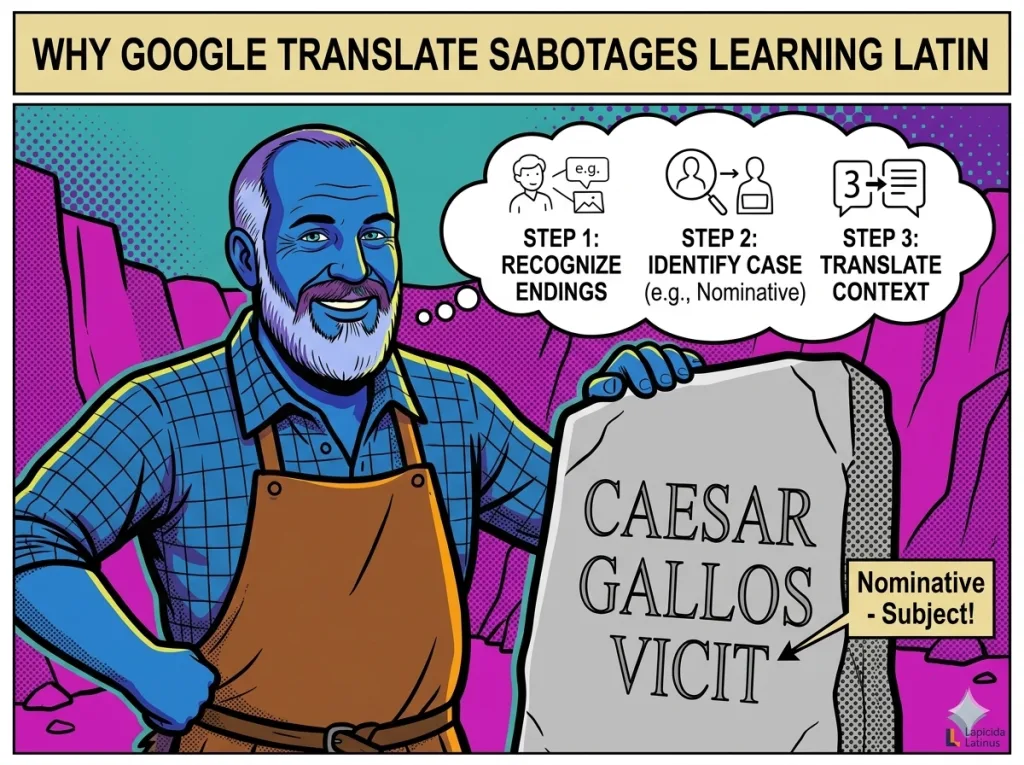
- Identify the subject and object: Nominative = subject, accusative = direct object. The ending determines this, not the position in the sentence.
- Attributes and predicative elements: Adjectives and participles agree with their referent in case, gender, and number.
- Look up vocabulary — but classify it yourself: Use a dictionary for unknown words, but determining the grammatical classification is your job.
- Formulate the translation: Only once the structure is clear should you formulate the German—not before.
The sentence quiz in Lapicida offers an interactive exercise using this method: sentences from Cicero, Caesar, and other authors, analyzed step by step.
More blog posts on this topic:






Frequently Asked Questions — Translating Latin
Can ChatGPT translate Latin?
Yes—for simple Latin, ChatGPT often provides useful translations. However, with complex constructions (ACI, ablative absolute, indirect speech), it regularly makes mistakes without correcting itself. And even if the translation is correct: if you let AI do the translating, you won’t learn.
Which dictionary is best for Latin?
For school use: PONS Latin or Stowasser. Free online: Perseus Digital Library (with morphological analysis), Wiktionary Latin. For the Latinum exam: a printed dictionary (Stowasser or Langenscheidt) as a reference.
How do you translate a Latin sentence step by step?
1) Identify the verb (tense, mood, person), 2) Subject in the nominative case, 3) Objects in the accusative/dative cases, 4) Assign attributes (adjectives) to their referents, 5) Look up unknown vocabulary, 6) Formulate the German sentence. Structure first—then meaning.
Does Google Translate help with learning Latin?
No. Google Translate provides a ready-made translation that takes over the thinking process you need for learning. It’s acceptable as a quick vocabulary check for individual words—but not as a learning aid for entire sentences.
Learn to translate Latin—with real texts
Learn Latin now. Our learning app: