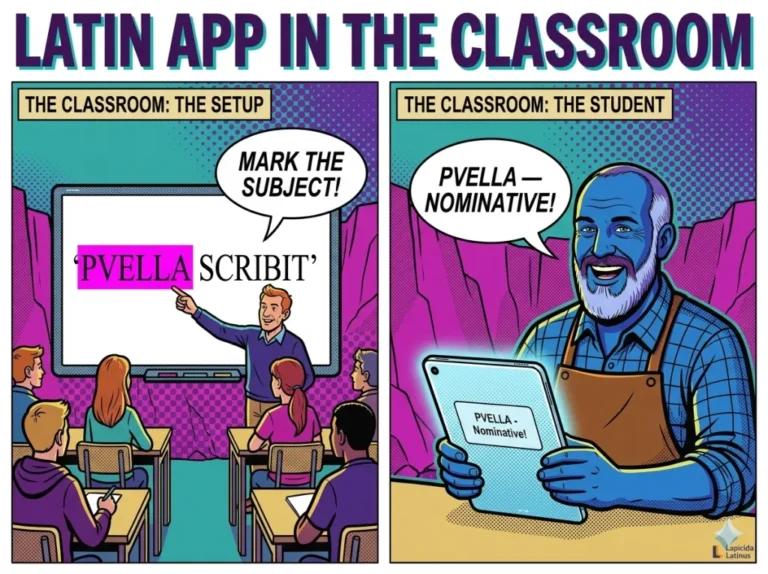
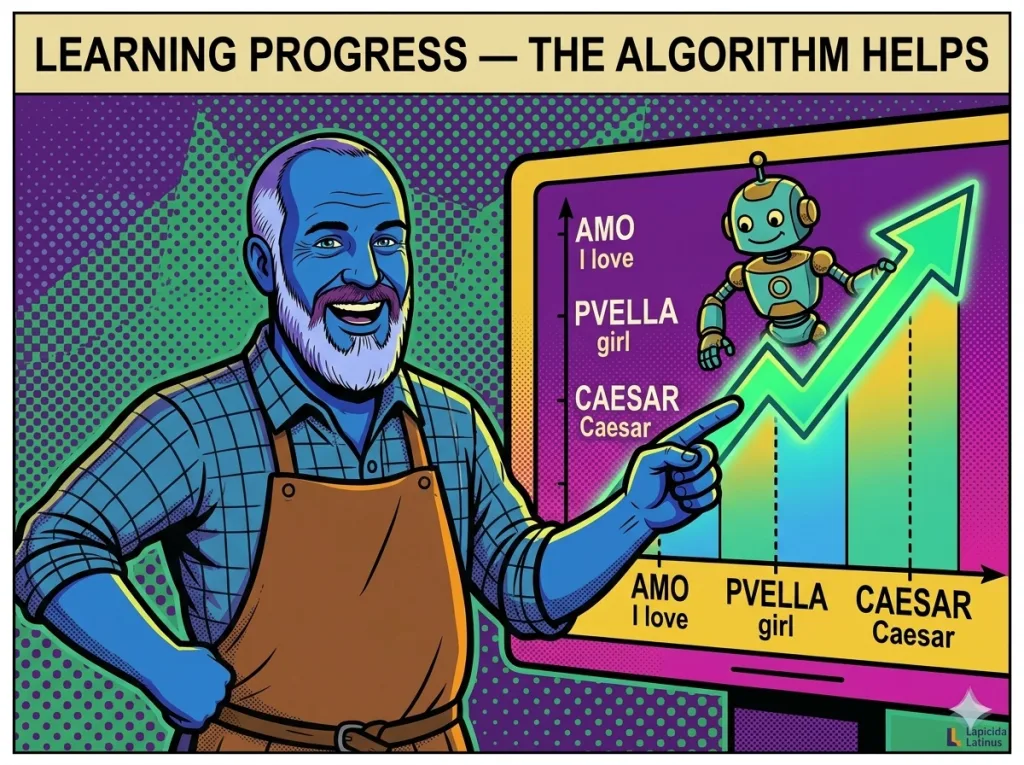
Latin Learning Progress: The Algorithm That Flags a Struggling Student
The Learning Progress module in the Lapicida Officina gives teachers a data-backed view of where every student actually stands. The attention algorithm flags students who are drifting toward falling behind. The confusion matrix shows which word forms get parsed wrong — again and again.
- Attention algorithm: more than 7 days without activity, or a downward score trend.
- Confusion matrix: which forms does a student mix up systematically?
- Activity log: sessions, time on task, items worked through.
- Box progress: average Leitner box level in the vocabulary trainer.
How does Lapicida measure learning progress?
Lapicida reads progress from three main signals: the box level in the vocabulary trainer (a spaced-repetition Leitner system, from Box 0 to Mastery), the sentence-quiz score per area (the percentage of clause elements correctly identified — active recall in practice), and activity frequency (when a student last worked, and whether the trend is rising or falling). Together, these three feed the attention algorithm.
| Dimension | Source | What it shows |
|---|---|---|
| Vocabulary-trainer box level | Leitner system (Box 0–Mastery) | Long-term mastery of vocabulary |
| Sentence-quiz score | correct / total per area | Grammar mastery by construction type |
| Activity frequency | session data | How regularly the student practises |
The attention algorithm — when is a student flagged?
The algorithm works with two independent signals. Either one on its own is enough to highlight a student in the class overview:
| Signal | Threshold | Meaning |
|---|---|---|
| Inactivity | >7 days without a login | The student hasn’t practised in over a week |
| Downward trend | Average score of the last 5 sessions < the 4 sessions before them | Performance is slipping despite activity |
What teachers can do with it: the algorithm only raises a flag — it makes no pedagogical diagnosis. You decide whether a quiet word is the right call, or whether outside reasons (illness, an exam-heavy stretch) explain the gap. The tool points; the teacher judges.
The confusion matrix — making systematic errors visible
The confusion matrix shows which pairs of word forms a student mixes up systematically. A few typical confusions:
| Confusion | Typical example | Teaching cue |
|---|---|---|
| Dative pl. vs. ablative pl. | militi·bus vs. militi·bus (identical form!) | Practise reading from context: check what the verb governs |
| Nominative vs. accusative sg. | mensa vs. mensam | Drill the a-declension endings |
| Gen. sg. vs. nom. pl. (o-decl.) | servi (gen. sg.) vs. servi (nom. pl.) | Check the role in the sentence, not just the ending |
| Perfect passive participle vs. adjective | laudatus (PPP) vs. bonus (adj.) | Trace it back to the verb it comes from |
Where does the data come from? For every form a student parses wrong, the forms trainer records which form they gave instead. From those pairs, the matrix builds a confusion rate — precise feedback, not a vague overall error percentage.
Want the bigger picture of how the pieces fit together? See how Lapicida builds learning around real author texts.
Watch learning progress in the Officina
Attention algorithm, confusion matrix and activity log — all at a glance in the free teacher app.
Activity log — what was learned, and when
- Session overview: date, duration, module (vocabulary trainer / forms trainer / sentence quiz / reading) and the number of items worked through each session.
- Module depth: in the vocabulary trainer, which box transitions happened? In the sentence quiz, which areas were practised, and with what score?
- Streak display: how many days in a row has the student practised? A long streak is a strong signal of a healthy learning routine.
- Progress export: the activity log exports as CSV for your own gradebook or for parent meetings.
Frequently asked questions — Latin learning progress
Learn Latin now. Our learning app:

When is a student flagged as at-risk?
After 7 days without activity, or when the average score of the last 5 sessions drops below the 4 sessions before them. The two signals are independent — either one is enough to trigger the flag.
What exactly does the confusion matrix show?
It lists the word-form pairs a student mixes up systematically — for example, ‘dative plural ↔ ablative plural in the consonant declension, 34% error rate over the last 30 days’. That is far more precise feedback than a single overall error percentage.
Can I print or export a student’s progress?
Yes. The activity log and the member list export as CSV. The confusion matrix can be printed as a PDF — useful for parent meetings or individual support plans.
Keep learning progress in view
Attention algorithm, confusion matrix, activity log — the Lapicida Officina. Teacher licence: €19.99 a year.
Go to the teacher app → Try the app free
About the author
Andreas Blankenstein is the founder of Lapicida Latinus — and dyslexic himself. When he had to earn his Latinum in record time, one thing became clear: endless table-cramming fails exactly the people who learn differently. So Lapicida builds learning around real author texts, colour-coded and in short steps. More about Andreas and the Lapicida method →
📸 SCREENSHOT HERE (block removable/replaceable): a fitting in-app screenshot for this topic — just the screen, in a row.
Latin Teacher App — Officina Dashboard · Spaced Repetition — review intervals explained · Active Recall — the testing effect explained · The Lapicida learning method · Learn Latin — how it works
Learn Latin now. Our learning app: