The Latin Alphabet — Letters, Pronunciation, and Special Features
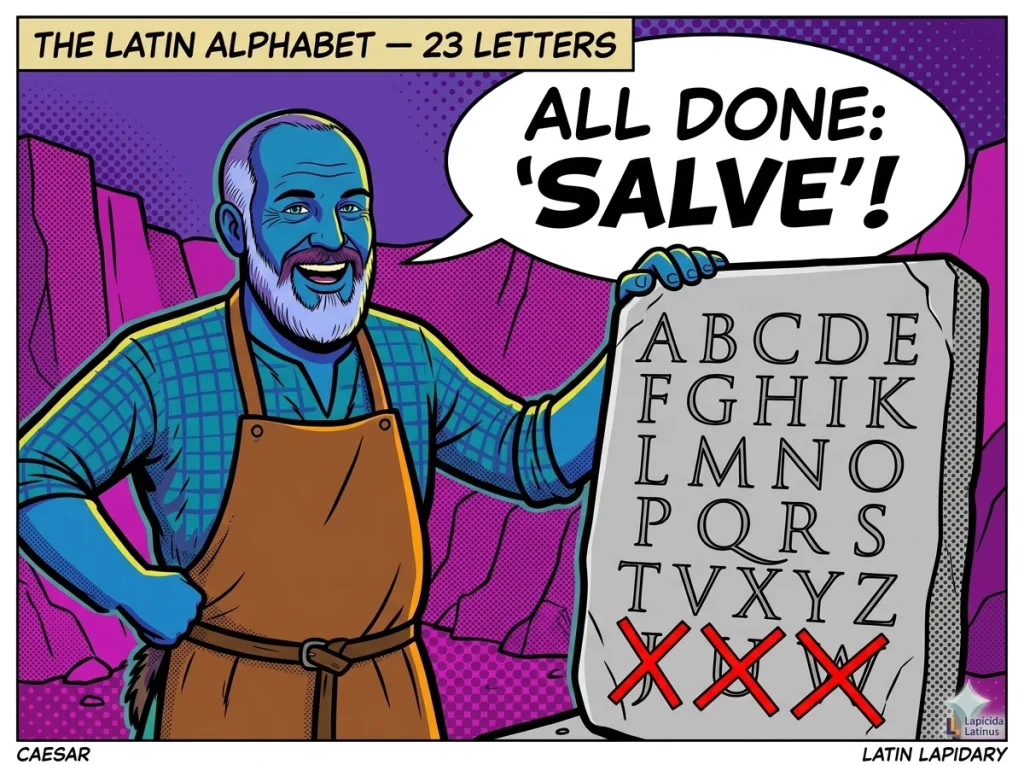
The Latin alphabet is the foundation of all Western European writing systems—our German alphabet is directly derived from it. Nevertheless, there are important differences: The ancient Romans did not have a W, a J, or a true V as we understand it today.
In this article, you’ll learn: the 23 letters of Classical Latin, their correct pronunciation (reconstructed Classical pronunciation), common mistakes with C, V, and I, and vowel quantities.
- Complete chart of letters with pronunciation notes
- The most important pronunciation rules for C, V, I, AE, and OE
- Vowel quantities: short vs. long vowels
- No W, no J—what that means
How many letters are there in the Latin alphabet?
The classical Latin alphabet has 23 letters: A B C D E F G H I K L M N O P Q R S T V X Y Z. The letters J, U, and W do not exist in classical Latin. I represents both the vowel [i] and the consonant [j], while V represents [u] (vowel) and [w] (consonant).
The Latin Alphabet — All 23 Letters with Pronunciation
In classical pronunciation (reconstructed, ca. 1st century BCE), the letters are pronounced as follows:
| Letter | Name | Pronunciation | Example |
|---|---|---|---|
| A | a | [a] short or [a:] long | aqua |
| B | be | [b] | bellum |
| C | ce | always [k] — never [ts] | Caesar = [kaesar] |
| D | de | [d] | deus |
| E | e | [e] short or [e:] long | rex |
| F | ef | [f] | filia |
| G | ge | always [g] — never [dsch] | Gallia |
| H | ha | [h] (aspirated, weak) | homo |
| I | i | [i] (vowel) or [j] (consonant) | iam = [jam] |
| K | ka | [k] — only in loanwords | Kalendae |
| L | el | [l] | luna |
| M | em | [m] | mater |
| N | en | [n] | nox |
| O | o | [o] short or [o:] long | orbis |
| P | pe | [p] | pax |
| Q | qu | always [kw] before u | qui = [kwi] |
| R | er | Tongue-R (rolled) | Roma |
| S | es | always [s] — never [z] | servus |
| T | te | always [t] — never [ts] | terra |
| V | u | [u] (vowel) or [w] (consonant) | vita, vinum = [winum] |
| X | ix | [ks] | rex = [reks] |
| Y | ypsilon | [y] — only loanwords from Greek | lyra |
| Z | zeta | [dz] — only loanwords | zona |
The Most Important Pronunciation Rules in Latin
These are the rules most commonly mispronounced in class:
- C is always pronounced [k] — never [ts]: Caesar = [Kaesar], Cicero = [Kikero]. The [ts] pronunciation didn’t emerge until the Middle Ages (Ecclesiastical Latin). In high school, classical pronunciation is expected.
- V is pronounced like [w]: vinum = [winum], via = [wia]. The “V” in Classical Latin is not a fricative [v] as in German, but a semivowel [w].
- I before a vowel = [j]: iam (now) = [jam], Iuppiter = [Juppiter]. In modern print, it is often written as “J,” but this is not classical.
- AE and OE are diphthongs: ae sounds like [ai]: Caesar = [Kaisar]. oe sounds like [oi]: poena = [poina].
- TI before a vowel = [ti] (not [tsi]): natio = [natio], not [natsio]. Ecclesiastical Latin pronounces it [tsio].
- Vowel quantities (short vs. long): A long vowel (with a macron: ā, ē, ī, ō, ū) is pronounced twice as long. There is no equivalent in German—but vowel length changes the meaning: mālum (apple) vs. malum (evil).
Learn Latin now. Our learning app:

No W, no J—the missing letters in Latin
The classical Latin alphabet lacks the letters J, U, and W—even though the corresponding sounds exist:
| Sound | Classical | Modern Latin/Pronunciation | Example |
|---|---|---|---|
| [j] | I before a vowel | J in modern editions | iam or jam (now) |
| [u] | V (vowel) | U in modern editions | VRBIS = urbis |
| [w] | V (consonant) | V remains V | vinum = [winum] |
| [w] | No W sound in original Latin | — | W only in loanwords |
In medieval manuscripts and inscriptions, one therefore often sees VRBIS (= urbis) or IVLIVS (= Iulius). It was not until the humanist printers (15th/16th centuries) that U and J were introduced as separate letters.
More on the history of the Latin alphabet: Wikipedia: Latin Alphabet.
For those who want to get started the right way with the alphabet: The Latin Learning Portal shows you the path from the alphabet to real sentences.
You can reinforce your knowledge of the letters in a fun way—for example, with Latin crossword puzzles.
More blog posts on this topic:





Frequently Asked Questions About the Latin Alphabet
How many letters are there in the Latin alphabet?
The classical Latin alphabet has 23 letters: A B C D E F G H I K L M N O P Q R S T V X Y Z. J, U, and W do not exist as separate letters in classical Latin. Y and Z were adopted for Greek loanwords.
How is C pronounced in Latin?
In Classical Latin, C is always pronounced like K: Caesar = [Kaesar], Cicero = [Kikero]. The pronunciation as [ts] (Zizero) is Ecclesiastical Latin and dates back to the Middle Ages. In high school, Classical pronunciation is generally expected.
How is V pronounced in Latin?
In Classical Latin, V represents both the vowel [u] and the semivowel [w]: vita = [wita], vinum = [winum]. The German [v], as in “Vogel,” does not exist in Classical Latin. Modern editions often use U for the vowel and V for the consonant.
Is there a W in Latin?
No. Classical Latin has no letter W. The [w] sound is represented by the consonant V. W as a separate letter appears only in medieval texts when Germanic names or loanwords were incorporated.
What are vowel quantities in Latin?
In Latin, a distinction is made between short and long vowels. Long vowels (marked with a macron in textbooks: ā, ē, ī, ō, ū) are pronounced twice as long. Vowel length can change the meaning: malum (short a) = evil; mālum (long a) = apple.
Reading and Understanding Latin — Step by Step
Learn Latin now. Our learning app: