
Christmas in Latin — Merry Christmas, Latin Carols and the Christmas Story
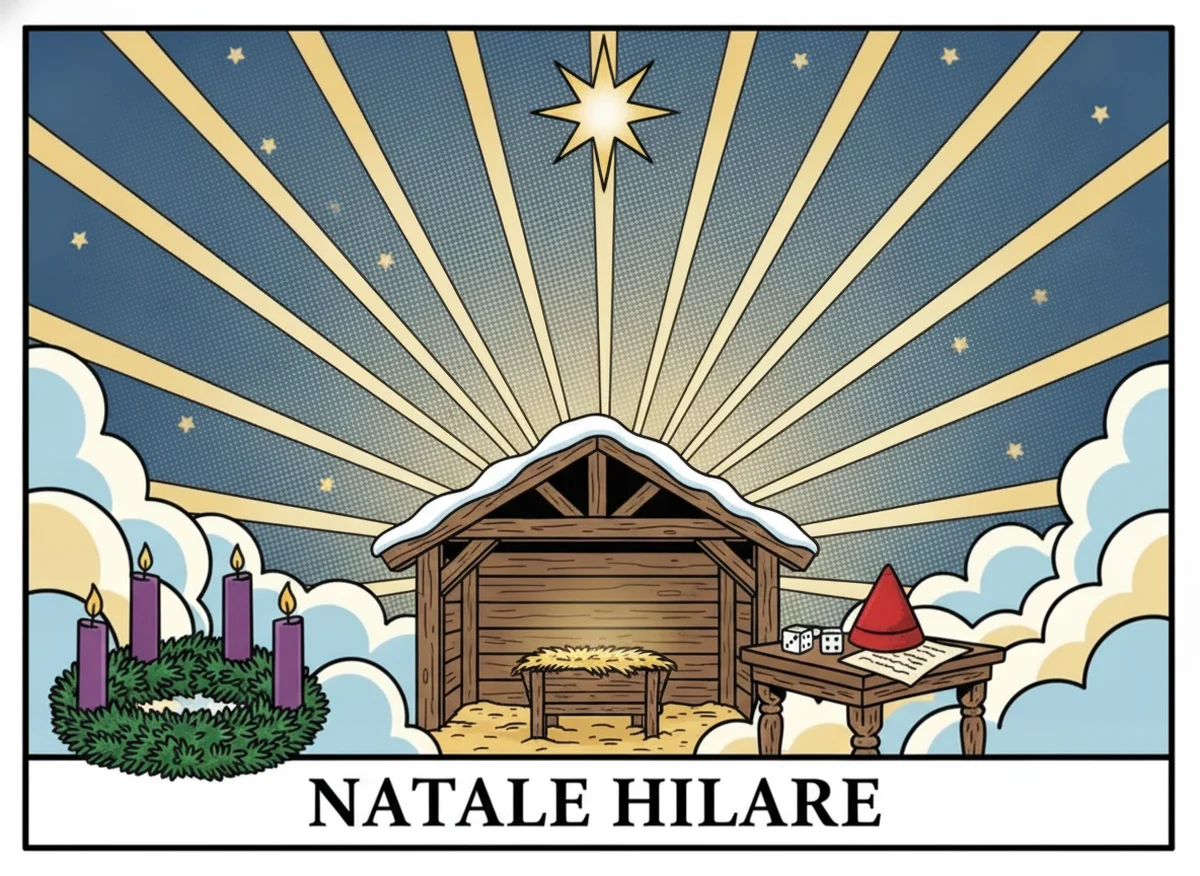
Christmas in Latin is Nativitas, “the Nativity, the birth”. To say “Merry Christmas” in Latin, you say Felicem Nativitatem! or, shorter, Natale hilare! Behind the greeting lies a whole treasury of Latin texts: carols such as Adeste fideles, the Christmas story from the Gospel of Luke, and the feast the Romans celebrated in December long before.
Here you will find everything in one place:
- Latin Christmas greetings with a literal translation – and why they use the accusative
- Christmas vocabulary with genitive and gender
- Latin Christmas carols and the Christmas story, each with a translation
- the Saturnalia: how the Romans celebrated in December
How do you say “Merry Christmas” in Latin?
“Merry Christmas” in Latin is Felicem Nativitatem! – literally “(I wish you) a happy Nativity”, meaning the birth of Christ. Just as common is Natale hilare!, “a merry birthday!”. For the new year you wish Felicem annum novum!
Merry Christmas in Latin: greetings with translation
You can write these Latin Christmas greetings on a card or say them aloud:
| Latin | meaning |
|---|---|
| Felicem Nativitatem! | “(I wish you) a happy Nativity!” accusative: the verb opto (“I wish”) is left out |
| Natale hilare! | “(I wish you) a merry birthday!” natale “birthday” (neuter); hilare agrees in case, number and gender |
| Felicem diem Nativitatis! | “(I wish you) a happy day of the Nativity!” Nativitatis is genitive: “of the Nativity” |
| Felicem Natalem Christi! | “(I wish you) a happy birthday of Christ!” natalis (short for dies natalis) “birthday”, Christi genitive |
| Felicem annum novum! | “(I wish you) a happy new year!” annus novus in the accusative |
Why is “Felicem Nativitatem” in the accusative?
Because a verb is understood: Opto tibi felicem Nativitatem – “I wish you a happy Nativity”. What you wish is the object, so it stands in the accusative; in the greeting the verb is simply dropped. English does the same with “Happy holidays!”, short for “I wish you happy holidays”, only English no longer shows the case. If you want the full sentence:
| Latin | English |
|---|---|
| Opto tibi felicem Nativitatem et annum novum faustum. | I wish you (one person) a merry Christmas and a happy new year. |
| Opto vobis felicem Nativitatem et annum novum faustum. | I wish you (several people) a merry Christmas and a happy new year. |
tibi and vobis are datives (“to you”). More on the cases in our guide to the Latin cases, and how the endings match in the Latin declension table.
How do you pronounce the greetings?
At Christmas you mostly hear Church Latin with its Italian sound; at school you learn the classical pronunciation. More in our guide to Latin pronunciation.
| Latin | pronunciation |
|---|---|
| Felicem Nativitatem | classical: feh-LEE-kem nah-tee-wih-TAH-tem Church Latin: feh-LEE-chem nah-tee-vee-TAH-tem |
| Natale hilare | classical: nah-TAH-leh HIH-lah-reh Church Latin: nah-TAH-leh HEE-lah-reh |
Christmas vocabulary in Latin
Ten words that keep coming up in the Christmas story and the carols – with genitive and gender, the way Latin vocabulary is learned. The bars over the vowels (macrons) mark the long syllables.
| Latin | meaning |
|---|---|
| stēlla, stēllae f. | star |
| pāstor, pāstōris m. | shepherd Luke 2:8: pastores erant |
| angelus, angelī m. | angel, messenger Luke 2:9: angelus Domini |
| īnfāns, īnfantis m. | infant, baby Luke 2:12: invenietis infantem |
| gaudium, gaudiī n. | joy Luke 2:10: gaudium magnum |
| pāx, pācis f. | peace Luke 2:14: in terra pax |
| lūx, lūcis f. | light |
| nox, noctis f. | night |
| dōnum, dōnī n. | gift |
| virgō, virginis f. | virgin, young woman |
In Lapicida you can save such words as your own list and practise them with spaced repetition, see Latin vocabulary.
Latin Christmas carols
Adeste fideles – in English “O Come, All Ye Faithful” – is the best-known Latin Christmas carol. It dates from the 18th century and calls the faithful to Bethlehem: Venite adoremus, “Come, let us adore”. All verses in Latin and English, translated line by line: Adeste Fideles – Latin lyrics with English translation.
Veni, veni, Emmanuel – “O Come, O Come, Emmanuel” – belongs to Advent. Each verse calls on Christ with a different Old Testament title, and behind them stand the seven O Antiphons of the week before Christmas. Lyrics, translation and the O Antiphons at a glance: Veni, Veni, Emmanuel – lyrics and translation.
More Latin carols worth knowing: In dulci iubilo mixes Latin and German lines (in English it became “Good Christian Men, Rejoice”); Quem pastores laudavere, Gaudete and Puer natus in Bethlehem. Many popular songs such as “Silent Night” also exist in modern Latin versions. Those texts are by living translators, so we do not reprint them here.
Read Latin texts yourself
In Lapicida you read real Latin texts, opened up word by word, including passages from the Vulgate and our own reading texts. The Latin texts in the app show you the form and meaning of every word.
Learn Latin now. Our learning app:

The Christmas story in Latin (Luke 2)
The Christmas story is told in the Gospel of Luke, chapter 2. In Latin it is read in the Vulgate, the Latin Bible. Two verses are familiar to almost everyone – the second is still sung as the Gloria:
| Latin | English |
|---|---|
| 2:11 quia natus est vobis hodie Salvator, qui est Christus Dominus in civitate David. | for to you is born this day a Saviour, who is Christ the Lord, in the city of David. |
| 2:14 Gloria in altissimis Deo, et in terra pax hominibus bonae voluntatis. | Glory to God in the highest, and on earth peace to men of good will. |
natus est is the perfect of nasci (“to be born”): “he is born”. hominibus bonae voluntatis means literally “to men of good will” – bonae voluntatis is a genitive of quality.
The full text with a line-by-line translation, origin and pronunciation is here: The Christmas Story in Latin – Luke 2, text and translation. More prayers such as the Ave Maria and the Gloria Patri are collected on our page Catholic prayers in Latin, and short sayings for cards in our Latin quotes.
How the Romans celebrated in December: the Saturnalia
Christmas is a Christian feast and came later. In December the Romans of the Republic celebrated the Saturnalia in honour of the god Saturn: first on 17 December, later over several days. For the festival much was turned upside down. Masters served their slaves, dice games were allowed, and slaves wore the pilleus, the felt cap of freed slaves. People greeted each other with Io Saturnalia!
What that could look like is told in our reading text “Io Saturnalia” from year 3. Ari and his friends draw lots for a king for the day:
| Latin | English |
|---|---|
| Rēgem sorte lēgērunt. Marcus culmōs tenēbat. Rēx Ariovistus factus est. | They chose a king by lot. Marcus held the straws. Ariovistus was made king. |
| „Canis prīmus edit”, inquit rēx. Lupus prīmus ēdit, et Marcus eī catīnum tenuit. | “The dog eats first,” said the king. Lupus ate first, and Marcus held the bowl for him. |
Rēx Ariovistus factus est – “Ariovistus was made king”: the lot has decided, and the new king lets the dog eat first. The whole story is one of the Lapicida reading texts in the app, see reading Latin texts in Lapicida.
Frequently asked questions about Christmas in Latin
How do you say “Merry Christmas” in Latin?
“Felicem Nativitatem!” – literally “(I wish you) a happy Nativity”. Shorter and just as common is “Natale hilare!”, “a merry birthday!”.
What is the Latin word for Christmas?
Christmas in Latin is “Nativitas”, “the birth”, in full “Nativitas Domini”, “the birth of the Lord”. Church Latin also says “Natalis Domini”, “the birthday of the Lord”.
Why is “Felicem Nativitatem” in the accusative?
Because the verb “opto” (I wish) is understood: “Opto tibi felicem Nativitatem”. What you wish is the object and stands in the accusative – like English “Happy holidays!”, short for “I wish you happy holidays”.
How do you say “Happy New Year” in Latin?
“Felicem annum novum!” – “a happy new year!”. As a full sentence: “Opto tibi felicem Nativitatem et annum novum faustum.” – “I wish you a merry Christmas and a happy new year.”
Which Latin Christmas carols are there?
The best known are “Adeste fideles” (O Come, All Ye Faithful) and, for Advent, “Veni, veni, Emmanuel” (O Come, O Come, Emmanuel). Others are “In dulci iubilo”, “Quem pastores laudavere”, “Gaudete” and “Puer natus in Bethlehem”.
Did the Romans celebrate Christmas?
No. Christmas is a Christian feast and came later. In December the Romans celebrated the Saturnalia: for a few days much was turned upside down, masters served their slaves and dice games were allowed.
Read Christmas in Latin
Carol, prayer or Bible text: with Lapicida you learn to read Latin yourself. For the week before Christmas try Veni, Veni, Emmanuel with the O Antiphons, for Christmas Eve the Christmas story in Latin.
Learn Latin now. Our learning app: