Latin First Declension (a-Declension) — Endings, Table & Examples
The first declension (also called the a-declension) is usually the very first one Latin learners meet. Its nouns end in -a in the nominative singular (puella, femina, terra) and are almost all feminine. Master it and you have the foundation every other declension builds on. This article is part of the Learn Latin series by Lapicida.
- All the endings of the first declension — singular and plural
- The complete table using puella
- The gender rule and the masculine exceptions (nauta, agricola, poeta)
- The six cases in a sentence, plus common mistakes
What is the first declension?
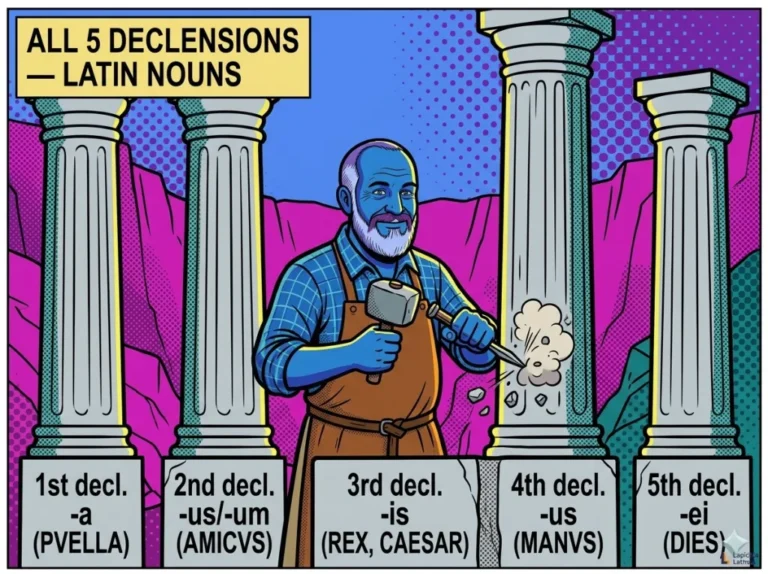
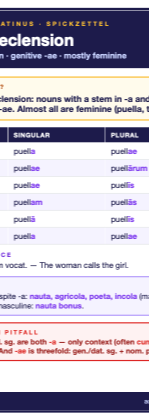
The first declension (a-declension) is the group of Latin nouns whose stem ends in -a. You recognise it by the genitive singular in -ae. Most of these nouns are feminine, such as puella (girl) or terra (earth). It is one of the five Latin declensions.
The endings of the first declension
These six pairs of endings apply to every first-declension noun:
| Case | Singular | Plural |
|---|---|---|
| Nominative | -a | -ae |
| Genitive | -ae | -arum |
| Dative | -ae | -is |
| Accusative | -am | -as |
| Ablative | -a | -is |
| Vocative | -a | -ae |
How to spot it: the genitive singular in -ae gives it away. That is why the dictionary lists the genitive too: puella, puellae.

The first-declension table: puella
puella, puellae f. — girl
| Case | Singular | Plural | Function |
|---|---|---|---|
| Nominative | puella | puellae | subject |
| Genitive | puellae | puellarum | possession |
| Dative | puellae | puellis | indirect object |
| Accusative | puellam | puellas | direct object |
| Ablative | puella | puellis | means / circumstance |
| Vocative | puella | puellae | direct address |
The same pattern is followed by femina (woman), terra (earth), aqua (water) and every other a-noun. See all classes on the Latin declension chart.
Learn Latin now. Our learning app:

Gender: why almost all a-nouns are feminine
The rule: first-declension nouns are feminine. But one important group is masculine — words for male people or occupations, even though they end in -a:
- nauta — sailor
- agricola — farmer
- poeta — poet
- incola — inhabitant
- pirata (pirate), scriba (clerk), collega (colleague)
This matters for agreement: an adjective follows the gender, not the ending — nauta bonus (the good sailor), not nauta bona.
One special form: to keep dea (goddess) and filia (daughter) distinct from deus and filius in the dative/ablative plural, Latin uses -abus: deabus, filiabus.
The six cases in a sentence
| Case | Latin | English |
|---|---|---|
| Nominative | Puella in horto sedet. | The girl sits in the garden. |
| Genitive | Casa puellae parva est. | The house of the girl is small. |
| Dative | Amica puellae epistulam scribit. | The friend writes a letter to the girl. |
| Accusative | Femina puellam vocat. | The woman calls the girl. |
| Ablative | Puella aqua plantas rigat. | The girl waters the plants with water. |
| Vocative | “Veni huc, puella!” | “Come here, girl!” |
Common mistakes
- Confusing nominative and ablative singular: both end in -a (puella). Only the context — often a preposition such as cum or in — shows the ablative. (In speech the ablative is long, -ā.)
- -ae is threefold: genitive singular, dative singular and nominative plural all end in -ae. The sentence decides which.
- Mixing up -arum and -orum: the genitive plural is -arum (puellarum) in the first declension, -orum in the second.
- Making masculine exceptions agree wrongly: poeta is masculine — poeta clarus, not poeta clara.
Frequently asked questions
What is the first declension in Latin?
The first declension (a-declension) contains nouns whose stem ends in -a and whose genitive singular ends in -ae, such as puella, puellae. Most of them are feminine.
How do I recognise the first declension?
By the genitive singular in -ae. That is why the dictionary gives the genitive form: puella, puellae.
Which first-declension nouns are masculine?
Words for male people or occupations: nauta (sailor), agricola (farmer), poeta (poet), incola (inhabitant), pirata, scriba, collega. They end in -a but are masculine.
How do I tell nominative and ablative singular apart?
Both end in -a. Only the context decides — often a preposition such as cum or in for the ablative. In pronunciation the ablative is long (-ā).
When do students learn the first declension?
Right at the start of Latin, usually in the first year. Together with the second declension it is the base for all further forms.
Practise the declensions actively
Lapicida Latinus makes you type the forms instead of just ticking boxes — forms trainer, sentence quiz and reading in one app. Start free, full version from €19.99/year.
Learn Latin now. Our learning app:
See also: Second declension · All five declensions · Latin nouns · Latin declension (Wikipedia).