Seneca, De brevitate vitae: read and translate in three stages
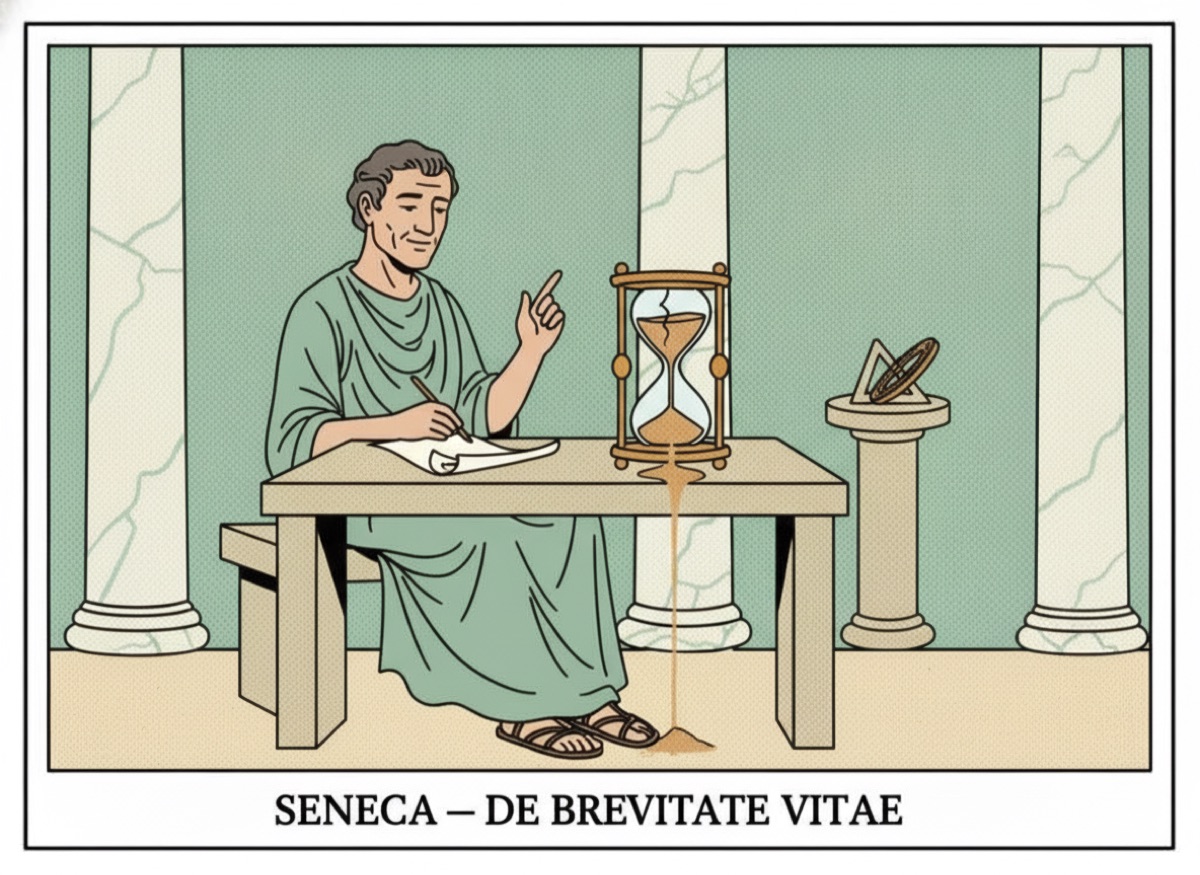
In De brevitate vitae, “On the Shortness of Life”, Seneca turns an old complaint around: life is not short, we waste it. In Lapicida you read chapters 1 to 3 in three stages, from a simplified text to the original. The table shows all nine texts at a glance.
| Chapter sentences per level | 21 | 24 | 27 |
|---|---|---|---|
| 1 Life is not short | 17 | 13 | 8 |
| 2 Those who lose their life | 25 | 22 | 19 |
| 3 The old man’s reckoning | 24 | 20 | 14 |
Level 21 is simplified, level 24 keeps close to the original and only splits the long periods, level 27 is Seneca’s own wording. All nine texts are part of the full version and can also be practised with Unda. Seneca’s letters have a page of their own: Seneca in Latin: the Letters to Lucilius.
What is De brevitate vitae about?
De brevitate vitae is the tenth book of Seneca’s Dialogi, his philosophical writings. Seneca probably wrote it around AD 49 for his friend Paulinus, who as praefectus annonae ran Rome’s grain supply. The thesis comes right at the start: it is not nature that gives us too little time, we waste it ourselves. Chapter 1 turns the complaint around, chapter 2 shows what people lose their lives to, and chapter 3 makes a hundred-year-old reckon how little of his time was really his.
Chapter 1: Life is not short
Seneca starts with the complaint of the crowd and of famous men. Hippocrates, “the greatest of physicians”, cried that life is short and art is long. In Seneca that reads vitam brevem esse, longam artem, known today as ars longa, vita brevis. Then comes the turn, the most famous sentence of the work:
Translation
Two sentences later Seneca draws the conclusion, with two contrasts in a row: not received but made; not poor but wasteful.
Translation
Chapter 2: Those who lose their life
Chapter 2 opens with the sentence often quoted as the motto of the whole work:
Translation
Then comes a long catalogue: one is held by greed, another by ambition, a third drinks, a fourth dozes. Seneca quotes a poet saying that only a small part of life is truly lived, and adds:
Translation
At the end of the chapter there is a sentence that recalls Seneca’s first letter. There he says vindica te tibi, “claim yourself for yourself”; here he observes that nobody does exactly that:
Translation
Chapter 3: The old man’s reckoning
Seneca picks out a hundred-year-old and makes him count: how much time did the creditor take, the mistress, the patron, the client, the quarrels with his wife? The result: he has fewer years than he counts. Seneca puts the reason into a sentence of two halves built the same way:
Translation
And to everyone who postpones life until retirement he puts the question:
Translation
The same opening in three stages
This is how the text grows from stage to stage. In the original, the first sentence is a long period with two quod clauses and an ut clause. Level 24 keeps Seneca’s words and only splits the period; level 21 says the same in two simple sentences:
Translation
Translation
Translation
Rule of thumb: first understand the thought in simple sentences, then Seneca’s words, then his periods. That way you reach the original without guessing.
Two sentences translated in four steps
First literally, then with what Seneca leaves out supplied, then with the Stoic idea, and only at the end as a finished sentence.
Sentence 1: Non exiguum temporis habemus, sed multum perdidimus.
- Literal: “Not little of time we have, but much we have lost.”
- Supplied: temporis depends on exiguum as a genitive (“little of time”, partitive genitive). With multum you supply the same word: “much [time]”. perdidimus is perfect: the wasting has already happened.
- With the Stoic idea: Stoicism separates what is in our power from what is not. We do not decide how long we live, but we do decide how we use our time. So it is not nature that is to blame, it is us.
- Finished: “We do not have too little time; we have wasted too much of it.”
Sentence 2: Omnia tamquam mortales timetis, omnia tamquam immortales concupiscitis.
- Literal: “Everything like mortals you fear, everything like immortals you desire.”
- Supplied: tamquam introduces a shortened comparison: “as if you [were] mortals”. mortales and immortales are predicative to the subject “you”. Both halves are built the same way (parallelism), and their content is opposed (antithesis).
- With the Stoic idea: For the Stoics, fear and desire are two of the four basic passions. Seneca shows that both come from the same mistake: we misjudge our time.
- Finished: “You fear everything as if you were mortal, and desire everything as if you were immortal.”
Jetzt Latein lernen. Unsere Lern-App:

De brevitate vitae for exams: text, style, context
In the German state of Baden-Württemberg, for example, the 2028 Abitur regulations prescribe “Seneca: philosophical writings” for the translation task in advanced Latin, and De brevitate vitae is one of them. For interpretation, three things are worth a look.
Style: antithesis, parallelism, anaphora
Seneca thinks in contrasts: non accipimus brevem vitam sed fecimus, tamquam mortales … tamquam immortales. In chapter 2 he piles up exclamations with the same opening, Quam multis divitiae graves sunt! … Quam multi continuis voluptatibus pallent! (2.4), an anaphora. And the catalogue alium … alium … alius lists the ways of losing one’s life.
Text: which wording?
The text comes down to us in manuscripts, and editions differ in some places. In the very first sentence The Latin Library has gignimur, other editions gignamur. Lapicida follows manuscript A, as The Latin Library does.
Context: Seneca’s life and time
It matters that Seneca of all people writes about lost time: he was an orator, a senator and later Nero’s tutor and adviser, one of the busy people he describes. More on Seneca’s style and life is on the page on the Letters to Lucilius.
Frequently asked — De brevitate vitae
What does “De brevitate vitae” mean?
“On the Shortness of Life”: an essay by Seneca for his friend Paulinus, the tenth book of his Dialogi, probably written around AD 49.
What is the main message of De brevitate vitae?
Life is not short, we make it short by wasting our time: “Non exiguum temporis habemus, sed multum perdidimus” (1.3). Life is long if you know how to use it (2.1).
Which chapters are in Lapicida?
Chapters 1 to 3, each in three stages: simplified (level 21), close to the original (level 24) and original (level 27). Together that makes nine texts with 162 sentences; they are part of the full version.
How hard is De brevitate vitae?
Seneca’s vocabulary is manageable; the hard parts are the long periods at the start and the many contrasts. If you read the simplified version first, you already know the ideas and words when you get to the original.
Jetzt Latein lernen. Unsere Lern-App: