The 5 Best Latin Apps of 2026 — An Honest Comparison

Anyone who wants to learn Latin will now find a manageable—though confusingly marketed—selection of apps. Some promise more than they deliver. This comparison evaluates the best Latin apps of 2026 based on the criteria that matter for real learning progress: grammar practice, vocabulary, reading, and test preparation. If you want to read original Latin texts for free, you can find them at the Perseus Digital Library.
- Evaluation Criteria: What Counts, What Doesn’t
- An overview of the 5 apps, with pros and cons
- Which app is right for whom
- Our recommendation based on learning goals
What Are the Best Latin Apps in 2026?
The best Latin app depends on your learning goal: For active grammar practice and Latinum preparation exam preparation, Lapicida Latinus is the leader—it’s the only app with sentence component exercises, level-appropriate reading texts, and targeted study lists. For a school dictionary and vocabulary practice, Navigium is well-established and exam-proven. Duolingo is good for initial motivation, but not for structured Latin study.
Full disclosure. Lapicida Latinus is one of the five apps in this comparison — and it is ours. So we have not reviewed it without saying so: the table states for every app what it does and does not do, including ours. If you would rather not take our word for it, read the comparison against the providers themselves — they are all linked below. We are paid for none of these mentions, and there are no affiliate links on this page.
How We Rated Them
| Criterion | Weight | Why it’s important |
|---|---|---|
| Grammar practice (conjugation trainer) | High | Grammar forms are the foundation of every translation |
| Sentence Analysis / Sentence Quiz | High | Understanding unfamiliar texts is a core skill |
| Vocabulary Trainer (Quality + Scope) | Medium | Vocabulary is necessary, but not sufficient |
| Reading with original texts | Moderate | Authentic texts = exam reality |
| Price / Value for money | Average | What do you get for your money? |
| Gamification / Motivation | Low | Helpful, but no substitute for learning |
A Comparison of the 5 Best Latin Apps in 2026
The following table shows at a glance which app covers which learning areas:
| App | Grammar Trainer | Sentence Quiz | Vocabulary Trainer | Reading | Exams (AP / Latinum) | Price |
|---|---|---|---|---|---|---|
| Lapicida Latinus | ✅ | ✅ | ✅ | ✅ | ✅ | Free / €19.99/year |
| Navigium | ✅ | ❌* | ✅✅ | ✅ | ⚠️ | €24/year · dictionary only €5.99 |
| Lateinorum | ❌ | ❌ | ⚠️ | ⚠️ | ❌ | Free tier permanently · optional premium |
| Cabuu | ❌ | ❌ | ✅ | ❌ | ❌ | Free / subscription · textbook lists €3.49–7.99 |
| Duolingo | ❌ | ❌ | ⚠️ | ❌ | ❌ | Free / Plus Subscription |
What the ticks do not tell you. A tick means “present”, not “built the same way”. Navigium has extensive forms training — identifying forms, declension and conjugation drills, agreement practice — and a large collection of edited original texts by Caesar, Ovid, Cicero, Catullus, Virgil and Phaedrus. The difference is not whether, but how it is built: Navigium is a look-up and drill tool, we are a learning companion — more on that below. * In Navigium you can click a word in a sentence and be told what it is. That is looking it up. In our sentence quiz you have to work it out yourself — and then find out whether you were right. That is the whole difference between seeing and knowing. And Navigium’s dictionary of roughly 38,500 entries has no counterpart on our side.
Where these claims come from: we checked Navigium against a complete source collection of our own. For Lateinorum, Cabuu and Duolingo we rely on what the providers state themselves — so “not mentioned” does not necessarily mean “does not exist”. If something here is wrong, tell us and we will correct it.
💡 Tip: No other tool offers verb conjugation practice, sentence quizzes, and reading exercises all at once. If you’re seriously preparing for high school or the Latinum exam, Lapicida is a must.
#1 Lapicida Latinus — Best Overall Package for Grammar Practice
- ✅ Vocabulary trainer with 11,000+ entries and spaced repetition
- ✅ Morphology trainer: all declensions and conjugations
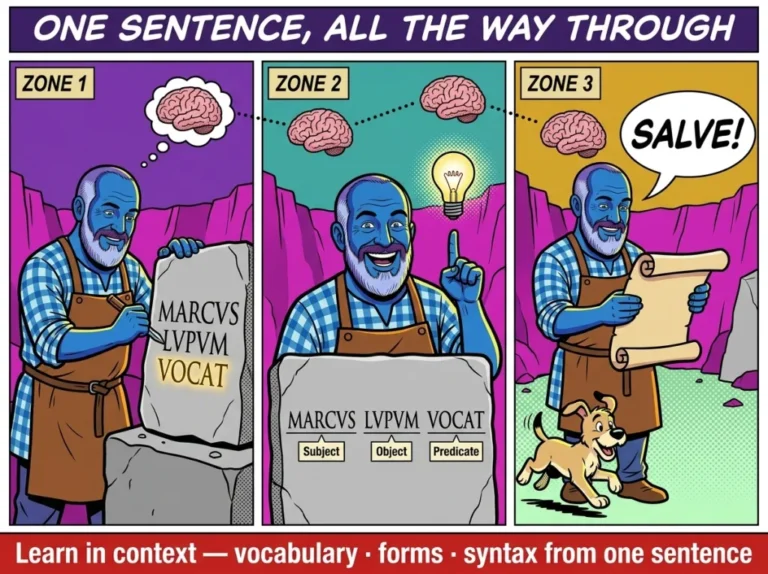
- ✅ Sentence quiz: 2,300+ original sentences from Cicero, Caesar, Ovid, Virgil, Pliny — active sentence component analysis (unique)
- ✅ Reading: Cicero, Caesar, Sallust complete (Levels 3–12) — Suetonius, Vulgate (Sermon on the Mount, Epistles of Paul, Acts) in preparation
- ✅ Dyslexia-friendly color coding
- ✅ Textbook vocabulary via scan function (OCR, any textbook)
- ✅ Fully offline on Android
- ⚠️ No school-approved dictionary
- ⚠️ No direct textbook integration (Stabilo pen, etc.) — Workaround: Scan feature
- 💶 Free (Basic) / €19.99/year — one purchase, no micro-transactions
#2 Navigium — Best school dictionary and vocabulary trainer
- ✅ 35,000+ entries in the exam-approved dictionary
- ✅ Strongly established in schools (grades 5–13)
- ✅ Vocabulary trainer with the Klett textbooks (Pontes, Libellus)
- ❌ No sentence quizzes / no sentence structure analysis
- ❌ No reading feature
- ❌ No scan feature for your own vocabulary
- 💶 Fee-based (subscription)
#3 Lateinorum — Passive reference tool with subscription
- ⚠️ Vocabulary trainer: Self-assessment (wrong / partially correct / correct) with spaced repetition — no active recall, no game mode
- ⚠️ AI scan: Capture vocabulary via photo — the AI translates, and the learner then self-assesses
- ✅ Built-in dictionary
- ⚠️ Texts in reading view — no guided learning exercises
- ❌ Grammar provided only as reference text; no interactive practice
- ❌ No verb conjugation trainer, no sentence quiz
- 💶 Free (most features), optional in-app purchases
#4 Duolingo Latin — For beginners and motivation
- ✅ Game-like, low barrier to entry, helps establish a learning routine
- ❌ No real grammar trainer
- ❌ No reading passages, no sentence quizzes
- ❌ Not suitable for high school or the Latinum exam
- ❌ No textbook integration, no scanning feature
- ⚠️ Seemingly free — many features only available with Duolingo Plus (subscription)
- 💶 Basic version free (with ads) / Plus subscription approx. 6.99 €/month
#5 Anki (with Latin deck) — Best flashcard solution
- ✅ Powerful spaced repetition system
- ✅ Many community-created Latin decks
- ❌ No grammar trainer, no sentence quizzes, no reading material
- ❌ Time-consuming setup
- 💶 Free (app) / Decks vary in price
Another app: Lateinon — The free Lateinon app offers a comprehensive grammar reference, translations of original texts (Ovid, Livy, Cicero), and a cultural section on ancient Rome. Strengths: free, extensive text database. Weaknesses: no active verb conjugation trainer, no sentence quizzes, no spaced repetition for vocabulary. Good as a reference tool—not as a daily practice tool for high school or the Latinum exam.
💡 Tip: The best app isn’t just one app. Use Navigium for the dictionary during exams, and Lapicida for daily grammar and reading practice—that’s the combination that really works in high school and for Latinum preparation.
Learn Latin now. Our learning app:

Our recommendation by learning goal
| Learning Goal | Recommendation |
|---|---|
| High School Grades 5–12 (Grammar Practice) | Lapicida Latinus |
| Catching up on / preparing for Latinum | Lapicida Latinus + Online Course |
| School dictionary for exams | Navigium (approved for exams) |
| Getting Started / Motivation | Duolingo (free, game-based) |
| Vocabulary Review for Adults | Lapicida or Anki |
| Introductory Latin without pressure | Duolingo |
The best combination for Latinum candidates: Lapicida Latinus for daily grammar and vocabulary practice + the Navigium dictionary for the exam + a structured course (distance learning or intensive course) for feedback on translations.
For those who want to dive deeper into the subject: The Latin Learning Portal explains which methods and grammar topics are truly helpful for self-study.
More blog posts on this topic:






What each of these apps actually is
A table of ticks answers the wrong question. It says what is there — not what it was built for. And that is what decides whether an app helps you learn or merely tests you.
| App | What it is | What that is good for |
|---|---|---|
| Navigium | a reference and drill tool. Alone among these it has almost everything — forms training, texts, a large dictionary — and presents it in tables and single questions. | Looking things up, checking, managing vocabulary. Strong once you know what you are looking for. |
| Cabuu | a vocabulary trainer, visual and well made, with animations and audio. | Remembering words. Nothing more is promised and nothing more is delivered. |
| Lateinorum | a dictionary with a scanner: photograph the page, translate it sentence by sentence. | Help exactly where you are stuck. |
| Duolingo | a language-learning app, built for modern languages. | First contact and a daily habit. |
| Lapicida Latinus | a learning companion: built around teaching, and thought out from the sentence. Forms are not tested, they are worked out. Get one wrong and you do not get a red number, you get the next step. | Walking the road from form to sentence to text — the exact road an exam asks for. |
And the difference does not stop at teaching: we offer more than one channel. Cards and quizzes are all most apps have. Three more roads matter here, and none of them is decoration:
- Audio throughout, not a sample. Around 33,000 recordings — words, individual forms and whole sentences. You can have a sentence read to you while you take it apart.
- The stylus. Endings are written, not tapped — on a tablet with pen or finger. Writing an ending by hand lodges differently.
- Dyslexia support. Its own typeface, adjustable contrast, calmer screens — and the German → Latin copying route that is expressly recommended for dyslexic learners.
And then there is what appears in none of these columns
The table above has a blind spot built into it: its columns come from what everybody has. Forms trainer, vocabulary, reading — those are arguable, and for Navigium one can fairly say: it has those too. What never appears are the things for which we found no counterpart in the other four apps here.
| What | How it works |
|---|---|
| Unda a text, step by step | A sentence is walked rather than tested: build the word, follow the word-chain, identify the form, fill the gap, read the whole thing. There is no “well done” screen — you work as long as you like and stop when it is enough. |
| Sensus which meaning fits here? | One word, several meanings — and the sentence decides. Four question types, including backwards from the English meaning to the Latin word. Ambiguity is one of the commonest translation errors and cannot be shown at all by a trainer that stores word pairs. |
| Turbo speed with a story | Fast rounds with a narrative running underneath: at most three cards, then the story moves on. The reward is the content, not a number — which is also why we have no streak. |
| Diagnostics the confusion atlas | Not “70 % correct” but what gets confused with what, across four levels. A percentage tells nobody what to do. “Confuses dative with ablative” does. |
| Officina the teacher dashboard | It shows children, not curriculum: topic × person. We want a teacher to be able to coach, instead of administering material under time pressure. |
| Co-op games together, but differentiated | Four of them. In the Sensus Tribunal a class negotiates the right sense — vote, discuss, vote again, transfer to a new sentence. In the Sentence Relay you take turns identifying the parts. In Turbo Race everyone plays their own level in a shared ranking. Forum is the class quiz on the projector. |
💡 The honest conclusion: on the forms trainer one can argue — which is exactly why we gave Navigium the tick above. On these six there is nothing to argue about, because there is simply nothing in the other apps here to compare them with. Trying it costs nothing: start in your browser.
Frequently Asked Questions — Best Latin App
Which Latin app is best for students?
For students from grade 5 and up, Lapicida Latinus is the strongest option: its verb form trainer, sentence quizzes with clause analysis, and reading passages cover exactly what’s required in class and on tests. Navigium is also a good choice for its school-approved dictionary.
Which Latin app is free?
Most of Latinorum’s features are free—optional in-app purchases, no mandatory subscription. Lapicida offers a permanent free basic version (A-declension, present tense verbs, simple sentence quiz). Duolingo is completely free with ads.
Is there a Latin app for the iPhone?
Lapicida Latinus is available as a PWA via Safari (add to Home Screen). Navigium and Lateinorum have native iOS apps. Duolingo has a full iOS app.
Which app is best for the Latinum exam?
Lapicida Latinus is the only app in this comparison that covers all exam-relevant areas: vocabulary, grammatical forms, sentence analysis, and reading passages. For the Latinum, Lapicida is recommended as a daily practice tool to complement a course.
Is Lapicida better than Navigium?
For grammar practice and sentence analysis: Yes, Lapicida is stronger. For the school-approved dictionary: No, Navigium is more established and has more entries. Ideally, use both in parallel.
Try the best Latin app—for free
Learn Latin now. Our learning app: