Learning Latin Vocabulary in Context — The Research Behind It
“You shall know a word by the company it keeps.” (J. R. Firth, 1957) — A word only reveals its meaning through the words around it.
For decades, learning Latin meant one thing above all else: cramming. Word pairs on flashcards, grammar tables recited over and over—amare means “to love,” res means “thing”—done. One building block after another. But depending on the sentence, *res* can also mean “situation,” “possession,” “state,” or “process”—and this is exactly where real Latin begins: not with memorizing word pairs, but with understanding Latin vocabulary in context.
That’s why Lapicida Latinus isn’t just a vocabulary trainer with a few extras. It’s a tool for truly learning—and mastering—Latin: vocabulary, verb forms, sentence elements, and authentic reading material, all interwoven and driven by a continuous narrative. This article explains the idea behind learning Latin the right way—and what’s included in version 1.4.0.
What’s the best way to learn Latin vocabulary?
The best way to learn Latin vocabulary is in context—that is, in a sentence rather than in isolation on a flashcard. The reason: A Latin word rarely has a fixed English translation, but rather a meaning that only becomes clear within a sentence. If you first build a basic vocabulary and then reinforce the meaning within sentences, you’ll be able to reliably recall vocabulary even in new texts.
Why cramming with flashcards fails when it comes to Latin
The classic flashcard reduces a word to a formula: “cavus” on the front, “hollow, arched” on the back. The problem isn’t the repetition, but the isolation.
“A Latin word has no German meaning; nor does it have a Latin meaning—it simply has a meaning.” (Hermann Steinthal, 1971)
Anyone who has memorized *res* merely as a “thing” will be at a loss in the next sentence by Caesar where it means “state.” Only context makes an ambiguous word unambiguous.
Mnemonic: A flashcard stores a word. A sentence stores its meaning.
Why Context Matters—In a Nutshell
Our brain doesn’t store words like a dictionary, but as a network: A word is the sum of its connections—especially to its neighboring words (Firth’s “company it keeps,” 1957). We’ve detailed the extensive research on this topic—the mental lexicon and the DFG project CALLIDUS—in a separate article: Context-Based Vocabulary Learning—the CALLIDUS Project.
In Latin, this is evident in fixed word combinations (collocations) that can only be understood in context:
| Latin phrase | Literal translation | Actual meaning |
|---|---|---|
| pontem facere | “to make a bridge” | to build a bridge |
| fidem facere | “to establish trust” | to build trust |
| aliquem reum facere | “to make someone guilty” | to accuse someone |
Here, facere never simply means “to do”—the meaning lies in the context (Caesar, Bellum Gallicum I). Here’s a hard fact: To truly understand a text, you need at least 95% of the words in a paragraph (Nation 2006)—achievable only through vocabulary that is embedded in context and can be retrieved from it, not by cramming lists. The cognitive load involved in learning Latin (Sweller 1988) explains why isolated lists overload working memory.
Learn Latin now. Our learning app:

This is how Lapicida implements the context-based approach
The idea of learning vocabulary from real texts in context comes from research. The DFG project CALLIDUS pioneered this approach using a corpus-based and automated method. Our response to “corpus-based and automated”: At Lapicida, reading texts are automatically broken down via a CLTK and AI pipeline—into sentences, verb forms, sentence components, and context-based vocabulary aids. This creates a shared set of sentence material that all trainers work with. Read more in Context-Based Vocabulary Learning — the CALLIDUS Project.
Context comes at just the right time. First, a vocabulary foundation is needed: without a basic vocabulary, meaning cannot even be formed within a sentence. The modules in which context plays a role build on this foundation:
- Vocabulary Trainer: builds the basic vocabulary—classic, but anything but dry: with colors, different card types, and game modes. Deliberately without sentence context, because only a solid foundation makes learning in context possible in the first place.
- And then comes Sensus. Once the foundation is in place, the words take on their meaning in context: Sensus practices words with multiple meanings—such as “res,” which can mean “thing,” “situation,” or “state,” depending on the sentence. The learning unit is not the word itself, but the pair (word, meaning)—each meaning develops into its own card.
- Form Trainer: each form is practiced using an example sentence from the shared sentence material.
- Sentence Quiz: sentence components in real sentences—subject, object, ACI, ablative absolute—exactly the constructions that recur in the reading passages.
- Reading: curated original texts with built-in vocabulary support—the leap from practice to real reading.
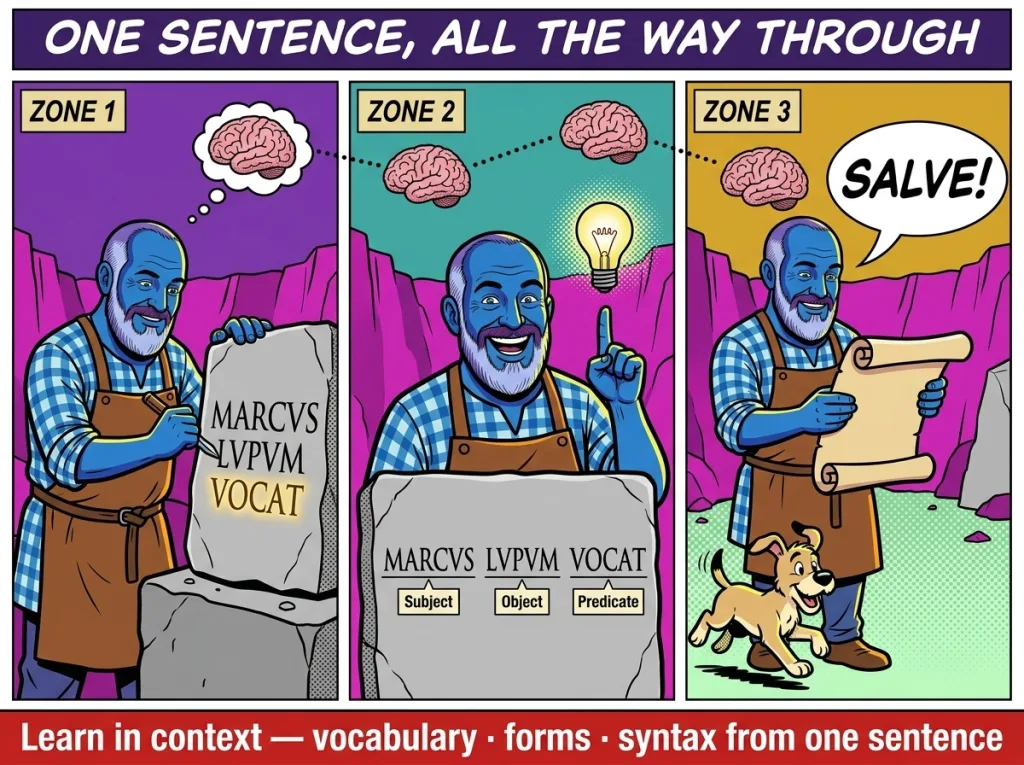
The key is the integration: forms, sentence components, and meanings are all practiced using the same sentence material. A sentence you’ve practiced in the Form Trainer reappears in the Sentence Quiz—marked with a 🧠 in the app. You’ll recognize it instead of starting from scratch.
From Sentence to Story
But why a whole story and not just individual sentences? Because context reduces the burden on working memory. Learning psychologist Anne Friedrich (LRS und Lateinunterricht, 2017) shows that younger learners process information primarily in an event-based manner; disconnected individual sentences force the mind to figure out anew in each sentence who is currently acting—recurring characters relieve this burden. This creates a stable situational model that is easier to anchor than isolated microstructures.
That is precisely why Lapicida’s sentences are set within a continuous story with a fixed cast. And in Sensus, we prefer to practice ambiguous words in exactly these familiar sentences: When characters and scenes are already familiar, the mind remains free for what matters most—the meaning.
And quietly in the background, the Officina Teacher Dashboard shows the teacher where each student is struggling—without requiring any extra effort from the learners.
The result: a tool for mastering Latin
This brings together something that doesn’t exist anywhere else in this combination. Three elements interlock:
- A shared sentence library. Conjugation practice, sentence quizzes, Sensus, and reading all draw from the same sentence material—the same sentence serves as a conjugation exercise one time, a sentence analysis another, and a reading passage yet another.
- A continuous narrative. These sentences tell a story with a fixed cast—familiar characters bring the grammar to life.
- Sensus, doubly anchored. Polysemes are practiced using real classical authors and well-known sentences from your own history. And each meaning travels through the box system as its own card: the learning unit is the pair (word, meaning).
And because learning should also be fun: The new Turbo Mode is a whirlwind through the final lessons—endless cards, crisscrossing vocabulary, verb forms, and sentence components, fast-paced and entertaining. Review that doesn’t feel like a chore—especially for younger learners. Also in version 1.4.0: game modes in the vocabulary trainer that can be freely disabled, a revamped guided sentence quiz mode, a restructured micro-help feature, and more in-depth analytics for teachers.
Here’s the point: Lapicida combines vocabulary, verb forms, sentence components, meaning, and authentic reading into a single learning path—driven by a story and tracked in the background. This exact integration is unique to Lapicida. Learn Latin—without any hassle.
And the flashcards? Don’t throw them away—use them properly. Context doesn’t replace repetition; it complements it: Learn using the box system based on the Leitner cycle, and combine the vocabulary base with its meaning in a sentence. Other apps—from pure flashcard tools to Navigium—usually stick to the list-and-lookup paradigm; that’s not a criticism, but rather a different purpose. You can find a detailed comparison in the Latin app comparison.
Frequently Asked Questions About Learning Latin Vocabulary
Should you learn Latin vocabulary in context or with flashcards?
Both, in the right order: First, build a basic vocabulary (classic review using the spaced repetition method), then reinforce the meaning in a sentence. Context ensures understanding and recall, while repetition ensures long-term retention.
Why isn’t it enough to memorize the English translation?
Because a Latin word usually has multiple meanings, and it’s the sentence that makes the meaning clear. *res* can mean “thing,” “situation,” “state,” or “possession.” If you only learn one translation, you’ll struggle with every sentence that uses a different meaning.
Is Lapicida just a vocabulary trainer?
No. Lapicida integrates vocabulary, verb forms, sentence structures, and authentic reading material into a unified set of sentences, all woven together by a continuous story—a tool for truly learning and mastering Latin, not just cramming vocabulary.
How many vocabulary words do I need to know to understand a Latin text?
Linguist Paul Nation shows that for successful text comprehension, you should know at least 95% of the words in a paragraph. More important than a huge vocabulary is a deeply ingrained core vocabulary that can be recalled in context.
Navigium or Lapicida for vocabulary learning?
Navigium is the best school dictionary and excels at look-up. Lapicida is designed for context-based training—the same sentences feature vocabulary, grammar, and sentence elements, with a box system consistent across all modules. The most effective approach is to combine the two: look up words in Navigium and practice them in context in Lapicida.
Really learning Latin—not just cramming vocabulary
Learn Latin now. Our learning app:
Learning Latin the Right Way — Overview · Context-Based Vocabulary Learning — the CALLIDUS Project · Spaced Repetition: The Right Repetition Intervals · Cognitive Load in Learning Latin · Latin Vocabulary Trainer — 13 Game Modes · Sentence Quiz — Vocabulary in Real Sentences · Latin App Comparison — Navigium, Lapicida & Co.