Latin App Comparison — Navigium, Lateinorum, Lapicida 2026
Latin App Comparison 2026 — Navigium, Lateinorum, Lapicida
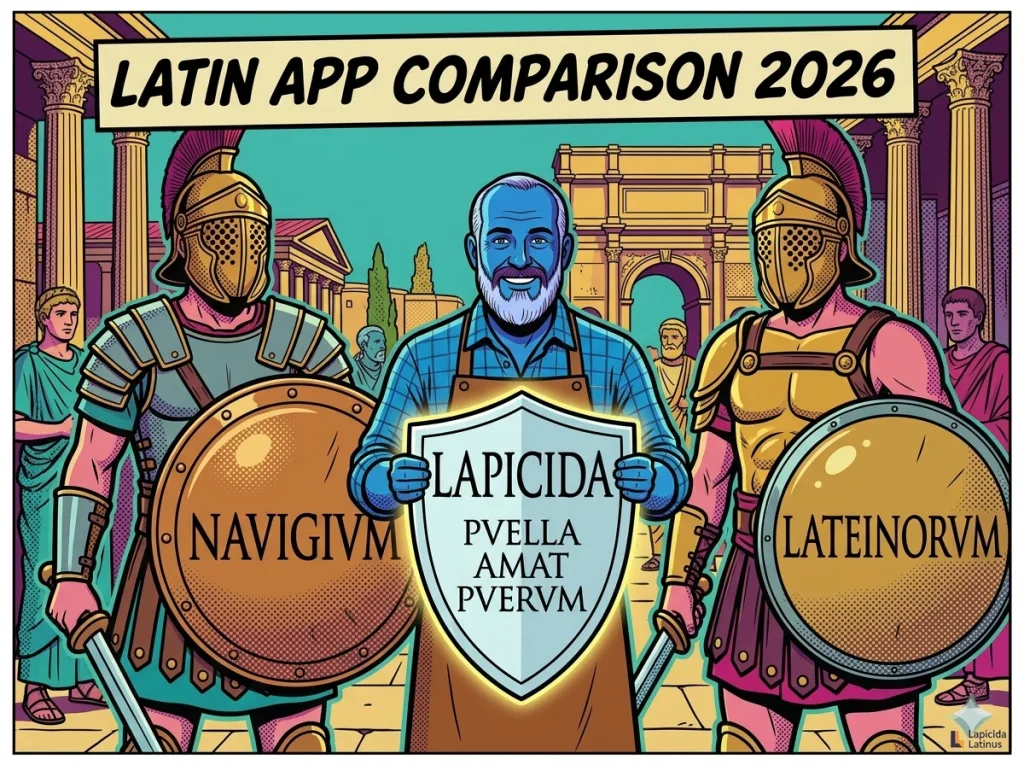
The 2026 Latin App Comparison shows that three apps dominate the German market for digital Latin learning: Navigium (an established school standard), Lateinorum (free, AI-powered), and Lapicida Latinus (grammar practice and reading). If you’re looking for the right Latin app comparison, you’ll find out here which app leads in which area—and why a combination is often better than a single choice.
- Navigium in Detail — Strengths and Weaknesses
- Lateinorum in Detail — What the Free App Can Really Do
- Lapicida Latinus in Detail — What Sets It Apart from the Other Two
- Direct Comparison by Learning Goals
Which Latin app is the best—Navigium, Lateinorum, or Lapicida?
All three apps have different strengths: Navigium stands out for its exam-approved dictionary and integration with school curricula. Lateinorum offers an AI-powered vocabulary trainer, but no interactive practice (grammar is presented only as a description, and texts are available only in read-only view). Lapicida Latinus excels in active grammar training—it’s the only app with a verb conjugation trainer, sentence component analysis (sentence quiz), level-appropriate reading material, and targeted study lists. For Latinum preparation and high school from grade 5 onwards, Lapicida is the strongest option.
Head-to-Head Comparison: Navigium vs. Lateinorum vs. Lapicida
| Feature | Navigium | Lateinorum | Lapicida Latinus |
|---|---|---|---|
| Vocabulary Trainer | ✅ 35,000+ entries | ⚠️ Self-assessment + AI scan (claims to use spaced repetition, but no active recall) | ✅ 11,000+ entries, active recall, 13 modes |
| Scan vocabulary (OCR) | ❌ | ⚠️ AI scan available — no learning training behind it | ✅ Scan + comprehensive learning program |
| Textbook vocabulary lists directly integrated | ✅ Textbook lists (Klett: Pontes, Libellus) | ❌ | ⚠️ Not directly — your own lists via scan |
| Targeted study lists (not just the library) | ✅ Textbook lists | ❌ | ✅ Custom lists + assignments |
| Form trainer (active training) | ✅ Available | ❌ only grammar descriptions | ✅ All declensions + conjugations |
| Sentence component analysis (sentence quiz) | ❌ | ❌ | ✅ unique |
| Reading original texts | ⚠️ Limited | ⚠️ Text display, no learning exercises | ✅ Cicero, Caesar, Sallust available — Suetonius, Vulgate in preparation |
| Reading tailored to your level | ❌ | ❌ | ✅ Graded by difficulty |
| School dictionary (approved for exams) | ✅ Yes | ❌ | ❌ |
| Offline mode | Dictionary apps offline ✅ — Navigium Online ❌ | ❌ | ✅ Fully supported on Android |
| LRS color coding | ❌ | ❌ | ✅ |
| Pricing Model | Subscription: €24/year (personal, 1 language) — School license starting at €2.50/student/year | Free (most features), optional in-app purchases | €19.99/year — one purchase, no micro-transactions |
| iOS | ✅ Native app | ✅ Native app | ⚠️ PWA (Safari) |
| Android | ✅ Native app | ✅ Native app | ✅ Native app (offline) |
The three apps in detail
Navigium — the industry standard
- On the market for 35 years — established in over 800 schools; many teachers are familiar with it
- The exam-approved comprehensive dictionary with 38,500 entries + 1 million inflected forms is its greatest strength
- Klett integration: Pontes and Libellus built right in—no upload required
- School integration: Berlin School Portal (SSO), Bavarian VIDIS Portal — explains its widespread use in schools
- Weakness: No gamified sentence quiz, no reading mode with vocabulary help — lacks training in sentence components; Navigium Online requires an internet connection
- Strong for exam dictionaries and inflection practice; not designed for sentence quizzes or guided reading
Lateinorum — Passive reference tool (subscription)
- Vocabulary trainer: Self-assessment (wrong / partially correct / correct), spaced repetition — no active recall, no game mode; AI scanner for photographing vocabulary words
- AI scanner: automatically translates vocabulary and entire texts — this is looking up information, not learning. Learning Latin means exactly the opposite: being able to make sense of unknown texts on your own
- Grammar presented as descriptive texts to read — no interactive practice, no conjugation trainer
- Texts presented as reading material — no progression, no guided training
- No sentence quizzes, no sentence structure analysis — there is no training for the core skills needed for exams and the Latinum
- The result: a good reference work for Latin, not a learning tool
Lapicida Latinus — the grammar training tool
- The only app with active sentence component training (sentence quizzes)—no other tool offers this
- Form trainer with clear progression: a/o declension → verbs → complex constructions
- Reading with original texts, level-appropriate (L3–L27): Cicero (De Amicitia, De Re Publica), Caesar (De Bello Gallico), Sallust (Bellum Catilinae) — Suetonius and the Vulgate (Sermon on the Mount, Epistles of Paul, Acts of the Apostles) in preparation
- Vocabulary scan via OCR: photograph a textbook page → list generated (like Lateinorum, but with actual learning exercises behind it)
- Dyslexia-friendly color coding (sentence elements highlighted in color)
- Weaknesses: Not an officially approved exam dictionary; iOS version available only as a PWA; no direct textbook integration like Navigium
- €19.99/year — one purchase, no micro-transactions and no feature locked behind an extra subscription
Learn Latin now. Our learning app:

Which app for which goal?
| Situation | Recommendation |
|---|---|
| High school, grades 5–12, grammar practice | Lapicida Latinus |
| Practice exam vocabulary | Navigium |
| Catch up on Latin | Lapicida Latinus + Course |
| Getting Started / Initial Motivation | Duolingo (free, game-based) |
| Dyslexia / Color-coding required | Lapicida Latinus (the only one with color coding) |
| Teacher dashboard with class tracking | Lapicida Latinus (Officina, €19.99/year) |
| Offline use (no Wi-Fi) | Lapicida Latinus for Android |
The best combination: Lapicida Latinus for daily grammar and reading practice + Navigium for the school-approved dictionary. Many teachers use both tools in parallel—each for what it does best.
Frequently Asked Questions — Latin App Comparison
What is the main difference between Navigium and Lapicida?
Navigium excels at providing a school-approved dictionary (35,000+ entries, approved for exams), school integration, and verb conjugation practice. Lapicida is unique in its training on sentence components (sentence quizzes) and curated reading material with vocabulary support—neither of which is available in Navigium. For Latinum preparation, we recommend using both together.
Is Lateinorum really free?
Most of Lateinorum’s features are free. There are optional one-time purchases for advanced features, but no mandatory subscription. The key point isn’t the price, but what you get: Lateinorum doesn’t offer verb conjugation practice or sentence quizzes—the core skills needed for exams and the Latinum.
Can I use Lapicida and Navigium at the same time?
Yes—that’s actually the recommended combination: Lapicida for daily grammar practice, sentence quizzes, and reading; Navigium for the dictionary, which is permitted in tests and exams.
Which app has the most vocabulary?
Navigium has the most comprehensive dictionary, with over 35,000 entries. Lapicida has over 11,000 vocabulary words for flashcard practice. Latinorum also has a large AI-powered vocabulary. For flashcard training, Lapicida is the most structured.
Which app is suitable for dyslexia?
Lapicida Latinus is the only one of the three apps with dyslexia-specific features: color-coding of sentence components, adjustable learning pace, and reduced visual complexity. For students with dyslexia, this is a decisive advantage.
Try Lapicida Latinus for free
Learn Latin now. Our learning app: