Is There a Duolingo Latin Course? — Review & Alternatives 2026
Duolingo Latin — does the course exist, and is it enough?
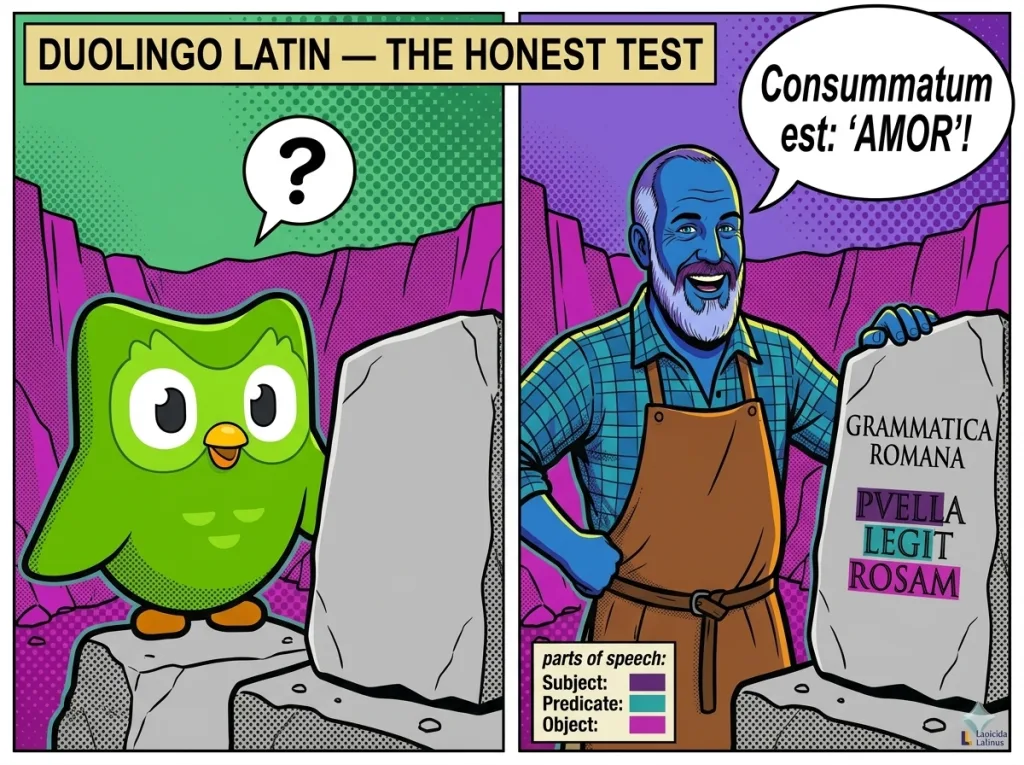
The short answer is easy: yes, Duolingo has a Latin course, and it is still there in 2026 — free, in the app and in your browser. The interesting question comes next. Latin does not work the way Spanish, French or English work, and that difference decides which tool actually helps. If you want to know why a good app can still be the wrong shape for Latin, read on — and find every topic gathered under Learn Latin.
- Does Duolingo have a Latin course — and what does it cover?
- Why Latin is built differently from modern languages
- Why “villa = house” is not a vocabulary entry but a fragment
- The five mistakes beginners make when they read Latin left to right
- What Duolingo is genuinely good for — and what you need beside it
Does Duolingo have a Latin course in 2026?
Yes — the course exists and is free, in the app and on the web. As a first contact it works. For school Latin, AP Latin or reading real texts it does not: Duolingo Latin follows the pattern of modern languages, where word order carries the grammar. In Latin the ending carries it. Reading a sentence left to right is reading Latin wrong.






Why Latin works differently from Spanish or English
In English, position tells you who is doing what. “The dog sees the girl” and “The girl sees the dog” are two different statements built from the same words. Every app that has you tap words into a line relies on exactly that.
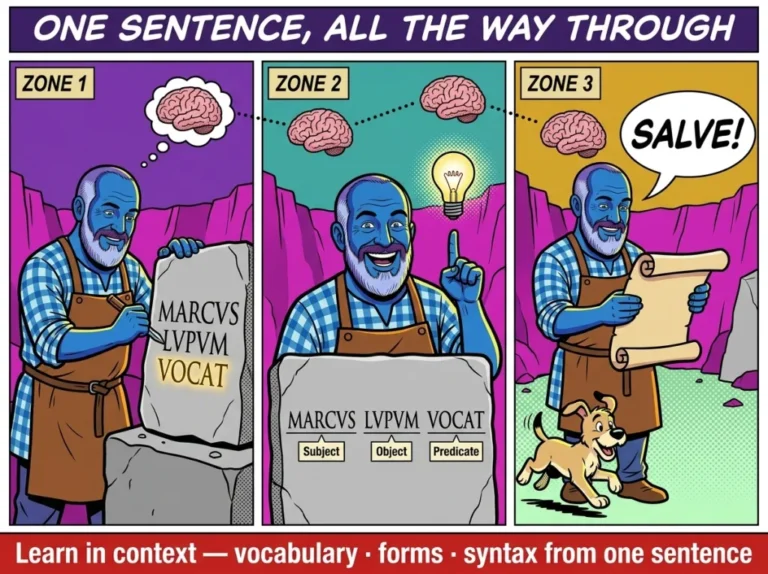
Latin does not work that way. All three of these sentences are correct, and in all three the same girl sees the same boy:
| Latin | Sentence elements | What the order actually does |
|---|---|---|
| Puella puerum videt. | subject · object · verb | the neutral, default order of Latin prose |
| Puerum puella videt. | object · subject · verb | puts the spotlight on the object: it is the boy she sees |
| Videt puella puerum. | verb · subject · object | stresses the action itself |
One thing must not get lost here: word order in Latin is not meaningless. It steers emphasis and focus, much like the start of an English sentence does. What it does not steer are the sentence elements. Who is subject and who is object lives in puella and puerum — in the last two letters. Nowhere else.
💡 Rule of thumb: in English the slot carries the role. In Latin the ending carries the role — the slot only carries the emphasis.
That is why a method built on arranging words teaches you very little here. Not because it is badly made, but because it was designed for a different kind of language.
And a second hurdle follows, one Spanish never puts in your way: a Latin noun has six cases in two numbers — twelve slots in the table — but only four to eight of them actually sound different. Puellae can be genitive singular, dative singular or nominative plural. Which one it is, only the sentence decides. A regular verb runs to roughly 150 forms in its core paradigm. Casa and casas are two forms, and that is the end of it.
Why “villa = house” is a fragment, not a vocabulary entry
In a modern language casa = house is a complete entry. In Latin the decisive part is missing. A Latin entry has three pieces: nominative, genitive and gender — villa, villae f.
| The piece | What it tells you about villa | Where it really hurts |
|---|---|---|
| villa the nominative | The headword — the form you look up. | Meet villam in a text and you have to work back to villa, or you will not find the entry. |
| villae the genitive | The declension. -ae means first declension, the stem is vill-, and from it come villam, villā, villās. | With villa the stem is visible up front. With rex it is not: only reg-is reveals reg-, and without it there is no regem and no regi. |
| f. the gender | Feminine — which is why it is villa magna and not villa magnus. | poeta ends in -a and is nevertheless masculine: poeta pulcher. Skip the gender and agreement collapses. |
Three more nouns make the same point from the other side: servus, exercitus and corpus all end in -us and belong to three different declensions. The nominative decides nothing.
This is where vocabulary trainers part ways. A tool that offers Latin alongside thirty other languages stores a word pair. A tool that does nothing but Latin stores a word description. Our database holds 11,568 entries; every one carries its part of speech, and of the 3,558 nouns 96.9 % carry the genitive and 96.1 % their declension (measured 15 September 2026). Alongside them sit 14,557 annotated sentences in which those forms actually occur.
More on learning vocabulary so that it survives contact with a real sentence: Latin vocabulary.
Forms first, then the sentence
This is the path a general language app does not offer: get the endings solid in the forms trainer, then find those same forms again in real sentences in the sentence quiz — where you identify the sentence elements yourself instead of tapping a translation.
Learn Latin now. Our learning app:

What Duolingo Latin is good for — and what is missing
Duolingo gets one thing right that most learning tools never manage: it gets people to start, every day. The course is free, friendly and takes the fear out of the subject. If you have never touched Latin and want to know how it feels, you are in the right place.
| If you want to | Duolingo Latin | What you need for it |
|---|---|---|
| Try Latin once and see | ✅ exactly what it is built for | — |
| Build a daily habit | ✅ gamification works | — |
| Get declensions and conjugations solid | ❌ | a trainer that asks for the form itself |
| Identify parts of a sentence you have never seen | ❌ | sentences where you assign the roles |
| Translate an original text | ❌ | reading with help at the line you are stuck on |
| Pass AP Latin or a school exam | ❌ | systematic grammar along a syllabus |
The five mistakes beginners make when they read Latin left to right, the way one reads a modern language — they turn up again and again in our help texts:
- The first word gets promoted to subject. In Caesarem vincit Brutus, Caesar comes first and still loses. The -em decides.
- Separated pairs are missed. A Latin adjective often stands far from its noun. Attach it to the neighbour and you are wrong — you are looking for agreement in gender, number and case, not for proximity.
- Embedded clauses get read straight through. In Puer, qui in silva habitat, est fortis, the main verb waits at the very end.
- The subject inside the verb is overlooked. Canem video means “I see the dog”, not “the dog sees”. The -o is the subject.
- Ambiguous endings get guessed. -o, -is and -ibus fit several cases. Which one applies is decided by the verb, not by instinct.
Not one of those five is fixed by learning more vocabulary. They all happen at the same moment: while you are working out the sentence. That is why our approach is a different one — we only do Latin, and the app is built around that single difference. How that is meant pedagogically is set out in our learning method; how the other apps in the field compare is in the Latin app comparison.
Further reading elsewhere: the Latin course at Duolingo itself, and a detailed review by the Society for Classical Studies, which assesses the course from a classicist’s point of view.
Frequently asked questions — Duolingo Latin
Does Duolingo have Latin?
Yes. Duolingo offers a Latin course, free in the app and on the web. It is aimed at beginners and is one of the best-known ways to come into contact with Latin at all.
Is the Duolingo Latin course still available in 2026?
Yes. The course is live and reachable in 2026, both from the English and the German entry points of the site, and it is still free.
Can you learn Latin with Duolingo?
As a first contact, yes. For school Latin or AP Latin, no. The course follows the pattern of modern languages, where word order carries the grammar. In Latin the ending carries it — identifying forms and sentence elements is not what the course drills.
Is Duolingo Latin free?
Yes. The course itself costs nothing; Duolingo funds it through advertising and an optional ad-free subscription. Nothing in the Latin course sits behind a paywall.
Is Duolingo enough for AP Latin?
No. AP Latin asks you to read Caesar and Vergil in the original and to justify your reading. That needs the full range of forms, constructions such as the ablative absolute and indirect statement, and the ability to break down a sentence you have never seen.
Who is Duolingo Latin good for?
For anyone who wants to try Latin once, and for anyone who has no study routine yet. It is a good beginning — it is simply not a substitute for a tool that trains forms and syntax.
What is better than Duolingo for Latin?
It depends on the goal. Anyone taking Latin at school or heading for AP Latin needs three things a general language app usually does not carry: a forms trainer, sentences for identifying the parts, and real reading with help at hand. Lapicida Latinus is built around exactly that; our app comparison surveys the wider field.
Learning Latin seriously — beyond the first contact
A forms trainer for every declension and conjugation, a sentence quiz with real analysis of the parts, reading with help right at the line, vocabulary with genitive and principal parts. We only do Latin — and the app is built around exactly that difference.
Learn Latin now. Our learning app: