Reading Latin Texts: Why One Sentence Beats the Whole Wall of Words
Reading Latin texts is the real goal of learning Latin — and the hardest step of all. Lapicida’s Reading module bridges the gap between grammar drills and genuine comprehension: original texts by Cicero, Caesar, Virgil, Ovid and other authors are worked through sentence by sentence, each one fully annotated.
- Authors: Cicero, Caesar, Virgil, Ovid, Sallust, Pliny, Suetonius, the Vulgate
- Levels L3–L27: aligned with Areas 1 to 9 of the sentence quiz
- Annotation: clause colouring and vocabulary help right on the text
- Graded reader: Marcus Lapicida Iunior — our own beginner corpus
- Teachers can build and share their own text collections
How does the Reading module work?
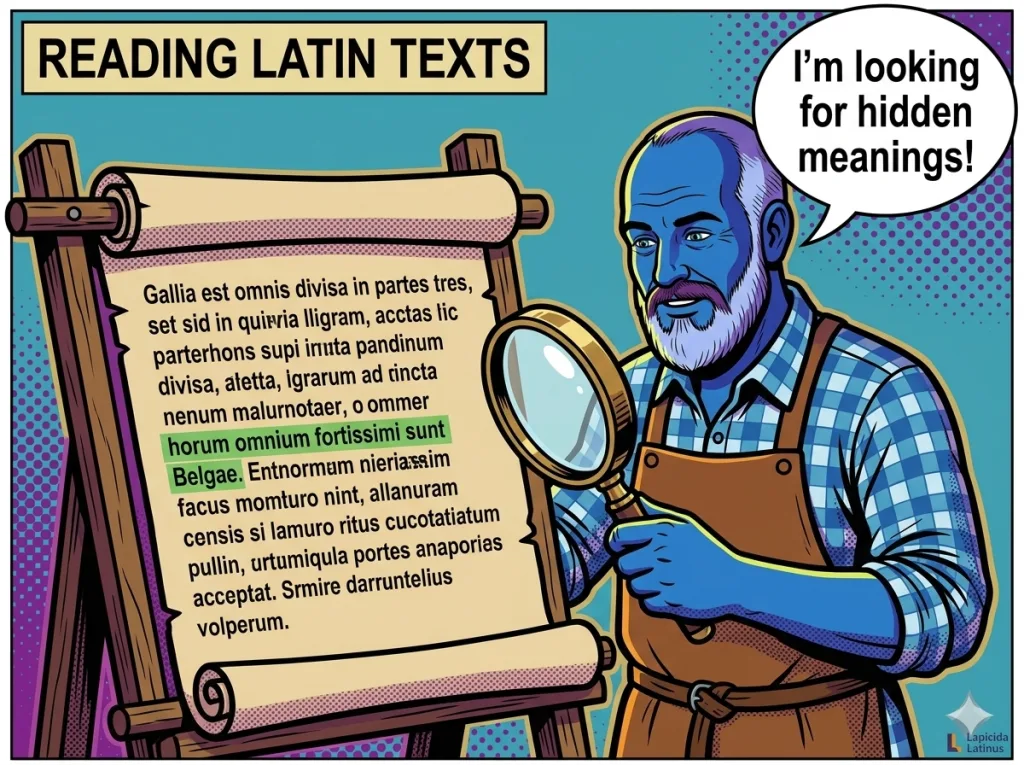
The Reading module presents Latin texts one sentence at a time. For every sentence you can assign clause functions, look up words and toggle the annotation on or off. The level system (L3–L27) tells you which grammar a text assumes — matched to how far you have come in the sentence quiz. To lock in word forms alongside your reading, work with the vocabulary trainer and reinforce meaning with vocabulary in context.
| Author / corpus | Theme / genre | Level range |
|---|---|---|
| Cicero | Speeches, letters, philosophy | L9–L27 |
| Caesar | Gallic War, Civil War | L9–L27 |
| Sallust | Historical monographs | L12–L27 |
| Virgil | Aeneid (excerpts) | L18–L27 |
| Ovid | Metamorphoses, Ars Amatoria | L15–L27 |
| Pliny | Letters | L12–L24 |
| Suetonius | Lives of the Caesars | L12–L24 |
| Vulgate | The Bible in Latin | L9–L21 |
| Marcus Lapicida Iunior | Graded reader (beginner) | L3–L12 |
The L3–L27 level system: grammar and reading, linked
The level system connects the sentence quiz directly to the reading. Every level states which sentence-quiz knowledge a text assumes:
| Level | Sentence-quiz knowledge assumed | Typical texts |
|---|---|---|
| L3 | Area 1 — subject / predicate | Graded reader (Marcus Lapicida Iunior) |
| L6 | Area 2 — objects | Simple narrative texts |
| L9 | Area 3 — prepositional phrases | Caesar: easier passages |
| L12 | Areas 4–5 — relative clause, ACI | Caesar: De Bello Gallico |
| L15 | Area 6 — NCI | Cicero: letters |
| L18 | Areas 7–8 — subordinate clause, participle | Cicero: speeches, Sallust |
| L21 | Areas 9–10 — subjunctive, ablative absolute | Cicero: philosophical texts |
| L24+ | Areas 11–14 | Virgil, Ovid, demanding prose |
Why L3 and not L1? Levels start at L3 because every text assumes at least subject/predicate and some core vocabulary. Levels climb in steps of three: L3, L6, L9 … L27, each building on the last. For the full path from first word to first author, see how to learn Latin step by step, while the choice of texts follows proven spaced-repetition principles.
Marcus Lapicida Iunior — our own graded reader
For beginners, Lapicida built its own graded reader: Marcus Lapicida Iunior, a fictional stonemason’s apprentice going about everyday Roman life. The stories are linguistically simplified (levels L3–L12) but contain real classical Latin — no artificial constructions.
The payoff: learners read genuine Latin sentences from day one, inside a coherent story, with a hero who thinks a lot like a student today. That drives reading motivation far more than isolated practice sentences.
Teacher feature — your own collections: teachers can create their own text collections, add vocabulary and annotations, and release them to their classes. That makes the Reading module a flexible classroom tool as well.
Reading is the final step — if you would rather work through everything in order, Learn Latin lays out all the stages.
Learn Latin now. Our learning app:

Why sentence by sentence, not the whole text?
If you want to read Latin, the web has superb sources: freely available full texts with facing translations, the vast interlinked corpus of the Perseus Digital Library, the immersive read-and-listen app Legentibus with its own commissioned readings, and carefully annotated printed school editions. Each has its strength: Perseus shines at looking up any word form, Legentibus at relaxed reading and listening, printed editions at commentary in the margin. Lapicida starts somewhere else — not with a finished text and notes down the side, but with actively working it out sentence by sentence, with measurable feedback and targeted review instead of pure re-reading.
- Cognitive load: a whole Latin text at once overwhelms working memory. One sentence at a time lowers the load and allows deeper processing.
- Measurable feedback: every sentence gives a clear result. The system knows where comprehension breaks down and steers review through active recall.
- Vocab help in the right place: unfamiliar words appear right on the word — not in a glossary at the end, but in the flow of reading.
- Annotation is optional: advanced readers can hide the annotation, read the text unaided first, then switch it back on to verify.
About the author
Andreas Blankenstein is the founder of Lapicida Latinus — and dyslexic himself. When he had to earn the Latinum in record time, one thing became clear: endless table-cramming fails exactly the people who learn differently. So Lapicida builds learning around real author texts, colour-coded and in short steps. More about the Lapicida method →
Frequently asked questions — Latin texts in Lapicida
Which authors are included in the Reading module?
Cicero, Caesar, Sallust, Virgil, Ovid, Pliny, Suetonius, the Vulgate (the Bible in Latin) and our own graded reader, Marcus Lapicida Iunior. The collection is expanded continuously. Every text comes with clause annotation and vocabulary help.
What level do I need to use the Reading module?
From level L3 — that matches the sentence-quiz knowledge of Area 1 (subject/predicate). Absolute beginners can start with the graded reader (Marcus Lapicida Iunior). Original texts by Cicero and Caesar begin around L9–L12.
Can teachers add their own texts to the module?
Yes. Through the Officina (the teacher dashboard), teachers can create their own text collections, define vocabulary and release the collections to classes. Texts can also be linked to a sentence-quiz area so their difficulty level is determined automatically.
Read Latin texts — start now
From Cicero to Virgil: original texts with annotation, vocabulary help and clause analysis. Levels L3–L27. Start free.
Learn Latin now. Our learning app:
Learn Latin — step by step · Latin vocabulary trainer · Latin vocabulary in context · Active recall for Latin · Latin spaced repetition · Latinum preparation · The Latin learning method — the red thread