
Identifying Sentence Elements in Latin — Explained Step by Step

If you can confidently identify the parts of a sentence in Latin, you hold the most important key to translation. Unlike in German, it’s not word order that reveals a word’s meaning—it’s the form. Latin encodes its sentence elements in the endings.
This means that if you know what each ending signifies, you can decipher any sentence—no matter how convoluted the word order is. And that’s exactly what makes translation so rewarding once you’ve figured it out.
In this article, you’ll learn:
- What sentence elements are in Latin and what kinds there are
- How to identify them step by step in every sentence
- The “Question-Method” system that works immediately on tests
- How Lapicida highlights sentence elements in different colors—and how that helps with learning
- Practice sentences with answers
What are sentence elements in Latin?
Sentence elements are the grammatical units of a sentence—subject, predicate, object, and adverbials. In Latin, they are identified not by word order but by case (ending): the subject is in the nominative, the direct object in the accusative, the indirect object in the dative, and the genitive object in the genitive.
More blog posts on this topic:
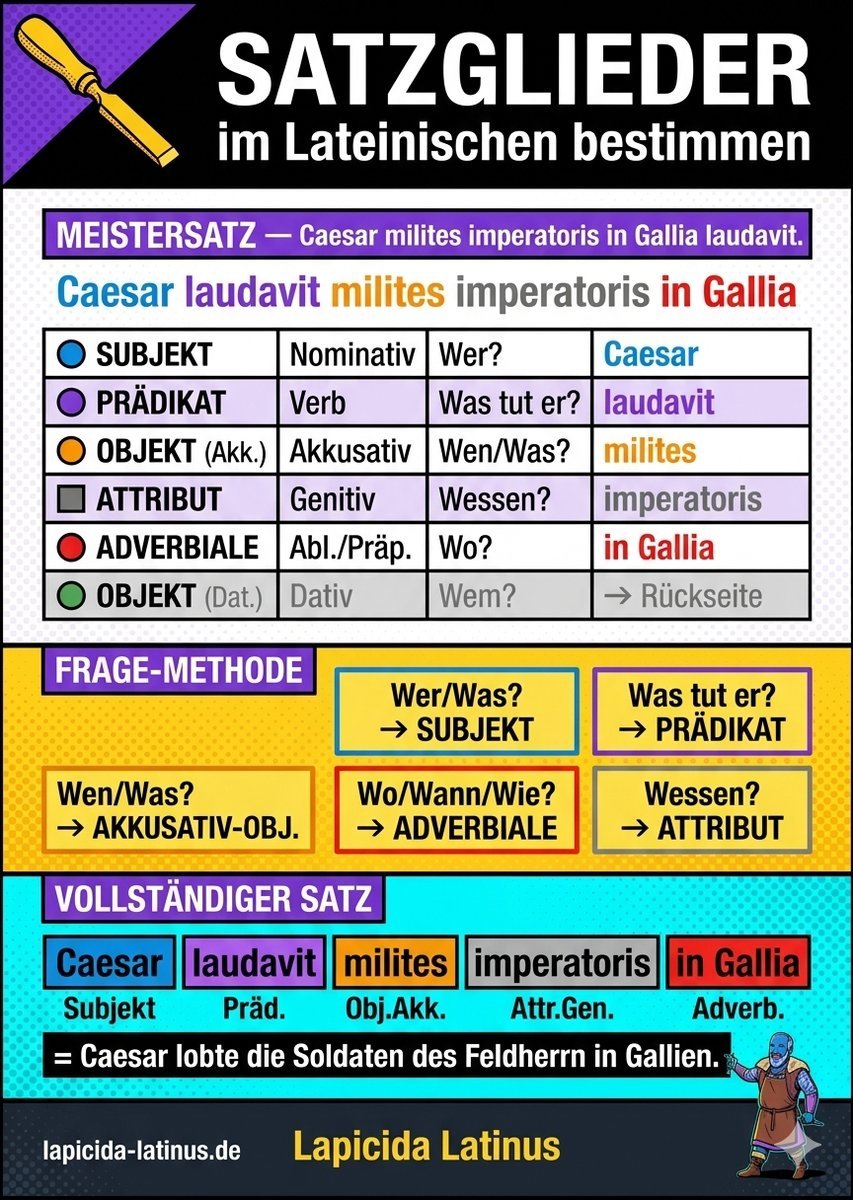
Sentence Elements in Latin at a Glance
| Part of a sentence | Case | Question | Example |
|---|---|---|---|
| Subject | Nominative | Who/What is doing it? | Caesar vincit. |
| Predicate | — | What does the subject do? | Caesar vincit. |
| Direct object | Accusative | Who/What? | Caesar Gallos vincit. |
| Indirect object | Dative | To whom? | Amicis donat. |
| Genitive object | Genitive | Whose? | Patriae memores sumus. |
| Ablative object | Ablative | Does the verb require the ablative? (mainly uti) | Gladio utitur. |
| Predicative noun | Nominative/Accusative | What is the subject/object? | Caesar prudens est. |
| Attribute | KNG-congruent | Which/Whose? | magnus Caesar |
| Adverbial | Ablative — with or without prep.; Acc. + prep. | Where/When/How/With what/Why? | In Gallia pugnat. · Gladio pugnat. |
Remember — this is where most marks are lost: In a sentence the ablative is almost always an adverbial modifier — with or without a preposition. Gladio pugnat (“He fights with a sword”) is therefore not an ablative object but an adverbial of means. A true ablative object exists in practice only with uti (to use): Gladio utitur.
The Question Method: An Example
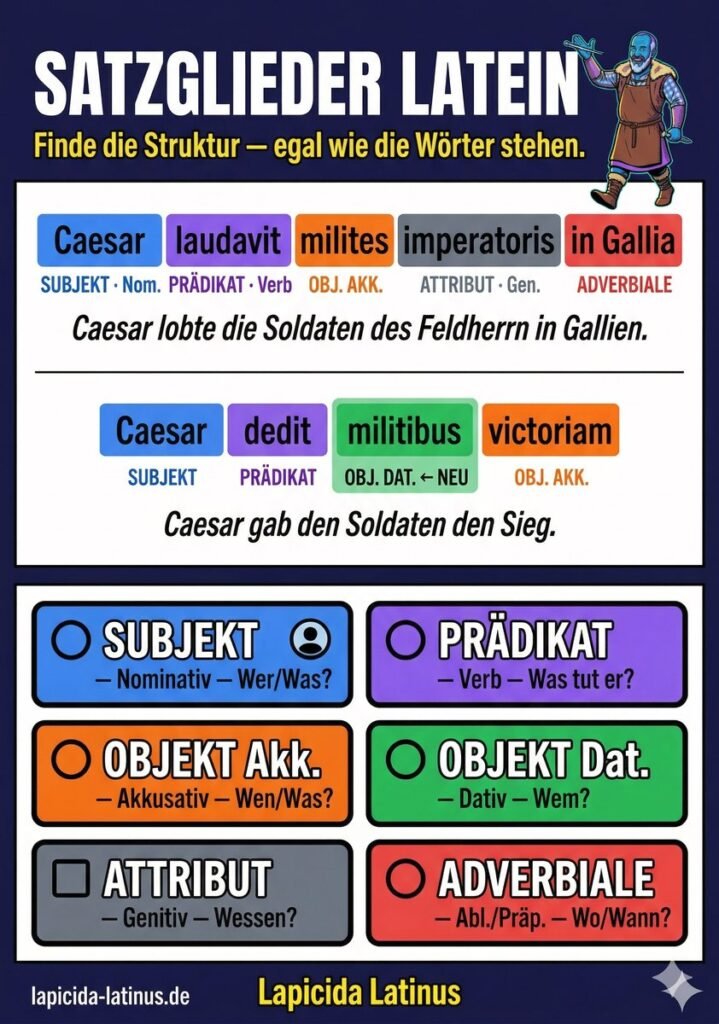
The model sentence shows how the question method works: Caesar milites imperatoris in Gallia laudavit.
For more complex accusative constructions, it’s worth taking a look at the ACI (Accusativus cum Infinitivo) and the NCI (Nominativus cum Infinitivo)—both build on the fundamentals of sentence elements.
| Sentence component | Question | English Answer | Latin Answer |
|---|---|---|---|
| Subject | Who is praising? | Caesar | Caesar (nom. sing.) |
| Predicate | What does Caesar do? | praised | laudavit (3rd person singular perfect) |
| Direct object | Who does Caesar praise? | the soldiers | milites (acc. pl.) |
| Genitive attribute | Whose soldiers? | the general’s | imperatoris (gen. sing.) |
| Adverbial | Where does he praise them? | in Gaul | in Gaul (abl.) |
Second example with a dative object: Caesar militibus victoriam dedit.
| Phrase element | Question | English Answer | Latin answer |
|---|---|---|---|
| Subject | Who gives? | Caesar | Caesar (nom. sg.) |
| Predicate | What does Caesar do? | gave | dedit (3rd person singular perfect) |
| Indirect object | To whom does Caesar give? | to the soldiers | militibus (dative plural) |
| Direct object | What does he give them? | victory | victoriam (acc. sing.) |
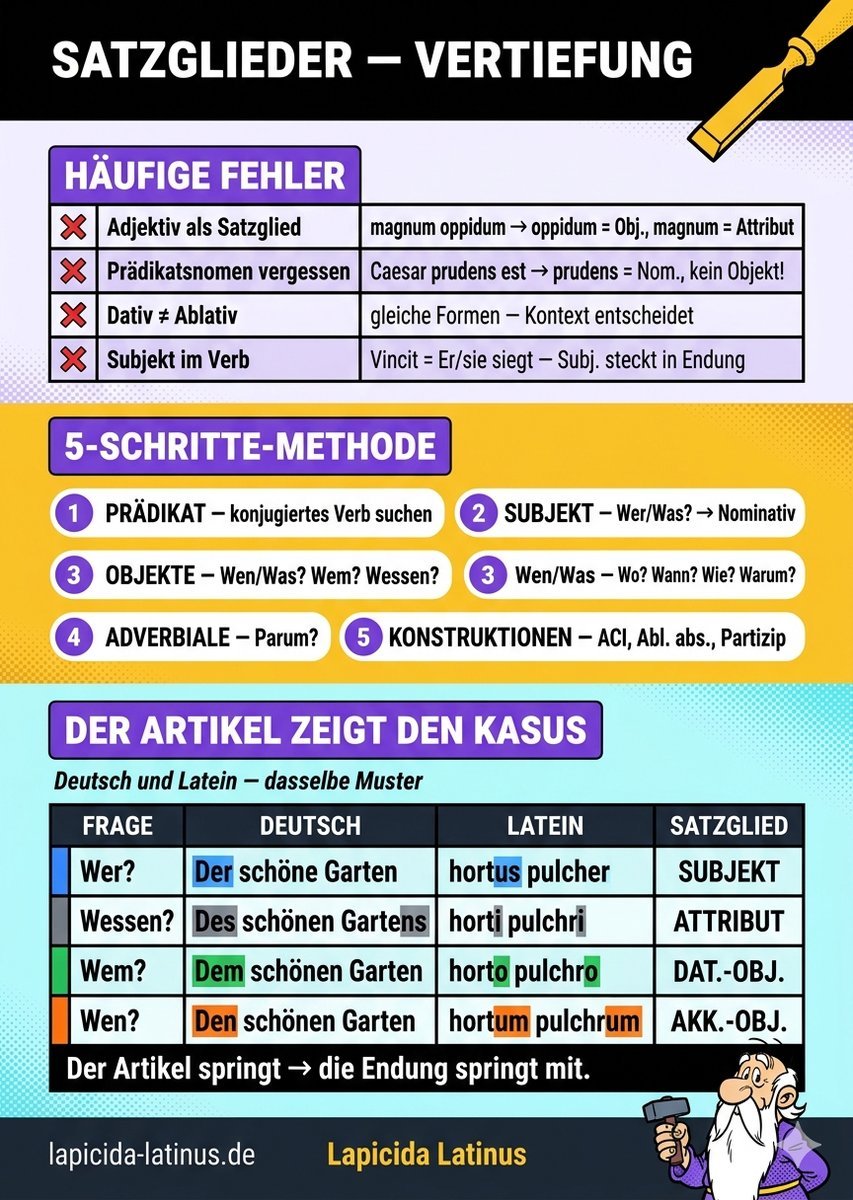
Tip — the article reveals the case: Ask the question in German and pay attention to the article. The soldiers / the victory → accusative. To the soldiers → dative. Of the general → genitive. The article changes from case to case — the Latin ending changes with it.
How do I identify sentence elements in Latin?
Here’s how to identify sentence elements in Latin, step by step
Predicate first
Find the conjugated verb. It’s the center of the sentence. What is someone doing? The predicate is always the starting point.
Find the subject
Question: Who or what is performing the action described by the predicate? The subject is in the nominative case. In “Caesar vincit”: Who is winning? → Caesar (nom.).
Identify the objects
Question: Whom/What? → Accusative (direct object). To whom? → Dative (indirect object). Whose? → Genitive.
Classify the remaining elements as adverbials
Whatever is not the subject, predicate, or object is usually an adverbial—place, time, manner, or reason.
Recognizing constructions
ACI, ablative absolute, and participle constructions are not sentence elements in the traditional sense—they build upon the foundational knowledge.
Understand Latin instead of cramming — try it right now.

The Subject in Latin
The subject is in the nominative case—always. It is the person or thing performing the action (in active sentences).
Tip: The verb agrees with the subject (person + number). If the verb is *vincunt* (3rd person plural), the subject must be plural.
Special case: In Latin, the subject can be omitted—it is then implied in the verb: Veni, vidi, vici. = I came, I saw, I conquered. The subject (I) is implied in the 1st person singular.
The Predicate in Latin
The predicate is the conjugated verb. It can be in the active or passive voice, in 6 tenses and 2 moods (indicative, subjunctive).
Compound predicate (verbum + esse): Laudatus est = He has been praised. Both parts are part of the predicate.
The object in Latin
| Object type | Case | Interrogative word | Example |
|---|---|---|---|
| Direct object | Accusative | Who? What? | Hostem vincit. |
| Indirect object | Dative | To whom? | To friends (dat.). |
| Genitive object | Genitive | Whose? | Patriae memores. |
| Ablative object | Ablative | Does the verb require the ablative? (mainly uti) | Gladio utitur. |
Note: Some verbs require a specific case. uti (to use) + ablative. meminisse (to remember) + genitive. Important: an object is always a case complement without a preposition — and for the ablative that leaves practically only uti. Every other ablative without a preposition (means, time, place: gladio, nocte, bono loco) is an adverbial modifier. So don’t ask “With what?” — ask: does this verb require the ablative?
The Attribute in Latin
An attribute is a phrase that provides further description of another part of the sentence (subject, object, adverbial). In Latin, the attribute agrees with its referent—the exact rule of agreement depends on the type: Adjectives and participles follow case, number, and gender (KNG) agreement; genitive attributes are always in the genitive case (no KNG agreement); appositives agree only in case and number.
| Attribute Type | Agreement | Example | Translation |
|---|---|---|---|
| Adjectival attribute | KNG with referent | magnus imperator | the great commander |
| Genitive attribute | Genitive (fixed) | gladius imperatoris | the commander’s sword |
| Participial attribute (PPP) | KNG with referent | milites victi | the defeated soldiers |
| Pronominal attribute | KNG with referent | meus amicus | my friend |
| Apposition | Case (+ usually number) | Caesar, imperator | Caesar, the general |
Mnemonic: An attribute is not an independent clause element—it always belongs to another. In Lapicida’s sentence quiz, it is therefore highlighted in color along with its referent.
💡 Study tip: Word order—in Latin, adjectival attributes usually follow the referent (insula amoena = the beautiful island). If the attribute comes before the referent, it is given special emphasis. Tip for difficult sentences: In Latin, attributes and their referents are often separated by other parts of the sentence (enclitic/hyperbaton)—e.g., multa amicorum vestigia (many traces of friends). Look for the case ending and put the appropriate word group together.
Adverbial phrases — 4 types
Adverbial phrases specify further details of the action—place, time, reason, or manner. In Latin, they often appear in the ablative (without a preposition) or with a preposition. There are four main types:
| Type | Questions | Case / Form | Latin Example | Translation |
|---|---|---|---|---|
| Locative (Place) | Where? Where to? Where from? | Abl. or Acc. + prep. | in Gallia / Romam | in Gaul / to Rome |
| Temporal (Time) | When? How long? | Abl. or Acc. | tertia hora / multos annos | at the third hour / for many years |
| Causal (Reason) | Why? For what reason? | Abl. or causa + Gen. | victoriae causa / timore | out of joy at victory / out of fear |
| Modal (manner) | How? With what? | Abl. (possibly with cum) | gladio / magna vi | with the sword / with great force |
Mnemonic: Anything that isn’t a subject, predicate, object, or attribute is classified as an adverbial. Ask yourself: Where? When? How? Why? — the answer indicates the type. Many adverbial phrases can be practiced specifically in the Form Trainer (ablative forms).
⚠️ 3 common pitfalls with adverbials:
- in + accusative or ablative? — Ironclad rule: Movement/Where to? → accusative (in silvam = into the forest). Place/Where? → ablative (in silva = in the forest).
- cum — Preposition or conjunction? — With a noun in the ablative = preposition (cum amico = with the friend). Introduces a subordinate clause with a verb = conjunction (cum veniret = when he came).
- Instrument vs. agent (passive) — Instrument/With what? → Ablative without a preposition (gladio = with the sword). Person/By whom? → a/ab + ablative (a Romanis = by the Romans).
Practice sentence elements with the Lapicida Sentence Quiz
The Sentence Quiz is the heart of Lapicida. Unlike flashcards or multiple-choice questions, you identify which word is which part of speech directly within the Latin sentence.
Here’s how the sentence quiz works: A real Latin sentence appears. You tap on a word—Lapicida asks: What part of speech is this? You get immediate feedback—right or wrong, with an explanation of why. After answering, you see the entire sentence highlighted in color and immediately recognize the pattern.
| Part of speech | Color in Lapicida |
|---|---|
| Subject (Nom.) | Blue |
| Predicate (Verb) | Purple |
| Direct object (acc.) | Orange |
| Indirect object (dative) | Green |
| Adverbial / Context | Gray |
Scientific Background: The sentence quiz uses active recall—proven to be the most effective learning method for grammatical structures. Instead of reading what a subject is, you have to find it. This anchors the knowledge more permanently than passive reading.
Practice Latin sentence elements with the Lapicida Sentence Quiz
The Lapicida Sentence Quiz trains you on Latin sentence elements directly using real Latin sentences—not with flashcards, but interactively within the text. You highlight sentence elements directly in the sentence. For every mistake, Lapicida explains exactly what was wrong and why.
In bold: What the Sentence Quiz offers:
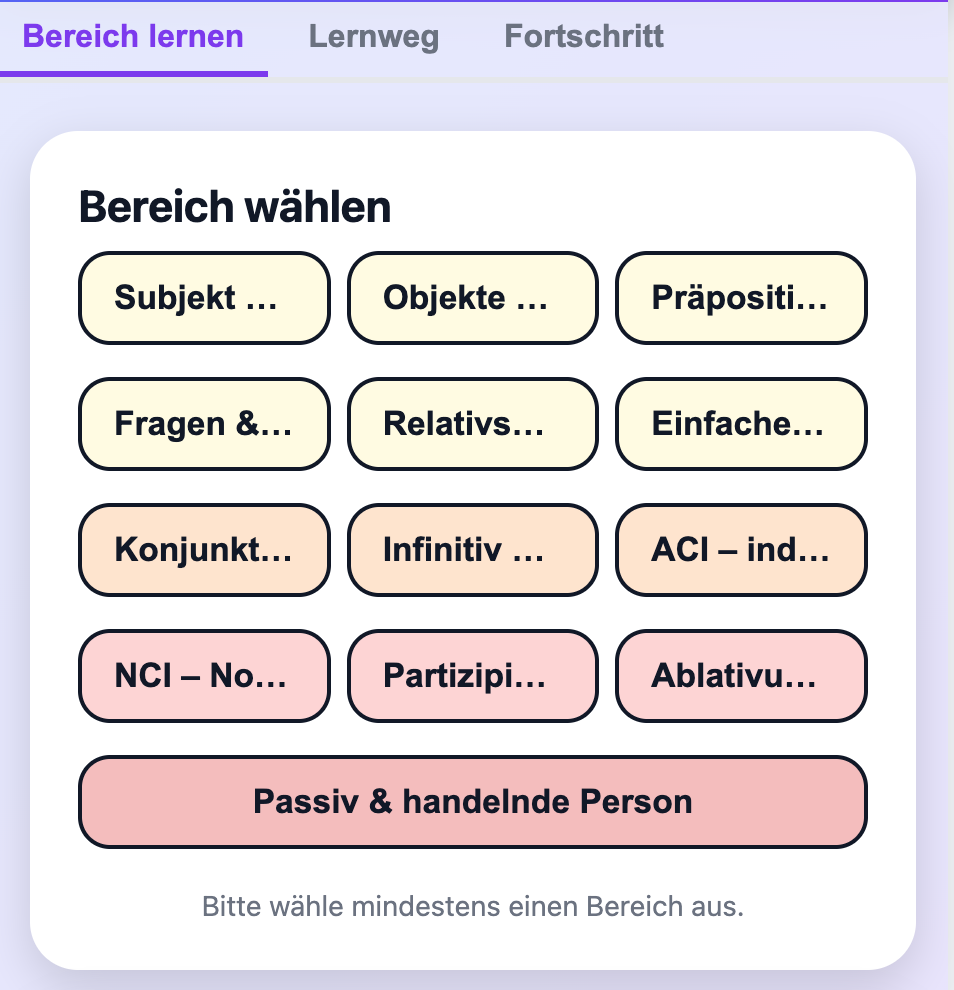
- 13 topics—from subject & predicate to the passive voice, building step by step
- All tenses and persons, active and passive
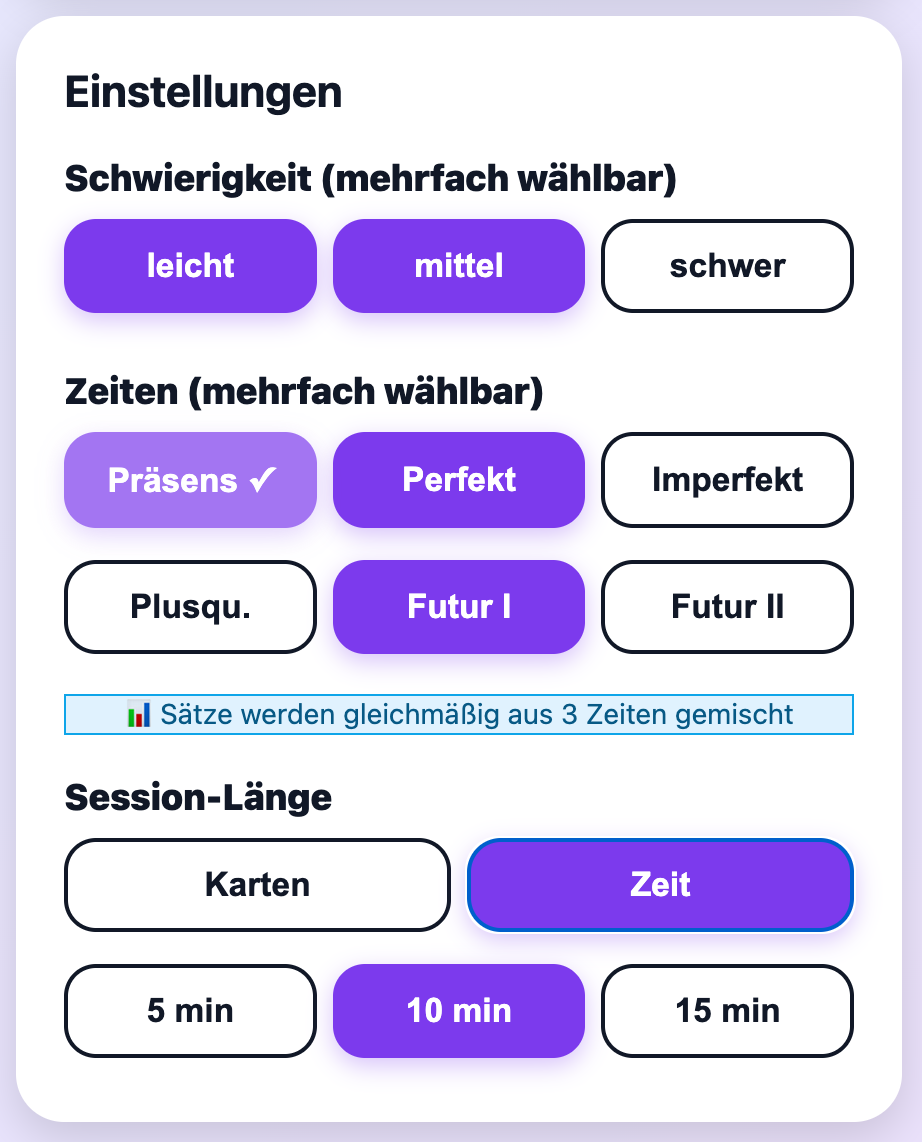
- Difficulty levels from easy to hard—you choose where to start
- SRS (Spaced Repetition) method: Sentences you haven’t mastered yet will reappear more often
- Feedback system with help texts — there’s an explanation for every type of mistake
Common Mistakes in Identifying Sentence Elements
- Mistaking an adjective for a separate clause element — An adjective belongs to the noun it modifies. Magnum oppidum videt → oppidum = object (accusative), magnum = attribute of the object, not a separate clause element.
- Failure to recognize a predicate noun — After esse (to be) and fieri (to become), there is no object, but rather a predicate noun in the nominative case. Caesar prudens est → prudens = nom., predicate noun.
- Confusing the dative and ablative — Many forms look the same. The key is: Does the verb take a dative object? Or is it an ablative of accompaniment with *cum*?
- Forgetting the embedded subject — Vincit has no visible subject — but it is implied in the ending. This implicit nominative is the subject.
Identifying sentence elements — Practice sentences
Sentence 1: Puer puellam amat.
💡 Mnemonic: In Latin, the case determines the meaning—not word order. *Caesarem vincit Brutus* means the same as *Brutus vincit Caesarem*: Brutus defeats Caesar (accusative = object). Only the ending reveals who defeats whom.
Solution 1
Subject: Puer (nominative singular)
Predicate: amat (3rd person singular present active)
Direct object: puellam (accusative singular)
Translation: The boy loves the girl.
Sentence 2: Magistro librum damus.
Solution 2
Subject: we (included in the verb — 1st pl.)
Predicate: damus (1st pl. present active)
Direct object: librum (acc. sg.)
Indirect object: Magistro (dat. sg.)
Translation: We give the book to the teacher.
Sentence 3: Caesar milites fortes laudavit.
Solution 3
Subject: Caesar (nominative singular)
Predicate: laudavit (3rd person singular, perfect active)
Direct object: milites fortes (accusative plural)
Translation: Caesar praised the brave soldiers.
Sentence 4: Amicis dona dedimus.
Solution 4
Subject: we (1st pl.)
Predicate: dedimus (1st pl. perf. act.)
Direct object: dona (acc. pl. neut.)
Indirect object: Amicis (dat. pl.)
Translation: We gave gifts to our friends.
The sentence quiz in Lapicida offers over 100 more practice sentences—with immediate color-coded feedback.
Practice sentence elements in Lapicida
What are sentence elements in Latin?
How do I identify sentence elements in Latin?
What is the difference between the subject and the object in Latin?
How many sentence elements does a Latin sentence have?
Why isn’t word order decisive in Latin?
Conclusion
Identifying sentence elements in Latin is the foundation of any translation. The method is simple: predicate → subject → objects → rest. With practice, it becomes second nature. And Lapicida shows you in color for each sentence whether you’re correct.
Practice now—for free
Understand Latin instead of cramming — try it right now.


