Active Recall for Latin — Why Retrieval Beats Re-Reading
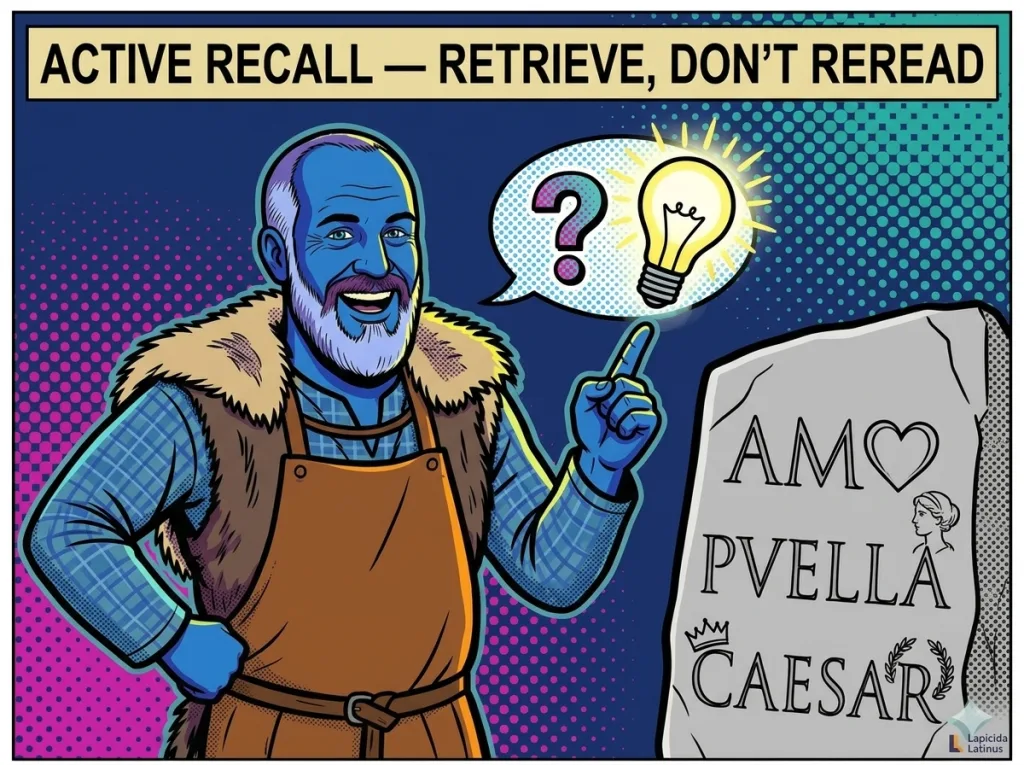
Read a text five times and feel confident — then a week later almost all of it is gone. Retrieve it actively, without looking — and a week later almost all of it is still there. That is the testing effect (active recall): one of the best-replicated findings in the psychology of learning. Lapicida builds every module on this principle.
- The testing effect: active retrieval vs. passive re-reading
- Roediger & Karpicke (2006): 61% vs. 40% after one week
- The fluency illusion: why re-reading fools us
- Bloom’s Mastery Learning — and how Lapicida defines mastery
What is active recall?
Active recall means pulling knowledge out of memory — with no aids, no looking things up. Its opposite is passive re-reading: reading the text again, reworking your notes, studying summaries. Active recall takes more mental effort — and it is exactly that effort that cements the memory trace.
Testing is not just measuring: “Testing is a powerful means of improving learning, not just assessing it.” (Roediger & Karpicke, 2006, p. 249) — tests are learning tools, not only assessment instruments.
| Method | Short term (5 min) | Long term (1 week) |
|---|---|---|
| Passive re-reading (SSSS) | 83% | 40% |
| Active recall / testing (STTT) | 71% | 61% |
The core experiment: Roediger & Karpicke (2006)
What was studied? Henry Roediger III and Jeffrey Karpicke had students learn scientific prose passages. One group re-read the text repeatedly (condition SSSS: Study-Study-Study-Study). The other group read it once, then recalled it from memory three times (condition STTT: Study-Test-Test-Test).
The result: After 5 minutes the re-readers won, 83% to 71%. After one week the finding flipped dramatically:
| Time point | Re-reading (SSSS) | Active recall (STTT) | Difference |
|---|---|---|---|
| After 5 minutes | 83% | 71% | Re-reading ahead |
| After 1 week | 40% | 61% | +53% for active recall |
The fluency illusion: The re-readers had read the text 14 times on average and felt very confident — a phenomenon called the fluency illusion. Fluent reading feels like understanding, but it is not. The active-recall group had read the text only 3.4 times — but retrieved the knowledge actively three times.
Roediger, H. L., & Karpicke, J. D. (2006). Test-enhanced learning: Taking memory tests improves long-term retention. Psychological Science, 17(3), 249–255.
Bloom’s Mastery Learning: master before moving on
Benjamin Bloom (1968) coined the concept of Mastery Learning: new material should only be added once a minimum level of mastery has been demonstrated. In a digital learning app that means a word or a sentence-element topic only counts as “mastery” once the learner has recalled it correctly, actively, several times in a row.
Why active recall makes mastery measurable: The mere feeling of understanding (from re-reading) is deceptive. Real mastery only shows in active retrieval without aids. That is why Lapicida uses Scripta mode at the highest box levels: the word must be typed out entirely from memory — not a single letter is shown.
Active recall works for any Latin topic — for an overview of every area, see Learn Latin.
| Box level in Lapicida | Active-recall level | Mastery definition |
|---|---|---|
| Box 0–1 | Supported (Flip, Type, MC) | Getting acquainted and imprinting |
| Box 2–3 | Partly active (Chunks, Trace, Shooter) | Producing with structural help |
| Box 4–5 | Fully active (Scripta) | Active recall with no help at all |
| Mastery | Automatic (Scripta, long intervals) | Long-term memory anchoring |
Active recall in Lapicida — from Flip to Scripta
13 retrieval modes with progressive activity: from the flashcard to pure writing-recall. The system decides automatically which mode fits right now.
Active recall in everyday study — tips without the app
- The Feynman technique: write the material down as if for someone who doesn’t know it yet — with no notes in front of you. Wherever you stall, you don’t understand it yet.
- The blank-page method: close the book, take a blank page, write down everything you still remember. Then look it up and fill the gaps.
- Use flashcards actively: flip the card after your retrieval attempt — not before. Force yourself to answer from memory first.
- Write summaries, don’t read them: writing a summary from memory (instead of reading a ready-made one) triggers the testing effect automatically.
Frequently asked questions — active recall
Learn Latin now. Our learning app:

What is the testing effect?
The testing effect is the finding that active retrieval (testing) cements knowledge in long-term memory more strongly than passive re-reading — even when the pure study time is identical. Roediger & Karpicke (2006) showed that after one week, learners using active recall retained 61% of the material, while re-readers retained only 40%.
What is the fluency illusion?
The fluency illusion arises when fluent reading is mistaken for a sign of understanding. Someone who has read a text four times feels confident — yet can often reproduce far less than someone who read it once and retrieved it actively three times. The confidence is an illusion.
How exactly does Lapicida use active recall?
The form trainer requires you to identify word forms in the sentence actively (no multiple choice in the higher boxes). Scripta mode in the vocabulary trainer is pure active recall: type the word out in full, with no letter shown. The sentence quiz requires active sentence-element assignment for every sentence.
Experience active recall now
From Flip to Scripta: 13 modes with a progressive active-recall level. Lapicida builds long-term memory systematically — start for free.
Start for free → · See the full version
About the author
Andreas Blankenstein is the founder of Lapicida Latinus — and dyslexic himself. When he had to catch up on the Latinum in record time, one thing became clear: endless table-cramming fails exactly the people who learn differently. That is why Lapicida builds learning around real author texts, colour-coded and in short steps. More about Andreas and the Lapicida method →
Latin Vocabulary Trainer — 13 modes · Latin Sentence Elements — step by step · Practice Latin Verb Forms · Learning Vocabulary in Context — the research · Latinum Preparation — 3-phase plan
Learn Latin now. Our learning app: