
Spaced Repetition: Why the Gaps Between Reviews Decide What You Remember
Spaced repetition — reviewing with growing gaps between sessions — is one of the most robust findings in all of cognitive psychology. It turns out that how much time you study matters far less than when you come back to it. Space your reviews well and the material lodges in long-term memory. Cram it all the night before the exam and you’ll have lost nearly all of it a week later. Lapicida builds spaced repetition into every module, systematically.
- The spacing effect: why distributed practice beats pure cramming
- Cepeda et al. (2006/2008): the optimal gaps and the 10–20% rule
- Sobel et al. (2011): nearly three times the recall in a real classroom
- How Lapicida puts spaced repetition to work in the vocabulary trainer and sentence quiz
What is spaced repetition?
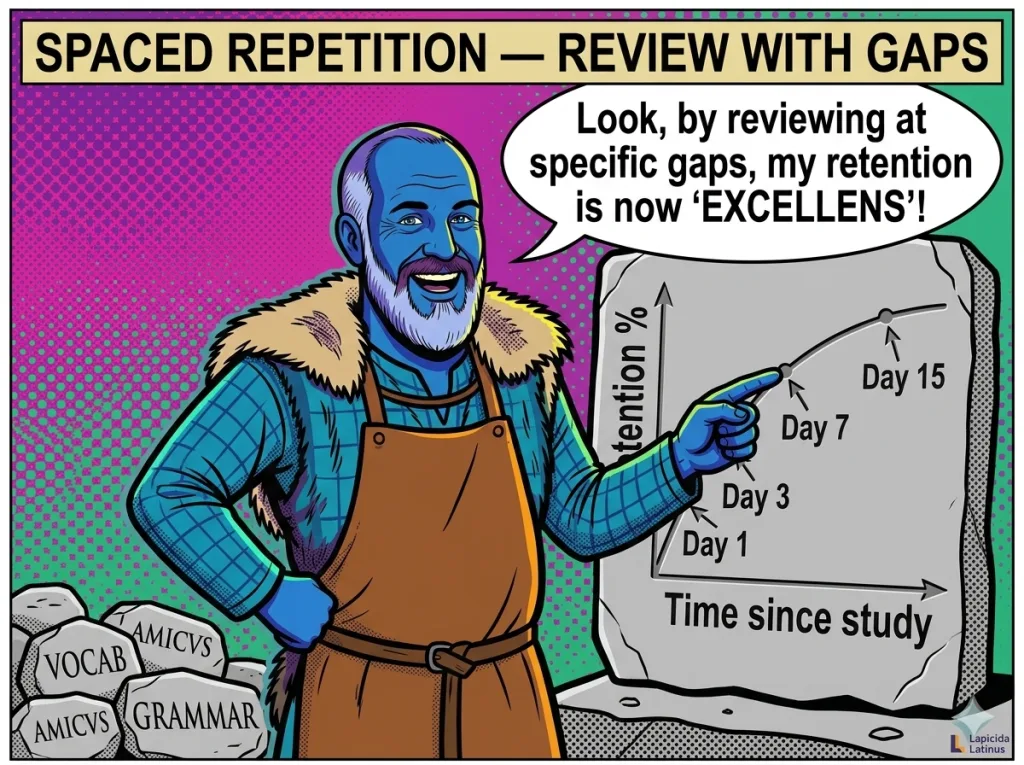
Spaced repetition means reviewing what you’re learning at widening intervals. Instead of hammering everything in a single day (massed practice), you split the same study time across several sessions with deliberate breaks in between. The first gap can be short (say, 1 day), the next one longer (3 days), the next longer still (7 days). The result: memory gets stronger with every review.
Learn Latin now. Our learning app:

Rule of thumb, after Cepeda et al. (2008): the optimal gap is roughly 10–20% of the time until the exam or moment you’ll need to use what you learned. If you want to still know a word in 30 days, review it 3–12 days after you first learned it.
| Target retention interval (RI) | Optimal gap (ISI) | Example |
|---|---|---|
| 7 days | 1–3 days | Short-notice test prep |
| 30 days | 3–12 days | Standard case for vocabulary |
| 3 months | ~2–4 weeks | Longer-term exam preparation |
| 1 year | ~1–2 months | Latinum prep across semesters |
Cepeda et al. (2006/2008): the meta-analysis and what it found
What was studied? Nick Cepeda and colleagues published a sweeping 2006 meta-analysis covering hundreds of studies on distributed practice, then followed up in 2008 with a study of more than 1,350 participants to pin down the optimal gaps. The underlying spacing effect goes all the way back to Hermann Ebbinghaus and is one of the most reliably replicated results in the psychology of learning.
- The spacing effect is universal: for the long-term retention of verbal material — vocabulary very much included — the spacing effect holds without exception. It has been replicated across age groups, languages and learning settings.
- Too little spacing is worse than too much: in the researchers’ own words, “having too little spacing is worse than having too much.” Review after an hour instead of waiting a few days and you lose almost the entire benefit.
- The 10–20% rule: the optimal inter-session interval (ISI) is roughly 10–40% of your target retention interval. It’s not a fixed number — it always has to be chosen relative to your goal.
Cepeda, N. J., Pashler, H., Vul, E., Wixted, J. T., & Rohrer, D. (2006). Distributed practice in verbal recall tasks: A review and quantitative synthesis. Psychological Bulletin, 132(3), 354–380.
Sobel et al. (2011): nearly triple the recall in a real classroom
What was studied? Sobel, Cepeda and Kapler ran their experiment not in a lab but in a real classroom, with fifth-graders learning English vocabulary (GRE-level words).
| Condition | Method | Result after 5 weeks |
|---|---|---|
| Massed | Both study sessions just 1 minute apart | 7.5% of definitions recalled |
| Spaced | Both study sessions 1 week apart | 20.8% of definitions recalled |
The result: the spaced group recalled nearly three times as many definitions (177% more) as the massed group — with identical study time. Sobel et al. showed that spaced repetition works powerfully even under real school conditions, with none of the tidy controls of a lab.
Sobel, H. S., Cepeda, N. J., & Kapler, I. V. (2011). Spacing effects in real-world classroom vocabulary learning. Applied Cognitive Psychology, 25(5), 763–767.
Spaced repetition works best inside a structured plan — if the Latinum is your goal, the Latinum preparation guide shows how to fit it together. The same mechanism sits behind every good flashcard system: pair spaced intervals with genuine retrieval — the kind you get from learning vocabulary in context — and you squeeze the most out of every minute of study.
Spaced repetition in Lapicida — automatic, no thinking required
Lapicida’s Leitner box system handles the review intervals for you. You just learn — the system makes sure each word comes back at exactly the right moment.
Here’s how you build with a system: grow your Latin vocabulary in the vocabulary trainer, lock in the forms, and put it all to work in real sentences in the sentence quiz — every area with spaced repetition built in.
How Lapicida puts spaced repetition to work
- Vocabulary trainer — 7 boxes: a Leitner box system with 7 boxes (Box 0 to Mastery) automatically decides when a word comes back. Cooldowns grow exponentially: 1 → 3 → 7 → 14 → 30 → 60 days.
- Sentence quiz — adaptive spaced repetition: sentences that trip you up return more often; sentences you’ve clearly nailed come back at longer intervals.
- Speed as a bonus: the system measures how fast you answer. Fast, correct answers speed up a word’s climb through the boxes — a sign it has become genuinely automatic.
- Offline sync: progress is stored locally and synced to the cloud, so an interrupted session never costs you your progress.
Frequently asked questions — spaced repetition
What’s the difference between spaced repetition and just reviewing?
Ordinary reviewing often means massed practice: everything right before the exam. Spaced repetition splits that same study time across several sessions with widening gaps. The research is clear: for the same amount of study time, the spaced group recalls almost three times as much after a few weeks as the massed group.
How long should the gap between two study sessions be?
After Cepeda et al. (2008): about 10–20% of the time until the exam. For vocabulary you want solid in 30 days, a gap of 3–12 days is optimal. Important: too-short gaps hurt more than too-long ones.
What is the Leitner box system?
In the 1970s Sebastian Leitner devised a physical flashcard system with five compartments. Cards you know move up into higher compartments with longer intervals. Lapicida takes that principle digital: 7 boxes, automatic cooldowns, and a forgiving soft-reset when you slip.
Put spaced repetition to work now
Lapicida runs spaced repetition automatically across the vocabulary trainer and sentence quiz. Learn smart — not more.
About the author
Andreas Blankenstein is the founder of Lapicida Latinus — and dyslexic himself. When he had to catch up on the Latinum in record time, one thing became clear: endless table-cramming fails exactly the people who learn differently. So Lapicida builds learning around real author texts, colour-coded and in short steps. More on Andreas and the Lapicida method →
Latin vocabulary trainer · Latin vocabulary · Learning vocabulary in context · Latinum preparation · Learn Latin as an adult · The Lapicida learning method · Why learn Latin
Learn Latin now. Our learning app: