LRS Latin App — the best app for students with dyslexia
Most Latin apps weren't designed for students with dyslexia. They display long vocabulary lists, require students to memorize tables, and provide no contextual clues. For students with dyslexia, this presents a double hurdle: first, they have to decode similar endings, and then figure out the context from scratch.
Lapicida Latinus was developed differently. The developer learned Latin himself while dealing with dyslexia—and built an app that he would have needed back then. The result: seven dyslexia-specific features that aren’t tucked away as special functions on the sidelines, but are at the core of the app. The Latin Learning Methodology page provides an overview of all the learning principles behind it.
What is the best Latin app for students with dyslexia?
LRS Latin App: Lapicida Latinus is the only Latin learning app with integrated dyslexia-friendly features: color-coding by sentence component, OpenDyslexic font, a 5-card limit, increased letter spacing, soft-reset SRS, and sentence-based training. The app is based on the recommendations of Sellin (BVL 2013) and Friedrich (2017)—and was developed by someone who learned Latin themselves while living with dyslexia. Try it for free—no account required.
What a Dyslexia-Friendly Latin App Must Be Able to Do
Not every app that claims to be suitable for dyslexia actually helps with learning Latin. Most dyslexia apps focus on German spelling—not Latin syntax or declensions. What a true dyslexia-friendly Latin app needs is derived directly from learning therapy research (Sellin 2013, Friedrich 2017, Cognitive Load Theory according to Sweller 1988):
| Feature | Why It Helps with Dyslexia | In Lapicida |
|---|---|---|
| Color-coding by sentence component | Parallel processing channel: Color is recognized before the word is decoded. Breaks through Ranschburg’s inhibition of similar endings. | ✓ A separate color for each case |
| OpenDyslexic font | Weighted subpages prevent letters from being reversed (b/d, p/q—typical in dyslexia). | ✓ Can be enabled globally |
| 5-card limit | Limits active cards to 5. Prevents systematic overloading of working memory. | ✓ Sliding-window principle |
| Audio pronunciation | Multisensory learning: The auditory channel reduces the burden on visual decoding. | ✓ 28,000+ OGG files |
| Increased letter spacing | Reduces visual crowding: Letters and letter endings are less likely to blur together. | ✓ 0.03em permanently |
| Sentence-based training | Eliminates fragmented skills: Endings are learned within a semantic context. | ✓ All modes in sentence context |
| Soft Reset SRS | First mistake = streak reset only. No total reset for careless mistakes. | ✓ The box doesn’t drop until the 2nd mistake |
The seven LRS features of Lapicida — how they work in practice
Color-coding by sentence element. The brain processes colors in parallel—even before a word is fully decoded. In the a-declension (a, ae, ae, am, ā), four out of five forms are nearly identical. Pál Ranschburg demonstrated in 1905: Similar items inhibit one another in memory. Color coding provides the anchor: the nominative is blue, the accusative is indigo—the case catches the eye before the ending is read.
OpenDyslexic. The font has uneven letter weights with heavier bottoms. This prevents the optical mirroring typical of dyslexia (b becomes d, p becomes q). In Lapicida, this can be enabled globally via the settings—and remains active in all learning modes.
5-card limit (sliding window). Working memory has a strict capacity limit that is reached more quickly by students with dyslexia (Sweller 1988). Lapicida’s vocabulary trainer holds a maximum of 5 active cards at a time. Only when a card is mastered (Box ≥ 3) does a new one move up. No stack of 50 vocabulary words at once.
Audio Pronunciation. Since May 2026, Lapicida has provided audio for over 28,000 words, forms and sentences. Latin pronunciation is phonetically accurate (1:1 letter-sound correspondence)—the audio confirms the spelling rather than confusing it. Learners with dyslexia benefit greatly from multisensory learning.
Letter spacing. All Latin texts in Lapicida have permanently increased letter spacing (0.03em). This reduces visual crowding: letters and endings blur less, especially in long word forms such as participles or subjunctive forms.
Sentence-Based Training (Predicate-First). The sentence quiz rigorously trains the predicate-first strategy: find the verb, then identify the subject and objects. This immediately provides person, number, and tense as anchors—and stops the extremely error-prone practice of linear reading. Katrin Sellin explicitly recommends this strategy for students with dyslexia (BVL 2013).
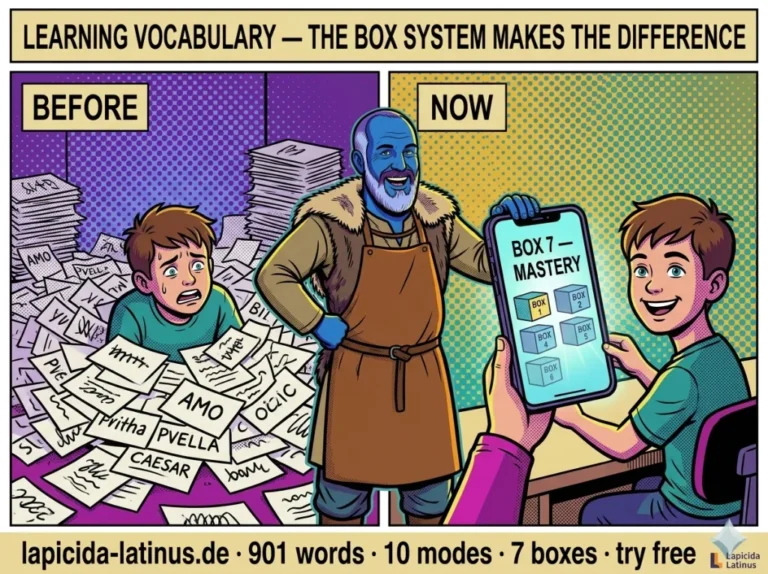
Soft-Reset SRS. Students with dyslexia make careless mistakes more frequently. A total crash back to Box 0 would be discouraging. Lapicida’s Soft Reset: The first mistake only resets the streak. Only after the second consecutive mistake does the card drop down one box. This allows for slip-ups without jeopardizing the learning goal.
Learn Latin now. Our learning app:

Lapicida in an app comparison: What other Latin apps can’t do
There are few apps that are even suitable for Latin. Even fewer focus on LRS. Cabuu and similar vocabulary trainers are general language-learning apps—they don’t offer Latin syntax training or LRS-specific features. A breakdown:
| Feature | Lapicida | Vocabulary trainer apps (e.g., Cabuu) | No digital tool |
|---|---|---|---|
| Latin sentence quiz with syntax training | ✓ | ✗ | ✗ |
| Color-coding by sentence component | ✓ | ✗ | ✗ |
| OpenDyslexic font | ✓ | ✗ | ✗ |
| 5-card limit (cognitive load) | ✓ | partially | ✗ |
| Audio pronunciation in Latin | ✓ | ✗ | ✗ |
| Soft Reset (SRS) | ✓ | ✗ | ✗ |
| Completely offline | ✓ | ✗ | — |
| Free trial available | ✓ | ✓ | — |
For a broader comparison of all available Latin apps: Latin App Comparison 2026. lapicida-latinus.de/de/latein-lernen/ summarizes all methodological background information on LRS and learning methods.
More blog posts on this topic:






Frequently Asked Questions: LRS Latin App
Is Lapicida free?
The freemium version is permanently free: a-declension, indicative active, sentence quiz (subject/predicate), 5 OCR scans, and a vocabulary set. The full version costs €19.99/year (= €1.67/month), €4.99/month, or a one-time fee of €59.99 (lifetime). The Officina teacher licence costs €19.99 per year.
Does Lapicida work offline?
Yes. The app is fully offline-capable. After the first launch, all data is stored locally—no internet connection or login required. This is especially important for students with dyslexia who want to learn undisturbed and at their own pace.
Which platforms does Lapicida support?
Android: native app in the Google Play Store. iOS: PWA via Safari (“Add to Home Screen”—no App Store required). Browser: web version at lapicida-latinus.de/webversion/—works on any device without installation.
Do I need an official dyslexia diagnosis to benefit from Lapicida?
No. Snowling & Hulme (2012) show that dyslexia is a continuum—many students struggle with the same patterns without ever having been diagnosed. Lapicida’s methods (color coding, sentence context, spaced repetition) are universal learning principles. The dyslexia-specific options (OpenDyslexic, letter spacing) are opt-in.
What makes Lapicida better than Cabuu or Quizlet for Latin?
Cabuu and Quizlet are general vocabulary trainers—they don’t have a Latin syntax trainer, sentence quizzes, or color-coding by sentence component. Lapicida is a Latin app developed from the ground up for Latin (and dyslexia): 3,100 original Latin sentences, 14 syntax areas, 13 game modes—all completely offline.
Which LRS features are available in the freemium version?
All LRS display features are also active in the freemium version: color coding, OpenDyslexic font, increased letter spacing, audio pronunciation, and the 5-card limit. The freemium restrictions apply to the scope of the material available for practice, not to the learning aids.
Learn Latin with LRS support — get started for free
Learn Latin now. Our learning app: