
Latin Fourth Declension (u-Declension) — portus, cornu Explained

The fourth declension (u-declension) is smaller than the first and second, but it covers important words — portus (harbour), manus (hand), exercitus (army), senatus (senate). You recognise it by the running -u-. Part of the Learn Latin series.
- All endings of the fourth declension
- Tables for portus (m.) and cornu (n.)
- Why manus and domus are feminine
- How to tell it apart from the second declension
What is the fourth declension?
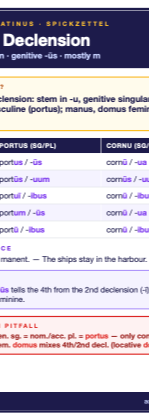
The fourth declension (u-declension) holds nouns with the stem vowel -u-. You recognise it by the genitive singular in -us (long -ūs: portus, portūs). Most are masculine, some feminine (manus, domus), a few neuter (cornu, genu).
The endings of the fourth declension
| Case | Masc./Fem. | Neuter |
|---|---|---|
| Nom. sg. | portus | cornu |
| Gen. sg. | portus | cornus |
| Dat. sg. | portui | cornu |
| Acc. sg. | portum | cornu |
| Abl. sg. | portu | cornu |
| Nom. pl. | portus | cornua |
| Gen. pl. | portuum | cornuum |
| Dat./Abl. pl. | portibus | cornibus |
| Acc. pl. | portus | cornua |
How to spot it: the genitive singular in -ūs (long). The dictionary shows portus, portus — unlike the second declension, whose genitive is -i.

The tables: portus and cornu
portus, portus m. — harbour
| Case | Singular | Plural |
|---|---|---|
| Nominative | portus | portus |
| Genitive | portus | portuum |
| Dative | portui | portibus |
| Accusative | portum | portus |
| Ablative | portu | portibus |
cornu, cornus n. — horn (neuter: nom. = acc., plural in -ua)
| Case | Singular | Plural |
|---|---|---|
| Nom. / Acc. | cornu | cornua |
| Genitive | cornus | cornuum |
| Dat. / Abl. | cornu | cornibus |
Note: the dative/ablative plural ends in -ibus — as in the third declension. See the declension chart.
Learn Latin now. Our learning app:

Gender: mostly masculine — with key exceptions
Most fourth-declension nouns are masculine (portus, exercitus, senatus, currus). But there are fixed exceptions:
- feminine: manus (hand), domus (house), porticus (colonnade), Idus (the Ides)
- neuter: cornu (horn), genu (knee), veru (spit)
domus is a special case: it mixes fourth- and second-declension forms and has its own locative domi (“at home”).
The cases in a sentence
| Case | Latin | English |
|---|---|---|
| Nominative | Portus navibus plenus est. | The harbour is full of ships. |
| Genitive | Aditus portus angustus est. | The entrance of the harbour is narrow. |
| Dative | Nauta portui appropinquat. | The sailor approaches the harbour. |
| Accusative | Naves portum petunt. | The ships make for the harbour. |
| Ablative | Naves in portu manent. | The ships stay in the harbour. |
Common mistakes
- Confusing it with the second declension: a word in -us is not automatically second declension. The genitive decides: -us = fourth, -i = second.
- Nom. sg. = gen. sg. = nom./acc. pl.: all four are portus. Only the sentence separates them.
- Overlooking the neuter: cornu, genu end in -u and take the plural in -ua.
- Taking manus as masculine: manus is feminine — manus dextra (the right hand).
Frequently asked questions
What is the fourth declension in Latin?
The fourth declension (u-declension) holds nouns with the stem vowel -u-, such as portus (harbour) or manus (hand). The genitive singular ends in -us.
How do I tell the fourth and second declension apart?
Both can end in -us in the nominative. The difference is the genitive singular: -us = fourth declension, -i = second. That is why the dictionary form matters.
Which fourth-declension nouns are feminine?
Mainly manus (hand) and domus (house), plus porticus (colonnade), tribus and Idus. Neuter are cornu (horn), genu (knee) and veru.
How does the neuter of the fourth declension work?
Neuter nouns end in -u in the singular (cornu). Nominative and accusative are identical, and the plural ends in -ua (cornua).
What about domus?
domus is a special case: it mixes fourth- and second-declension endings and has its own locative domi meaning “at home”.
Practise the declensions actively
Lapicida Latinus makes you type the forms instead of just ticking boxes — forms trainer, sentence quiz and reading in one app. Start free, full version from €19.99/year.
Learn Latin now. Our learning app: