Sallust in Latin — Read & Translate the Catiline Conspiracy
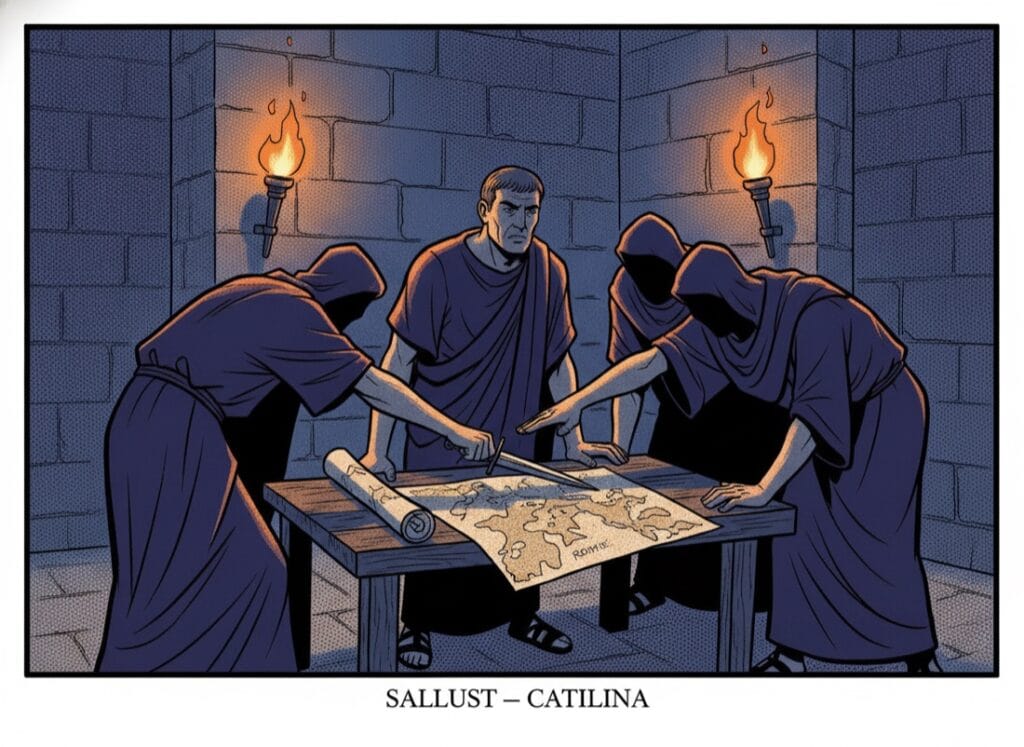
Sallust (Gaius Sallustius Crispus, 86–35 BC) is regarded as Rome’s first pragmatic historian — and a classic author of upper school and exam reading. In class you meet him above all in the Coniuratio Catilinae (Bellum Catilinae), his monograph on Catiline’s conspiracy, and in the Bellum Iugurthinum. The appeal: sharp character portraits and a dark analysis of Roman moral decline. The hurdle: Sallust’s deliberately terse, archaic style. That is exactly where our idea comes in: read the same author in stages — from a gently simplified version matched to your level up to the verbatim original. This page belongs to our Learn Latin section and leads straight into our in-app reader.
Important: this is not a grab-bag of level sentences — you practise those in the Sentence Quiz. In the reader you get the real Sallust as a connected text, on the historical material. Because context carries understanding — fragments never become reading.
- Who Sallust was — and why the Coniuratio Catilinae is a classic school author
- Sallust’s famous portrait of Catiline in the original, with our own translation
- How the app grades the same Sallust passage from simplified to the original
- The typical Sallust pitfalls — the historical infinitive, archaisms, brevitas
- Common student mistakes and how to avoid them
Who was Sallust?
Gaius Sallustius Crispus (86–35 BC) was a politician in Caesar’s circle who, after his political career, became Rome’s first great historian to not merely narrate events but interpret and morally judge them. He is famous for two monographs: the Coniuratio Catilinae on the conspiracy of 63 BC and the Bellum Iugurthinum. For the classroom, Sallust is a model of historiography: pointed portraits, sharp social criticism and a deliberately compressed, archaic style that turns away from Cicero.
Sallust’s portrait of Catiline — in the original
Right at the start of the Coniuratio Catilinae Sallust draws his anti-hero in a single, pointed sentence — a model of his art of portraiture:
Catilina fuit magna vi et animi et corporis, sed ingenio malo pravoque.
Sallust, Coniuratio Catilinae 5,1
Our translation: “Catiline was of great vigour of both mind and body, but of an evil and depraved character.” In one sentence greatness and decay stand side by side — exactly the tension that runs through Sallust’s whole work. The doubled et … et and the hard sed set the opposites as if with a chisel.
You can check the Latin wording against free editions: The Latin Library, the original text at Wikisource, and the overview at Wikipedia.
In stages to the original — how the app grades the text
Reading research names a hard threshold: only when you know about 95% of the words in a paragraph do you read fluently. Jump straight from the textbook into Sallust’s compressed sentences and those 95% are almost always missing. So we read the same Sallust material in stages: first a simplified version matched to your level, then steadily harder — up to the unchanged original. The cognitive load is shared, and forms and vocabulary are recycled again and again in real sentence context.
In our in-app reader the Coniuratio Catilinae is built exactly this way — the same passage across several stages:
| Stage | Collection in the app | Focus |
|---|---|---|
| from year 3 | Catiline’s character · simplified | The portrait, untangled |
| upper school · L15/L18 | Bellum Catilinae 5–9 (moral decline) | Sallust’s social criticism in the original |
| upper school · L27 (original) | Bellum Catilinae 51–55 (Caesar’s speech) | Sallust’s unchanged text |
The same passage, two stages — the portrait of Catiline
Here is what the path looks like. On the left the gently simplified version from “Catiline’s character (stage L9)”; on the right the same thought in Sallust’s unchanged original (stage L15, Coniuratio Catilinae 5):
Simplified · stage L9
“Lucius Catilina ex nobili genere erat. Magnas vires corporis et animi habebat. Sed ingenium malum habebat.”
Lucius Catiline came from a noble family. He had great strength of body and mind. But he had a bad character.
Original · stage L15 (Sallust, Cat. 5)
“Catilina fuit magna vi et animi et corporis, sed ingenio malo pravoque.”
Catiline was of great vigour of both mind and body, but of an evil and depraved character.
The same content — only the difficulty grows: three clear main clauses with habebat against Sallust’s compressed original, which packs the qualities into bare ablatives (magna vi … ingenio malo) and reduces the verb to a single fuit. Both times real Sallust in context, not isolated sentences.
Key idea: the hardest text does not make you better — the one you understand at 95% does, and then one step higher. That is how you reach the original safely.
Learn Latin now. Our learning app:

The Sallust pitfalls — and how to crack them
Sallust writes deliberately compressed and archaic. Three features cost students the most marks in exams. One example each:
1. The historical infinitive
In dramatic scenes Sallust strings together bare infinitives instead of finite verbs: Catilina in agmine … laborare, vigilare. Search for a predicate and you despair. The historical infinitive is translated with a normal past tense (indicative) — “he toiled, he kept watch.” Signal: several infinitives side by side, no finite verb.
2. Archaisms — the old forms
Sallust imitates the venerable style of the ancestors. Watch for: -ere for -erunt in the 3rd person plural perfect (coepere = coeperunt), -is for -es in the accusative plural of i-stems (partis = partes), and u for i in endings (maxumus = maximus). Not a mistake in the text, but intent.
3. Brevitas — brevity with gaps
Sallust saves words wherever he can. Often esse or a pronoun is missing and must be supplied; clauses are deliberately asymmetric (variatio). Rule of thumb: if the verb is missing, supply “is/was”, and read the ablative as a quality (“of great vigour”) rather than literally.
| Pitfall | Signal | Most common mistake |
|---|---|---|
| Historical infinitive | several infinitives, no finite verb | fruitless verb-hunt instead of past tense |
| Archaisms | -ere, -is, maxumus | read as an error/unknown form |
| Brevitas | sentence without esse, piled ablatives | verb searched for instead of supplied |
Frequently asked — Sallust
Is Sallust hard to translate?
Sallust writes short and archaic. The main difficulties are the historical infinitive, the archaisms (coepere, maxumus) and the brevitas with omitted esse. Learn these patterns and read in stages, and you will manage well.
From what level can I read Sallust?
Simplified versions (such as Catiline’s character) can be read from the third year. The unchanged original of the Coniuratio Catilinae is typical upper-school and exam level.
Which work of Sallust is read in school?
Most often the Coniuratio Catilinae (Bellum Catilinae) on Catiline’s conspiracy, with the famous portrait of Catiline and the speeches of Caesar and Cato in the Senate. Alongside it stands the Bellum Iugurthinum.
Why does Sallust write so archaically?
Sallust deliberately imitates the strict, terse style of the Roman ancestors to underline his moral criticism of his age. The archaisms and the brevitas are stylistic devices, not chance.
Learn Latin now. Our learning app: