Cicero in Latin — Read & Translate Rome’s Greatest Orator
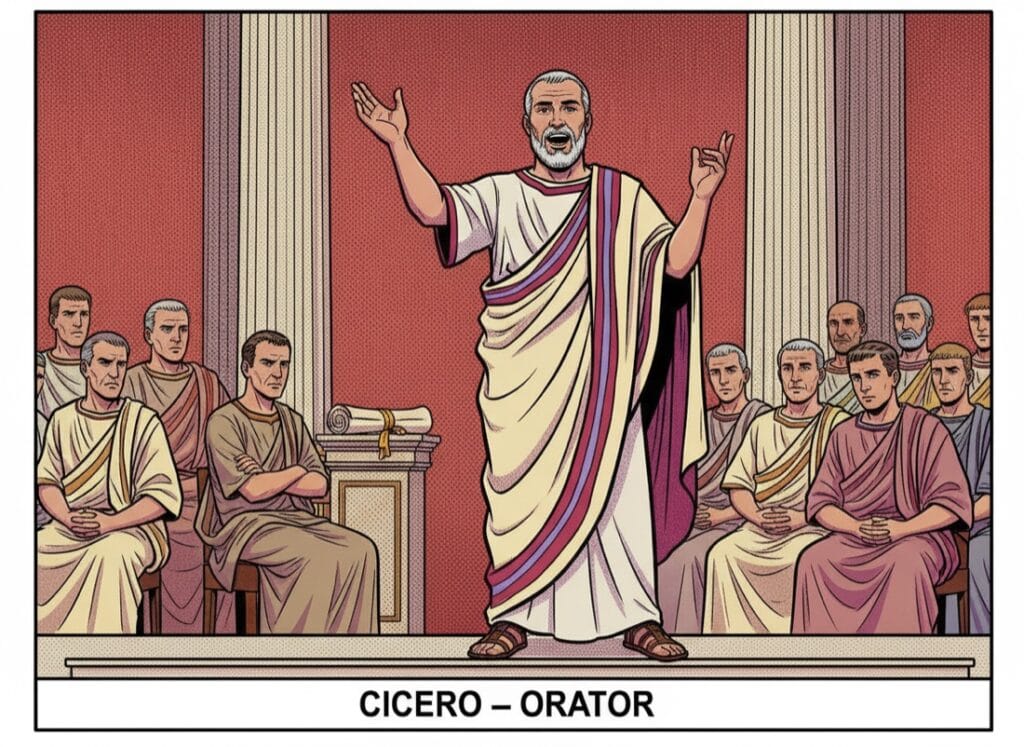
Cicero (Marcus Tullius Cicero, 106–43 BC) is Rome’s greatest orator and its most important philosophical writer — and one of the most widely read authors in Latin classrooms and on the road to real original reading. In school you meet him above all in his philosophical works: Cato maior de senectute (On Old Age), Laelius de amicitia (On Friendship), the Somnium Scipionis and the Tusculanae disputationes. The appeal: clear thought in flawless Latin. The hurdle: Cicero’s artfully built periods. That is exactly where our idea comes in: read the same author in stages — from a gently simplified version matched to your level up to the verbatim original. This page belongs to our Learn Latin section and leads straight into our in-app reader.
Important: this is not a grab-bag of level sentences — you practise those in the Sentence Quiz. In the reader you get the real Cicero as a connected text, following the philosophical argument. Because context carries understanding — fragments never become reading.
- Who Cicero was — and why he is the classic school author for rhetoric and philosophy
- A famous sentence from De senectute in the original, with our own translation
- How the app grades the same Cicero text from simplified to the original
- The typical Cicero pitfalls — the relative connection, iste, subjective vs. objective genitive
- Common student mistakes and how to avoid them
Who was Cicero?
Marcus Tullius Cicero (106–43 BC) was an orator, lawyer, consul (63 BC) and philosophical writer — the defining voice of the late Roman Republic. As a homo novus he rose to the top of the state without noble ancestry, exposed the Catilinarian conspiracy, and in his final years shaped the very language of Latin philosophy. For the classroom, Cicero is the model case of classical prose: clear in thought, rhetorically composed and syntactically demanding — the ideal step from Caesar to challenging original reading.
A line of Cicero in the original — from De senectute
In Cato maior de senectute the aged Cato defends old age against every prejudice. One of its best-known sentences sums up Cicero’s view of human worth in a classic tricolon:
Non viribus res magnae geruntur, sed consilio, auctoritate, sententia.
Cicero, Cato maior de senectute 17
Our translation: “Great things are not achieved by physical strength, but by counsel, authority and judgement.” Three watchwords of Roman thought — consilium, auctoritas, sententia — stand here in Cicero’s signature three-step: it is not the strength of youth that sustains the state, but the experience of age.
You can check the Latin wording and the author against free, scholarly sources: the Stanford Encyclopedia of Philosophy (Cicero), the original text of the Laelius de amicitia on Wikisource, and the biographical overview at Wikipedia.
In stages to the original — how the app grades the text
Reading research names a hard threshold: only when you know about 95% of the words in a paragraph do you read fluently. Jump straight from the textbook into Cicero’s periods and those 95% are almost always missing — vocabulary, dense syntax and philosophical argument all arrive at once. So we read the same Cicero material in stages: first a simplified, Cicero-near version matched to your level, then steadily harder — up to the unchanged original. The cognitive load is shared, and forms and vocabulary are recycled again and again in real sentence context.
In our in-app reader Cicero is built exactly this way — the same author across several stages, from an easy start to the original:
| Stage | Collection in the app | Focus |
|---|---|---|
| from year 3 | De amicitia · simplified retelling | Friendship, untangled |
| year 3–4 | De senectute (On Old Age) · adapted | A connected argument |
| upper school | Laelius de amicitia 17–32 · up to stage 18 | First taste of the original: periods & subjunctive |
| upper school · original | Somnium Scipionis (L24) · Tusculanae I (L27) | Cicero’s unchanged text |
The same reading, two stages — De amicitia
Here is what the path looks like. On the left our gently simplified entry from the app collection “De amicitia · retelling (stage L3)”; on the right the same author in Cicero’s denser original from “Laelius de amicitia 17–32 (stage L18)”:
Simplified · stage L3
“Amicitia magna res est. Vera amicitia rara est. Boni viri amici sunt.”
Friendship is a great thing. True friendship is rare. Good people are friends.
Original · stage L18 (Cicero, Laelius 17)
“Praeclara res est et sumus otiosi. Doctorum est ista consuetudo.”
It is a splendid thing, and we do have leisure. That is rather the custom of the learned.
The same material — only the difficulty grows: three short statements against Cicero’s elliptical original, where the verb is left to be understood (ista consuetudo [est]) and the thought unfolds across the dialogue. Both times real Cicero in context, not isolated sentences.
Key idea: the hardest text does not make you better — the one you understand at 95% does, and then one step higher. That is how you reach the original safely.
Learn Latin now. Our learning app:

The Cicero pitfalls — and how to crack them
Cicero writes clearly, but in long, carefully built periods. Three constructions cost students the most marks in exams. One example each:
1. The relative connection (relative connection)
Cicero begins whole sentences with a relative pronoun: Catilina ex urbe excessit. Qui statim ad exercitum contendit. Translate Qui mechanically as “who” and you get a broken sentence. A relative pronoun at the start of a sentence is almost always a demonstrative — so “He at once hurried to the army,” not “who.” Rule of thumb: new sentence + relative pronoun = “this man / and he.”
2. iste — the pronoun of contempt
Cicero’s speeches teem with iste, ista, istud. It is not a neutral “this”: for Cicero iste is the demonstrative of contempt and almost always points at the opponent. Consilia istius hominis video does not mean a flat “the plans of this man,” but a scornful “I see through the schemes of that man there.” Translate the emotion too.
3. Subjective or objective genitive?
Cicero loves phrases like timor hostium. The reflex translation “the fear of the enemy” is often wrong. Check the context: are the enemy afraid (subjective genitive) or is someone afraid of the enemy (objective genitive — “the fear of the enemy”)? Same genitive, two meanings — only sense decides.
| Pitfall | Signal | Most common mistake |
|---|---|---|
| Relative connection | Relative pronoun at sentence start | “who” instead of “this man” → broken sentence |
| iste | iste/ista/istud, often in speeches | translated neutrally instead of scornfully |
| Subj./obj. genitive | noun + genitive with a noun of feeling/action | context ignored, wrong direction chosen |
Frequently asked — Cicero
Is Cicero hard to translate?
Cicero writes clearly, but in long, artful periods. The main difficulties are the relative connection, the scornful iste, and the subjective vs. objective genitive. Learn these patterns and read in stages, and you will manage well.
From what level can I read Cicero?
Simplified versions (for example from De amicitia) can be read from the third year. More demanding passages follow in upper school; the unchanged original of the Somnium Scipionis or the Tusculanae is typical upper-school and exam level.
Which works of Cicero are read in school?
Most often the philosophical writings Cato maior de senectute (On Old Age), Laelius de amicitia (On Friendship), the Somnium Scipionis from De re publica and the Tusculanae disputationes, along with the speeches against Catiline.
How does Cicero prepare you for exams?
Cicero is one of the most common exam authors. Reading his texts in the original trains exactly the periods, constructions and vocabulary that appear in exam passages. Graded reading builds that level step by step.
Learn Latin now. Our learning app: