Caesar: De Bello Gallico — Learn It from Simplified Text to the Original
For most learners, Caesar’s De Bello Gallico (the Bellum Gallicum) is the first real Latin original they ever read — and often the hurdle before a Latin qualification. The reason is well known: between textbook sentences and Caesar’s compressed prose lies the notorious „reading shock“. Our idea tackles exactly that: read the same text in stages — from a strongly simplified version matched to your year of study up to the verbatim original. This page belongs to our Learn Latin section and leads straight into the in-app reader.
Important: this is not a pile of level-matched sentences — you drill those in the Satzquiz. Here you read the real Caesar as a connected text, on the historical material. Context carries comprehension; fragments never become reading.
- What the Bellum Gallicum is — and why Caesar is the classic school author
- The famous first sentence in the original, with our own translation
- How the app grades the same Caesar text from simplified to the original
- The four grammar hurdles in Caesar — ACI, ablative absolute, PC, indirect speech
- Common student mistakes and how to avoid them
What is Caesar’s De Bello Gallico?
The Bellum Gallicum (De Bello Gallico) is Caesar’s account of his campaigns in Gaul (58–50 BC). It is the classic entry point into original Latin: clear yet syntactically dense prose, a gripping historical narrative, and a model of Roman self-presentation. Anyone learning to read and translate Caesar’s De Bello Gallico usually starts with Book One.
The famous first sentence from De Bello Gallico — in the original
Few Latin sentences are quoted as often as Caesar’s opening. It shows at once what defines his style: short cola, clear structure, not a wasted word.
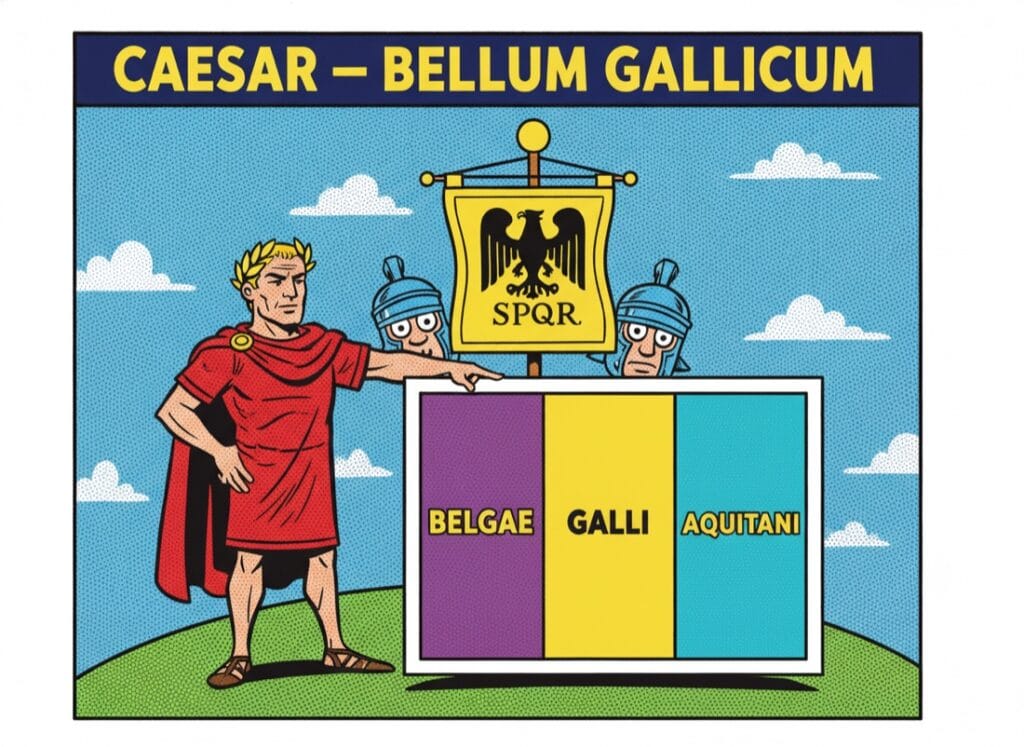
Gallia est omnis divisa in partes tres, quarum unam incolunt Belgae, aliam Aquitani, tertiam qui ipsorum lingua Celtae, nostra Galli appellantur.
Caesar, De Bello Gallico 1.1
Our translation: „Gaul as a whole is divided into three parts: one is inhabited by the Belgae, another by the Aquitani, and the third by those who are called Celts in their own language and Gauls in ours.“ Even here a critical eye pays off: Caesar writes as a proconsul with a clear political self-interest — his campaigns are meant to look like the defence of Rome. That makes the text an excellent training ground for source criticism, too.
You can check the Latin wording against two freely available editions: Wikisource (Liber I), The Latin Library, and the overview on Wikipedia.
Reaching the original in stages — how the app grades the text
Reading research points to a hard threshold: only when you know roughly 95% of the words in a paragraph do you read fluently. Jump straight from the textbook into the original and those 95% are almost never there — vocabulary, dense syntax and historical background all arrive at once. So we read the same Caesar material in graded stages: first a simplified, Caesar-flavoured paraphrase matched to your year of study, then steadily harder — up to the unchanged original. The cognitive load is shared, and forms and vocabulary keep recurring in real sentence context.
In our in-app reader the Bellum Gallicum is built exactly this way — the same storyline across several stages, from an easy start to the original:
Closer than you think: by the end of your 4th year — when, per the curriculum, the gerund completes the full grammar — you read the real, unaltered original (level L27).
| Stage | Collection in the app | Focus |
|---|---|---|
| from year 2 | Bellum Gallicum I,1 (Gaul) · simplified | The first sentence, untangled |
| year 3 | Bellum Gallicum I,1–9 (The Helvetii) · simplified | First connected narrative |
| year 4 | Bellum Gallicum I (The Helvetian War) · adapted | Longer periods, closer to the original |
| upper school | Orgetorix conspiracy (I,3–8) · adapted | ACI and indirect speech in context |
| Year 4 · L27 (original) | Bellum Gallicum I (Ariovistus) · in the original | Caesar’s unchanged text |
The same passage, two stages — the opening on Gaul
Here is what the path looks like in practice. On the left the simplified version from our app collection „BG I,1 · simplified (stage L6)“, on the right the same content in the unchanged original:
Simplified · stage L6
„Gallia tres partes habet. Tres gentes Galliam incolunt. Belgae primam partem tenent. Aquitani alteram partem tenent. Celtae tertiam partem incolunt.“
Gaul has three parts. Three peoples inhabit Gaul. The Belgae hold the first part. The Aquitani hold the second part. The Celts inhabit the third part.
Original · stage L27 (Caesar, BG 1.1)
„Gallia est omnis divisa in partes tres, quarum unam incolunt Belgae, aliam Aquitani, tertiam qui ipsorum lingua Celtae, nostra Galli appellantur.“
Gaul as a whole is divided into three parts: one is inhabited by the Belgae, another by the Aquitani, and the third by those who are called Celts in their own language and Gauls in ours.
Same content — only the difficulty grows: five simple L6 main clauses (habet, tenent, incolunt) against one dense original period with a passive periphrasis (est divisa) and relative clauses (quarum… qui… appellantur). That is exactly the „context, difficulty grows“ effect — both times real Caesar in context, not isolated sentences.
Rule of thumb: it is not the hardest text that improves you, but the one you understand at 95% — and then one stage higher. That way you reach the original safely.
Learn Latin now. Our learning app:

Caesar’s grammar hurdles — and how to crack them
Caesar’s prose is famously clear, yet heavily compressed. Four constructions cause most of the trouble. Here is one example each:
1. The ACI — and the se/eum trap
After verbs of saying and thinking, Caesar packs whole clauses into an accusative-and-infinitive. The commonest trap is the reflexive: Legatus dixit se venire. = „The envoy said that he himself was coming.“ Here se refers to the same person as the main-clause subject. With eum (Legatus dixit eum venire.) a different person is meant. Memory aid: same = se, other = eum. More in the ACI chapter.
2. The ablative absolute
Caesar’s trademark. Hostibus victis, Caesar in castra rediit. = „After the enemy had been defeated, Caesar returned to camp.“ Don’t translate word for word; work out the logical sense (temporal, causal, concessive, modal) and resolve it into a subordinate clause, a prepositional phrase or a main clause. See the ablative absolute chapter.
3. The participium coniunctum
Unlike the ablative absolute, this participle agrees (in case, number and gender) with a real element of the sentence: Caesar milites hortatus signum dedit. = „After Caesar had encouraged the soldiers, he gave the signal.“ Watch the time relation and voice (present participle = simultaneous/active, perfect passive participle = prior/passive). Recognise the participium coniunctum.
4. Indirect speech (oratio obliqua)
When Caesar reports the speeches of Gallic envoys, the text tips into a web of accusative-infinitives and subjunctives. Key point: the Latin subjunctive in the subordinate clause is usually rendered by a normal indicative in English, not by „would/might“. See how Latin indirect speech works.
| Construction | Signal | Commonest mistake |
|---|---|---|
| ACI | accusative + infinitive | nominative instead of accusative; se/eum confused |
| Ablative absolute | noun + participle in the ablative | translated word for word |
| Participium coniunctum | participle agreeing with a sentence element | translated as a mere attribute |
| Oratio obliqua | subjunctive in the subordinate clause | subjunctive rendered as „would“ |
Frequently asked questions — Caesar’s De Bello Gallico
Is Caesar’s De Bello Gallico hard to translate?
Caesar’s prose is clearly structured but compressed. The hard parts are mainly the ACI, the ablative absolute, the participium coniunctum and indirect speech. Master those four and read the text in graded stages, and you will manage well.
At what level can I start reading Caesar?
A strongly simplified version of the first sentence works as early as the second year of Latin. Connected passages follow in years three and four; the unchanged original is typical upper-school and Latin-exam level.
Which passage of Caesar do you read first?
The classic start is the beginning of Book One: the geographical opening „Gallia est omnis divisa in partes tres“ and the war against the Helvetii. These passages are linguistically accessible and self-contained.
How does Caesar prepare you for a Latin exam?
Caesar is one of the most frequent exam authors. Reading him in the original trains exactly the constructions and vocabulary that appear in exam texts. Graded reading builds that level step by step.
Learn Latin now. Our learning app: