Phaedrus in Latin — Read & Translate the Fables
Phaedrus (c. 15 BC–AD 50) is the classic first author for Latin poetry — his animal fables in verse (iambic senarii) are short, clear and carry a familiar moral. The wolf and the lamb, the fox and the grapes, the fox and the crow: small stories with a large lesson. The appeal: real Latin literature you can almost read in one go. The hurdle: the verse word order that pulls apart words that belong together. That is exactly where our idea comes in: read the same author in stages — from a gently simplified version matched to your level up to the verse original. This page belongs to our Learn Latin section and leads straight into our in-app reader.
Important: this is not a grab-bag of level sentences — you practise those in the Sentence Quiz. In the reader you get the real fable as a connected story. Because context carries understanding — fragments never become reading.
- Who Phaedrus was — and why his fables are the classic entry into poetry
- The famous verse from Lupus et Agnus in the original, with our own translation
- How the app grades the fable from simplified to the verse original
- The typical Phaedrus pitfalls — verse word order, ellipsis, the moral (promythion/epimythion)
- Common student mistakes and how to avoid them
Who was Phaedrus?
Phaedrus (c. 15 BC–AD 50), a freedman connected with the imperial household, put the Greek fable tradition of Aesop into Latin verse. His Fabulae are short animal tales with a moral that stands either at the beginning or the end. For the classroom, Phaedrus is the ideal entry into original poetry, usually in the 2nd or 3rd year: a manageable plot, familiar material, a clear lesson — and yet real, metrically bound Latin.
A verse of Phaedrus in the original — Lupus et Agnus
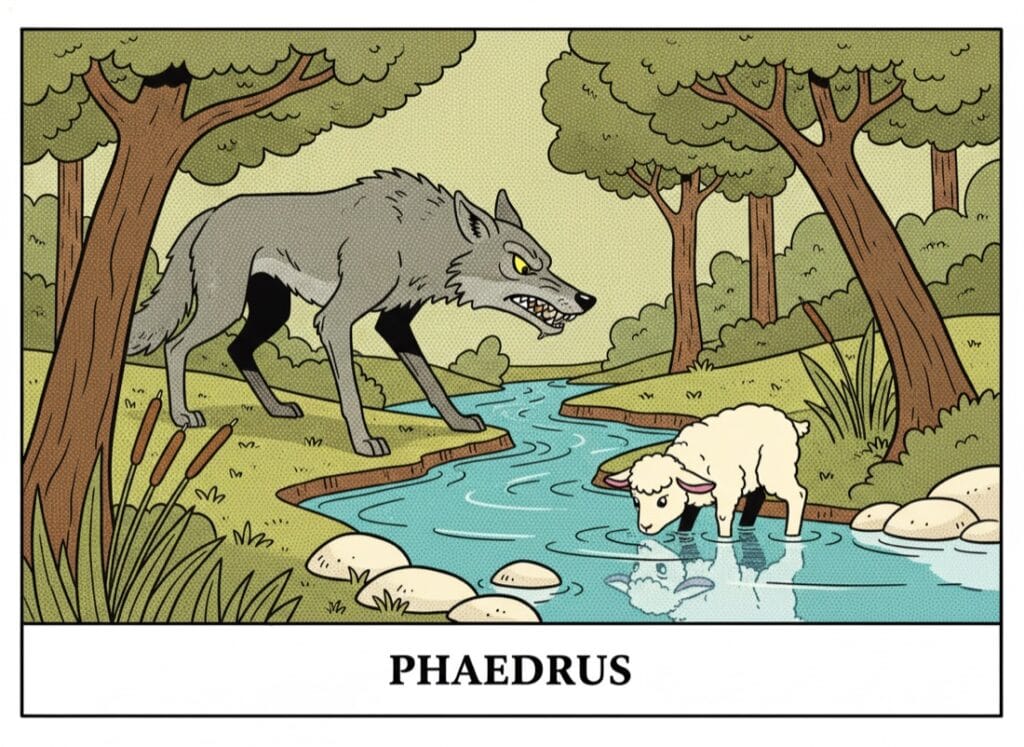
The best-known fable is the very first: a wolf and a lamb drink at the same stream, the wolf upstream, the lamb far below. The verse that opens the scene is famous:
Superior stabat lupus, longeque inferior agnus.
Phaedrus, Fabulae 1,1 (Lupus et Agnus)
Our translation: “Upstream stood the wolf, and far below the lamb.” A single line already holds the whole conflict: the stronger looks for a pretext to harm the weaker. The moral of the fable is aimed, as Phaedrus himself says, at all those who oppress the innocent with invented reasons.
You can check the Latin wording against free editions: The Latin Library, the original text at Wikisource, and the overview at Wikipedia.
In stages to the original — how the app grades the fable
Reading research names a hard threshold: only when you know about 95% of the words do you read fluently. With Phaedrus the vocabulary is manageable — the hurdle is the verse word order. So we read the fable in stages: first a simplified prose version matched to your level, then steadily harder — towards the metrically bound verse original. The cognitive load is shared, and forms and vocabulary are recycled again and again in real context.
In our in-app reader the fables are built as a gentle entry ladder:
| Stage | Fable in the app | Moral |
|---|---|---|
| stage L3 | The Fox and the Grapes · simplified | What you cannot reach, you disparage |
| stage L6 | The Wolf and the Lamb · simplified | The stronger looks for a pretext |
| stage L9 | The Fox and the Crow · simplified | Believe flattery and you lose |
| goal · verse original | Phaedrus, Fabulae (iambic senarii) | Phaedrus’ unchanged verse |
From the prose entry to the verse — Lupus et Agnus
Here is what the path looks like. On the left our simplified prose entry from “The Wolf and the Lamb (stage L6)”; on the right Phaedrus’ verse original — the goal the stages lead toward:
Simplified (prose) · stage L6
“Lupus et agnus aquam bibebant. Lupus superior erat. Agnus inferior erat.”
A wolf and a lamb were drinking water. The wolf was upstream. The lamb was downstream.
Verse original · goal (Phaedrus 1,1)
“Superior stabat lupus, longeque inferior agnus.”
Upstream stood the wolf, and far below the lamb.
The same content — only the difficulty grows: two plain prose sentences with erat against the verse, where the verb stabat serves both animals (supply it in the second half) and the words follow emphasis, not order. That is exactly what the prose stage prepares you for.
Key idea: the hardest text does not make you better — the one you understand at 95% does, and then one step higher. That is how you reach the verse safely.
Learn Latin now. Our learning app:

The Phaedrus pitfalls — and how to crack them
Phaedrus is simple in vocabulary but bound in verse. Three features cost the most marks. One example each:
1. Verse word order (hyperbaton)
To keep the metre, words that belong together often stand far apart — an adjective at the start of the line, its noun at the end. Order by sense, not by sequence: which adjective agrees (in case, number, gender) with which noun? Pair them up first, then translate.
2. Ellipsis
Phaedrus saves words to the extreme. Often esse or a pronoun is missing and you must supply it: Superior stabat lupus, longe inferior agnus [stabat]. Rule of thumb: if the second half has no verb, supply it from the first.
3. The moral (promythion / epimythion)
The lesson of the fable stands either at the very beginning (promythion) or at the end (epimythion) — and is grammatically detached from the animal story, often phrased in general terms. Notice the shift: the text deliberately jumps from the concrete animal to a general statement about “people.”
| Pitfall | Signal | Most common mistake |
|---|---|---|
| Verse word order | adjective and noun far apart | followed word order instead of agreement |
| Ellipsis | second half without a verb | verb not supplied from the first half |
| The moral | general sentence at start/end | abstract statement tied to the animal |
Frequently asked — Phaedrus
Is Phaedrus hard to translate?
Phaedrus is simple in vocabulary and so a popular entry text. The hurdle is the verse: word order, ellipsis and the detached moral. Order by sense, read in stages, and you will manage well.
From what level can I read Phaedrus?
Simplified prose versions of the best-known fables can be read from the second or third year. Phaedrus is considered the classic first entry into Latin poetry.
Which fables of Phaedrus are read in school?
The best known are Lupus et Agnus (The Wolf and the Lamb), Vulpes et Uva (The Fox and the Grapes) and Vulpes et Corvus (The Fox and the Crow). All are short and carry a clear moral.
What is a promythion or epimythion?
These are the names for a fable’s moral: at the beginning it is called a promythion, at the end an epimythion. It is grammatically detached from the animal story and states the lesson in general terms.
Learn Latin now. Our learning app: